
By Christine Swan
Last weekend, the London weather was gorgeous. I decided to walk from Southwark to Kingsland Road, Hackney.
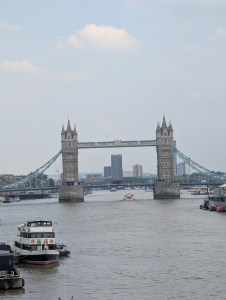
Walking across London Bridge
I walked along Borough High Street, past the George Inn, the last galleried inn in London, across London Bridge, through the City to Shoreditch, and onto the Kingsland Road, one of the last places that my great grandfather, David Deighton, had lived.
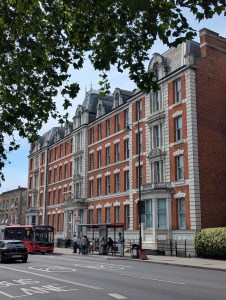
Shoreditch infirmary
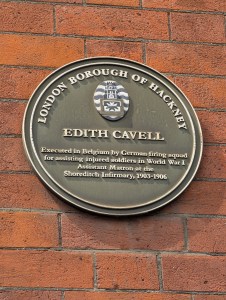
A very famous matron
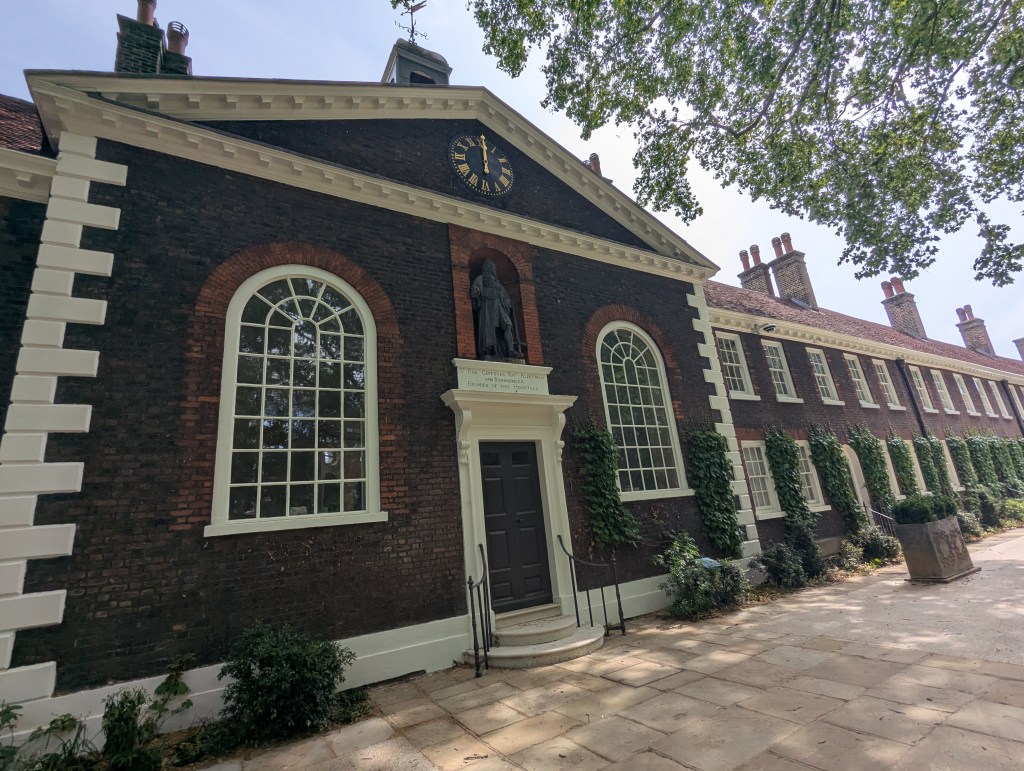
My destination was the Museum of the Home, a set of almshouses built by the Guild of Ironmongers and Sir Robert Geffrye. The museum was opened by London County Council in 1914 as the Museum of Furniture. The name Geffrye is tainted by his slave trading associations. While his statue still stands above the chapel building, There are debates as to whether it should be removed to his grave.
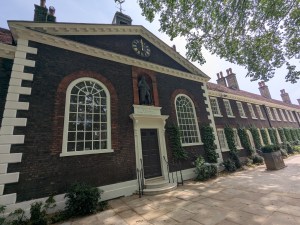
The chapel of the almshouses, saved for the nation by London County Council
The museum is arranged so that visitors begin their tour in the basement. Exhibits focus on the evolution of specific items and the history of the home environment, as well as cultural perspectives of what makes a home.
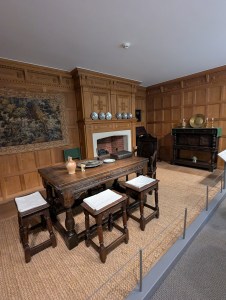
Dining, Tudor style
From the lower level, visitors can exit to walk around the museum garden, which contains sections to represent gardens through the ages. The weather was so lovely, I resolved to see all of the interior before going out to enjoy more sunshine so I walked up to ground level to continue viewing the exhibits. This was the part of the museum that I remember the most well from my previous visit. Whole rooms are presented to show living spaces through time, from Tudor to modern times. This section is valuable for inspiration to recreate a period accurately in furniture and decor. All rooms are represented – even a mid-twentieth century bathroom with tiles that appeared to match those in my childhood home. The compact space of a tenement flat is sub-divided into recognisable zones.
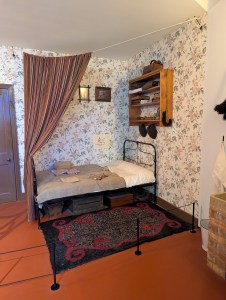
Compact living in a tenement flat
I had booked onto a tour of the almshouses which have been restored to show how they would have looked at different periods of their history. This is a newly restored part of the museum and not a part of the complex that I have seen previously. To become an almshouse resident, prospective people were usually elderly but still able to live independently. They were also churchgoers with good character, which would definitely excluded a number of my Hackney ancestors.
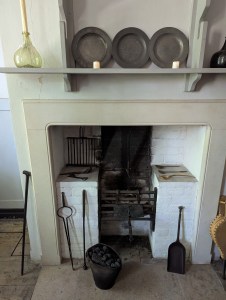
A cosy fireplace in the eighteenth century almshouse
A sparse room still provided some comforts – a good sized fireplace and a separate space for preparing food, was better than many other local residents, including my ancestors. As an alternative to the workhouse, this was a considerable improvement. The grounds and beautiful buildings made this a life to be envied. During the eighteenth century, Kingsland Road bordered on a rural area but, by the nineteenth, the local population had grown rapidly and undesirables may have wanted to explore the beautiful gardens and houses with furniture and other possessions. The almshouses had rules that residents must agree to, including a sundown curfew for their safety.
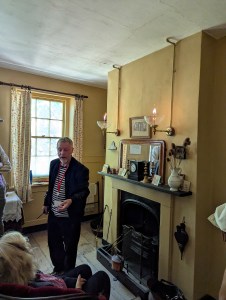
All mod-cons in the nineteenth century almshouse, including fishtail gas lighting
Nineteenth century almshouses had gas lighting, more modern fireplaces, bathing facilities, improved sanitation, and a washhouse, with copper, in the basement. This would have been a stark contrast to the extreme poverty of doss houses, homelessness, rookeries, and workhouses.
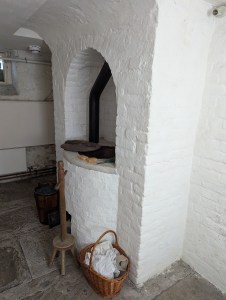
A Victorian copper and dolly – the height of laundry convenience
In one room, was a bentwood chair, with a rush seat. I asked the tour guide: “What is the origin of this chair please?” The guide politely replied that he didn’t know.
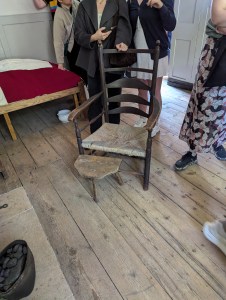
The chair of unknown provenance
When the museum opened in 1914, just before the start of the Great War, my two times great grandfather, William Henry Bull, was making cane chairs less than a mile away in Ada Street. Our family legend was that he donated a chair to the new museum which aimed top showcase local furniture making. When I enquired previously, I was assured that there was no chair in the collection that was sourced from him. However, my latest visit, where the provenance of some items seemed less certain, has rekindled my hope that the family story is true. I intend to enquire again. It may be that improvements in cataloguing and research, may prove a match.

William Henry Bull – chairmaker
Unfortunately, I needed to skip the gardens and head back to Southwark as I had a theatre trip planned for later that evening. I would have loved to have stopped for a cup of tea, but was lacking in time. I walked back through Shoreditch, the City and back across London Bridge. I intend to try to find out if a Bull chair still exists. I have so few physical heirlooms, this would be a wonderful thing if true.
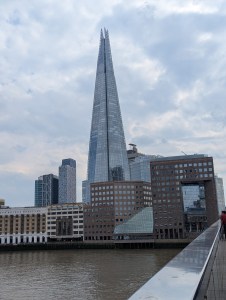
Back across London Bridge
More information
Museum of the Home – https://museumofthehome.org.uk/

