
By Christine Swan
I last visited Lille in April 2025. The weather was chilly but glorious with spring sunshine. On this occasion, I also visited Valenciennes and Tourcoing. Over the last eighteen months, I have continued the research into my Huguenot and Walloon heritage and have discovered more families and places to visit. Finally, my DNA test is indicating that I have six percent Belgian heritage, and suggesting that I may have inherited it from both of my parents, although I have not yet confirmed my maternal links. One shared link suggested that there may be a link with the famous de Ruvigney family – exciting indeed!
My paternal family appear to have been less grand, including tenant farmers, onion sellers, and the inevitable weavers. Although I would like to find that I have descended from the sunny South, all of my discoveries this far centre around Northern Europe – France, Belgium, the Netherlands and Germany. Last year I visited Antwerp, which does seem to have been a significant region as the starting point for some Protestants, including the le Sedt family.
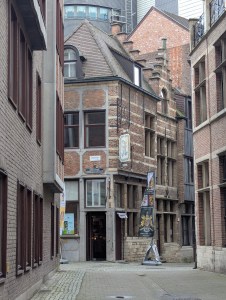
The oldest house in Antwerp – now a restaurant
Valenciennes was a significant producer of textiles in the sixteenth century, manufacturing worsted and wool fabric – the saye or serge cloth that I discovered when researching my Leiden-based ancestors.

A remaining part of Valenciennes fortifications, an indication of its importance
Another cloth was a mix of silk and wool – a mix of fibres still used for modern, quality wool base layers, however this sixteenth century weave was a half-silk satin, probably intended for outer garments, but with insulating properties. Valenciennes later became a famous producer of lace.
The sixteenth century was a very turbulent time with Spanish occupation and persecution of Protestants. Those that could afford to escape to England, did so, including Guislain Galmar, my twelfth great grandfather. Interestingly, Guislain’s son Pierre was baptised in the Catholic church of Saint Gery in 1599. Pierre’s older brothers Anthoine and Quentin, definitely escaped to England, as did their younger sister Sara, but I cannot find any record of Pierre in Canterbury. In 1625 Guislain is recorded as being an elder of the crypt church in Canterbury Cathedral. Quentin was also a church official ten years later.

The Crypt Church inside Canterbury Cathedral
Tourcoing is a suburb of Lille that extends almost as far as the Belgian border. In reality, the border can be crossed without even realising. In the sixteenth century, Tourcoing was a wool weaving town. The yarn was originally dyed with woad, but later with imported indigo. Tourcoing suffered as did other local areas, with religious persecution and fighting. Wealthy Protestants left when they could while the fighting Hurlus experienced some success. Vincent Ferre, another of my twelfth great grandfathers, fled from Tourcoing with his father Pierre, and siblings towards the end of the sixteenth century. Pierre died in Canterbury in 1601, and his children remained living there for several decades.
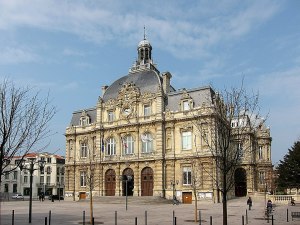
Tourcoing Hotel de Ville
The fortified city of Lille experienced similar turmoil but famously resisted the advance of the Hurlus. Gervais Despaigne, my eleventh great grandfather, was the exile from Lille. When he arrived in Canterbury, sadly he only experienced about ten years of peace before passing away in 1594. His wife Marguerite Bousseman, was also born in Lille.
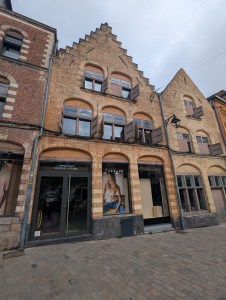
Flemish houses in Vieux Lille
These are a few of the connections that I have discovered that link me to the north eastern corner of France, and so I am visiting again. In my planned trip, I intend to take in some new areas including Wambrechies, on the trail of the Bonte family, Roubaix, to visit the home town of the Tiberghien or Tiberguin family, and Tournai, as I discovered an ancestor from the Flemish city of Doornik.
There comes a point where you simply cannot progress any further back in time from internet-based records. The heraldry of wealthy families, Lords, Dukes, Princes and Kings, are carefully recorded – but not onion sellers or farmers. Instead, I discover what I can, and then visit the source and use my imagination. Sometimes, the vieille ville district is a good starting point, as are local museums.
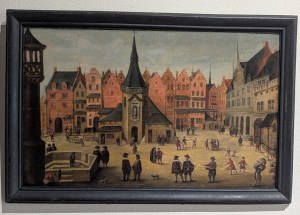
Grand Place de Lille – a painting in l’Hospice Comtesse that helps me to visualise the city of my ancestors.
For those who know me well, I am a committed rail enthusiast, and for those who haven’t visited Lille, it is only one hour and twenty minutes from London St Pancras, so easily reachable in a day. When my parents lived just outside of Dover, a day trip to Calais was a regular jaunt, my journey to Lille is actually shorter. Once through the Tunnel, the whole of Europe awaits you ready to explore. Lille is a great base for exploring Flanders, whatever your motivation.
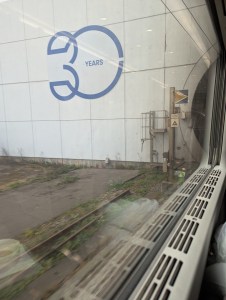
Entering the Channel Tunnel
The journey to Lille is so quick from St Pancras International that I don’t even have time for a nap. It seems that no sooner am in the Channel Tunnel, than I have arrived. Travelling by train is also very convenient as Lille Europe and Lille Flanders are very close together, and both close to the city centre – far more convenient than an airport.
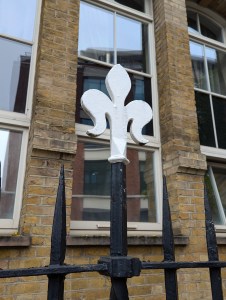
A Fleur de Lys decoration on a railing in Spitalfields, London. The Fleur de Lys is part of the Coat of Arms of Lille.
Returning to England, I always reflect on signs and symbols from a “strangers’ ” past. In Spitalfields, some silk weavers’ bobbins can still be seen above doors in Fournier Street. The high workshop windows still exist, where looms would have clattered during the day as the shuttle flew backwards and forwards. Fleur de Lis Street sits on the boundary between Spitalfields and Shoreditch, and symbols appear around the area. And four hundred years later my visit to France is also a symbol, except that now, I am the stranger.

