
By Christine Swan
I can’t remember the last day trip I took with my son. One thing that prospective parents are never told is how your relationship with your child grows as they become an adult. We have always got along very well, and my son and I are the best of friends. Time spent together is precious and treasured.
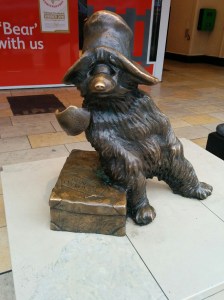
Please look after this bear – Good morning Paddington
On what was not quite the hottest day of the week, we headed off in the morning, to arrive at Paddington before lunchtime. We hopped onto the tube to Liverpool Street and began our wanderings at Spitalfields Market, looking for a birthday present. After a thorough scrutiny of potential gifts, we moved on to Shoreditch. Labour and Wait presented a few more choices but, indecision and procrastination led me to leave with just a bar of my favourite laundry soap and a discussion at the pay desk about washboards.
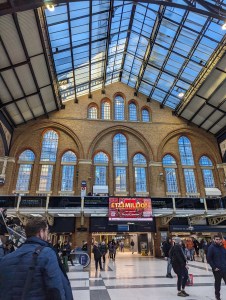
The impressive concourse of Liverpool Street station
On to Brick Lane, past what was the Flower Pot Inn, but now appears to be closed, we walked down as far as the mosque in the former Huguenot Chapel. We engaged in the “Are you hungry yet?” and “What do you want for lunch?” debate, as Brick Lane is synonymous with food. However, we decided to delay our dining, despite my urge to snack on South Asian sweets.
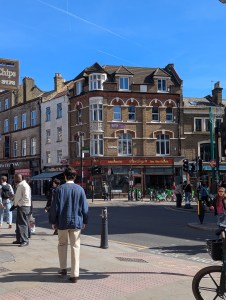
What was the Flower Pot Inn at the top of Brick Lane.
Walking back along Fournier Street, I pointed out the weaver’s trade signs, fire insurance plaques, the shutters, and large attic windows. I explained that our ancestors had been poor and mostly plied their trade from the Bethnal Green side of Brick Lane – in Hare Street, and closer to St Matthews Church.
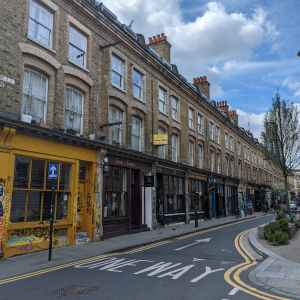
What was Hare Street, now Cheshire Street, where William Deighton wove silk
Christ Church is the landmark that everybody familiar with Spitalfields recognises. Its imposing presence has loomed over this part of London for three hundred years. If Nicholas Hawksmoor had intended the spire to reflect the wealth of the residents, it would have only reflected a proportion of them.
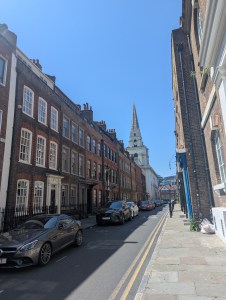
Looking along Fournier Street, towards Commercial Street
On the opposite corner of Fournier Street is the famous Ten Bells pub. As I usually am only free to visit at weekends, getting near the door of the Ten Bells is a challenge, and getting to the bar is a game of extreme patience. However, on a relatively quiet Wednesday lunchtime, we breezed in and within a few moments, our thirsts were quenched with a cooling pint. The Ten Bells was originally the Eight Bells, but its name updated when the church added to its number, and it was moved from its original location in the mid-nineteenth century. Some of its tiled interior is original, or at least, dates from its moved position, but some are modern. Also some sections of wall are hand painted, to match the pattern of the tiles. The Ten Bells is as much a part of Spitalfields’ history and landscape, so if the queue is manageable, a visit is a must.
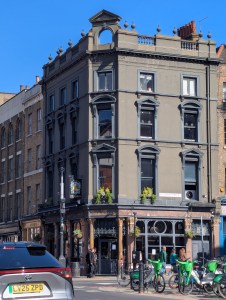
The iconic Ten Bells pub
By this time, my stomach was reminding me that it had been several hours since we had eaten so we headed for my son’s favourite casual dining spot, Boxpark. The pavements were hot and the sun quite strong, so we were grateful to find a shady table to eat our chosen street food items from the wide range of options. Once again, I have not visited Boxpark at lunchtime midweek, so was rather surprised how quiet it was. It has been earmarked for closure which I think is a shame. In a time when young people are struggling to find meaningful employment, the hospitality industry that will not be so greatly impacted by AI. Entrepreneurs can develop a concept and start small, which is the whole idea behind a mini-mall. With so many large shopping centres becoming empty, in my opinion, that model does not work in the twenty-first century, app-ordering generation. I believe that there is plenty of scope to offer small, affordable units, with shared eating and drinking space, plus extras such as weekend and evening DJ and entertainment events. Fortunately, a recent development in my home town of Worcester is replicating the “start small” concept in utilising a sequence of railway arch units, which are becoming a food and drink quarter.
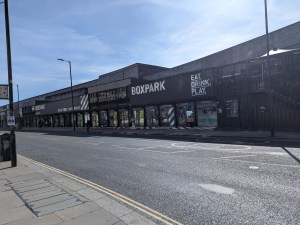
Boxpark, Shoreditch
I digress. We were still birthday present-less and this was becoming a priority as our virtual sand-timer was running out. I suggested that we might find something suitable in Leadenhall Market.
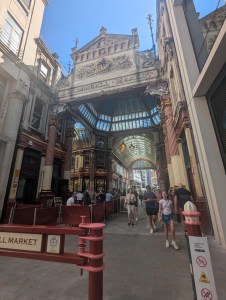
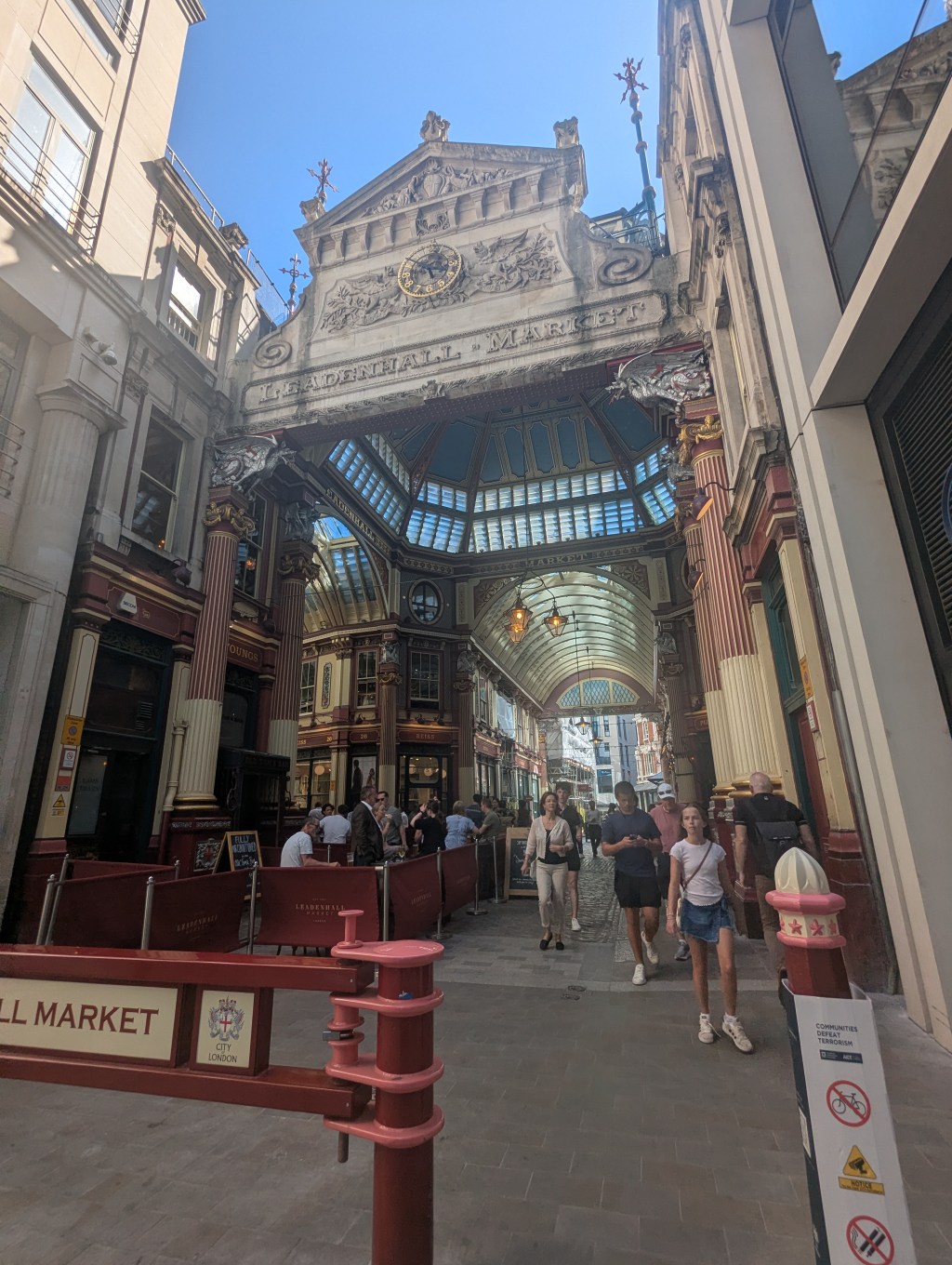
At Leadenhall Market
This beautiful covered market has stood for centuries in the heart of the City. Although the ornate ironwork dates from the nineteenth century, the market is much older. It seemed fitting that, with its connection to Harry Potter, we sought a gift for my son’s partner as a memento of our visit. In the spirit of “buying small”, we also visited the SoLo Craft Shop and bought some beautifully scented candles as the perfect birthday present. This shop sells the wares of about ninety small businesses and is open every day of the week. Not only did we purchase our quest, but also a hand-crafted birthday card.
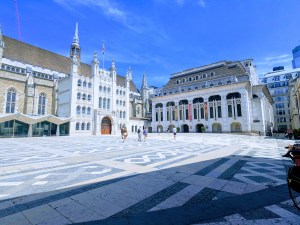
The Guildhall Art Gallery is air-conditioned
The afternoon was still exceedingly warm, and the stone walls of the City buildings did little to offer respite from the blazing sun. I knew that my son had never seen the Roman Amphitheatre nearby, situated in the basement of the Guildhall Art Gallery. I am also wise to the fact that it is beautifully air-conditioned. The security guard commented on my Pellici’s Cafe linen bag, which initiated his memories of cafe culture at both this and Arthur’s Cafe in Kingsland Road. I was unfamiliar with the latter as it closed after the owner’s death. We chatted about my Dad’s work around the area, detecting water leaks and being involved in their repair, cycling around the East End with a big key and a listening stick. The tales that he told me of the old East End have stayed with me – and here we were, the two most recent generations, walking around his manor, remembering.

The Roman amphitheatre at the Guildhall Art Gallery
The security guard had some photos of Arthur’s Cafe, which he shared with us before we left and he went on his break. Away from the sanctuary of air-conditioning, the late afternoon was still decidedly Mediterranean in climate. We had missed the pre-rush hour off-peak deadline, so had time for some refreshment across the way in The Old Doctor Butler’s Head pub in Mason’s Alley. Dating from the seventeenth century, Doctor Butler was a rather eccentric physician who developed “cures” for conditions of the nervous system, including scare tactics for epilepsy by firing duelling pistols, and cold-water plunges for the plague. He also recognised the restorative nature of a pint of good beer and developed a medicinal brew for gastric conditions. This is likely to have been more safe than drinking water at that time and his success led him to own a number of pubs. We raised our glasses to Old Doctor Butler before taking the tube from Moorgate back to Paddington, and thence home.
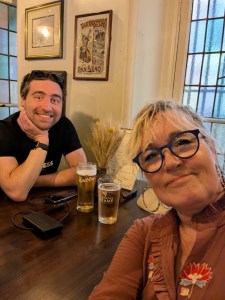
Sampling the Doctor’s finest at Old Doctor Butler’s Head
The train sped through West London, Berkshire, Oxfordshire and across the green landscape of the Cotswolds. The sun set on a perfect day. More memories made, and we didn’t forget the birthday gift!
More information
Spitalfields Market guide – https://www.spitalfields.co.uk/
The Gentle Author’s guide to the Ten Bells pub – https://spitalfieldslife.com/2010/12/14/at-the-ten-bells/
Boxpark, Shoreditch guide – https://www.boxpark.co.uk/venues/shoreditch
Leadenhall Market guide – https://leadenhallmarket.co.uk/
The Guildhall Art Gallery guide – https://www.cityoflondon.gov.uk/things-to-do/attractions-museums-entertainment/guildhall-art-gallery
All photos by the author

