
By Christine Swan
I have been researching my family tree for almost twenty five years. In that time, I have lost a number of close relatives, some still to painful to record in my family tree. Throughout my research journey, I have learned a great deal and refined my tactics over the years. I can find information more quickly and cross-reference to improve accuracy.
My father first began building our family tree, but without using the internet, this was incredibly painstaking and involved reading numerous documents and publications. I do remember being part of this journey and remember visiting the City of London cemetery to clean the gravestone of the family grave, and reading copies of The Stage researching our thespian ancestors. I was interested and fascinated – who were these people? And, do I share any of their characteristics?

A scrap of paper started my project
When I started my own contribution, I took out a free trial subscription to Ancestry and was able to cross-reference recent ancestors with my parents. They were able to add additional facts and physical descriptions of people as they remembered them. My first top tip is to speak to older family members. Spend time talking to them about where they lived, and who they remember. Ask them what life was like when they were younger and if they have any stories. In my experience, elderly people love to talk and will be delighted that you are interested. For my father, it was also a race against time. Before dementia took hold, I was so pleased that I gained so much knowledge from him and that I have been able to preserve his memories. I see them as precious heirlooms.
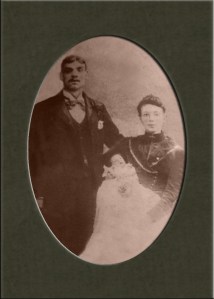
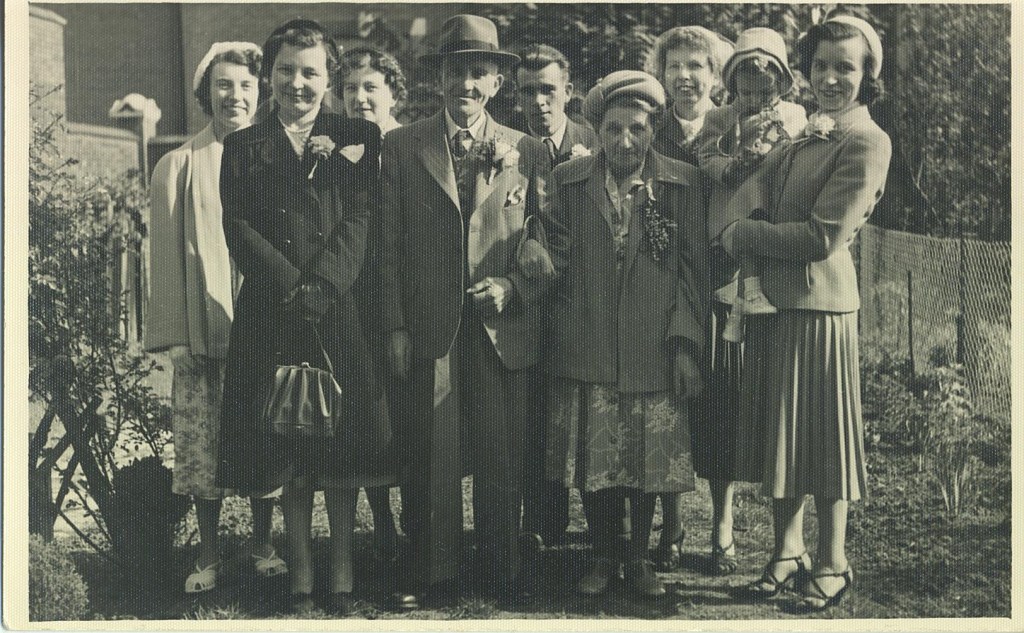
Family photos show the costume and styles of the day
My mother also loved to talk. After she had a stroke, talking was the closest that she came to physical activity. She delighted in talking and her memory was as sharp as a pin. However, she was the youngest daughter so could not remember everything.
One absolute triumph of my research was to reconnect with living relatives who we had lost touch with, including my mother’s eldest sister. As a programmer, I am skilled at solving problems using logic. Finding a living person is far more challenging than researching the dead. To meet my oldest living relative was an absolute pleasure, and what a wonderful character she was. I felt like a sponge – wanting to soak up all that she could remember, and she was only too happy to share. I began to feel as if I knew these people.

A very tiny me with my aunt who I was delighted to reconnect with in her final years
As my interest grew, I began to realise that if something is stated as a fact, it may not necessarily be true. I genuinely don’t believe that some people knew how old they were, or the ages of their children. Perhaps they exaggerated their age to impress the census enumerator, or maybe they lied to impress them with their youthfulness. They may have lied to join the army. Hence my second top tip – do not rely on just one source. Triangulate with other sources to check facts.
My research has become somewhat an obsession, and I have added other subscriptions to my portfolio, however, if you have the time to search, there are lots of free resources out there. For example, a reader’s ticket at the National Archives, is free of charge. I have discovered some excellent website that are free, such as the Dutch genealogy site Wie Was Wie. The social media platform Facebook, has a number of local history groups that hold resources. Local museums may also have archives, as do councils. As with the National Archives reader’s tickets are usually free, the only cost will be your time. When I was looking to verify why my great grandfather was admitted to the London Hospital, I contacted their archives, and was able to search the records and see the original entry of his medical details from 1891, for no charge whatsoever. My third top tip is to make the most of free resources and to never feel embarrassed to ask for access. In my experience, if you are a bit cheeky, if often pays dividends.

Census records can be very useful in identifying family members, but spelling needs considered to be fluid
In history, much of the population were unable to spell accurately, even if they could write. As names would have been spoken to the enumerator, up to the 1911 census – which was the first to be completed by the householder. Therefore, the enumerator was estimate how the name should be spelled. My fourth top tip is to consider all possible spellings, including phonetic ones. Consider transcription errors in typed documents, and illegible letters in handwritten. Could that letter be an “e” or an “a”? Don’t become too bogged down in detail, consider all options and set your name accuracy to broad. Some individuals changed their name – my great grandfather changed his name with no apparent driver to do so. My family name appears to have a relatively short history and I have no idea why my great grandfather chose it. Before the days of deed poll, I find this rather unsettling! A great uncle used his partner’s surname, as well as two other names.

My great grandfather’s name reverted to his mother’s after her death. His age is greater than his legitimate brother, but is listed below
I discovered far more illegitimacy in my family tree than I ever imagined I would. Be prepared for the dead ends. You may never discover who a father was. Therefore, the maternal line may prove to be more reliable. There may be clues in census records – an older child listed beneath their younger siblings for example, a child being labelled as a “visitor” when you know that they were , in fact, a son or daughter. My great grandfather was very ashamed of his illegitimate state, which makes me very sad. However, in his life, he had a happy marriage and adored my father. My fifth top tip is that sometimes you will reach a dead end, but that’s OK.

My paternal great grandmother was illegitimate and was baptised with her mother’s family name
Many of my family were dirt-poor. I have found so many useful facts while laboriously searching through Poor Law records. Many of these are not indexed so patience is needed, as well as time for trawling through hundreds of pages. Admission and discharge records sometimes give very little away other than a name and a date, but examination records can provide names of family members, their ages, marriage information, and occupation. Orders of removal and settlement papers similarly provide additional details. I discovered a copy of a handwritten letter by my great grandfather which included information about his half brother, while trying to arrange a meeting with the Poor Law Union. Other sources are also valuable – physicians on board ships transporting convicts to Australia, kept a voyage journal detailing births, deaths and disease outbreaks onboard. Regimental records include detailed accounts of battles and troop movements. My sixth top tip is invest time in systematic searching of non-indexed sources – it can reveal secrets not available elsewhere.
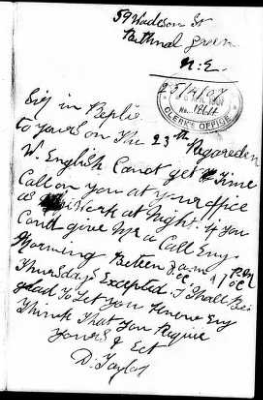
A letter from my great grandfather, complete with spelling errors
I do make mistakes. If I believe that a fact is incorrect, I will go forwards to the most recent generation, where records are likely to be more comprehensive. For example, an ancestor born in the seventeenth century will not appear in census records, but, you may be able to confirm, beyond doubt, recent generations, and then work back one step at a time. I do still accept hints from other people’s family trees, but I do not accept them as fact until I have verified the details. The seventh tip is to check and verify each step and don’t be too disappointed if you make a mistake.
Some ancestors were hard-working, law-abiding, and led unremarkable lives. If their name was John Smith, you certainly have your work cut out! Ancestors who had unusual names, appear in the local court sessions, or were famous in some other regard, may be easier to research. However, their records can sometimes plug some gaps. For example, they may have been a witness to a marriage. Newspapers have included details of criminal acts for centuries. The salacious details of Daniel Crudgington’s arrest, including his own words being quoted, was an absolute treasure trove of information. Top tip eight is to research ancestors with unusual names or occupations and use these as reference points for other relatives.
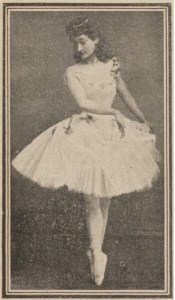
Performing ancestors are fascinating to research, but stage names can cause confusion
If, like me, you enjoy travel, you may wish to visit where your ancestors lived. I find this also very useful for conjuring the details of their lives. As I reported last week, I had not realised how close my grandfather’s cafe was to their house until visited. It is always disappointing when an address no longer exists. I use a website called Old to New Street Names, to map road names. If an ancestor’s house is demolished, are there any neighbouring properties that are of a similar age? Try to visualise a whole street of these houses. Sometimes, you do strike gold and an area has survived almost intact. I found this in Leiden in the Netherlands. I was able to stand on the street where my ten time great grandfather lived and found properties of the age when he would have lived there. A museum showed me what how the city would have appeared to add to the realism of my experience. As mentioned previously, local council archives will also hold historic plans of streets. Tip nine is to research places as well as people.

Always a delight to locate a surviving ancestral seat – this, where the Crudgington family lived in the seventeenth century
My final tip in this post is to never give up, and to be kind to yourself. New publications are being digitised, more records are being transcribed and more subscribers enable more content. It is worth revisiting a dead end every few years. This is emotional work. I have sat and cried over the tragic death of a young person, I have felt helpless as a desperate father pleaded for financial support while an official trivialised his case, (the father punched the official on the nose and this was reported in the newspaper). A homeless alcoholic dies on the street, and the press make light of her failings. I feel angry at the injustice.
Every story is a life, and every life is a story. When I embarked on my quest, I vowed to tell everybody’s story. I realise now that in doing this, I remember them, and memorialise their life. There are still many stories to tell.
More information
The National Archives – https://www.nationalarchives.gov.uk/visit/researching-here/readers-tickets/
Old to New Street Names – https://www.maps.thehunthouse.com/Streets/Old_to_New_Abolished_London_Street_Names.htm
Convict transport surgeon records information – https://www.digitalpanopticon.org/Surgeons_Notes_from_Transport_Vessels_1817-1857
London Poor Law records from the London Archive – https://www.thelondonarchives.org/your-research/research-guides/poor-law-records-from-1834-onwards

