
By Christine Swan
Reflecting on the news headline that an increasing number of young people are NEET (Not in Education, Employment, or Training), this week, I thought about work and all that it means.
For me, work was independence and the opportunity to acquire my own income, albeit, modest initially. During my family history research, I have learned that for many families, it was essential that children worked to add to the family coffers. Many of these jobs seemed trivial, running errands, or acting as a junior assistant. However, it wasn’t until 1788 that a minimum age of eight years was specified for chimney sweeps’ apprentices, but even this was not enforced. Young children climbed up cramped and dangerous chimneys, pushing brushes to clean away soot. It wasn’t until 1875 that enforcement was made possible, in part due to publicity of the issue via Rev. Charles Kingsley highlighting the issue in his 1863 book: The Water Babies.
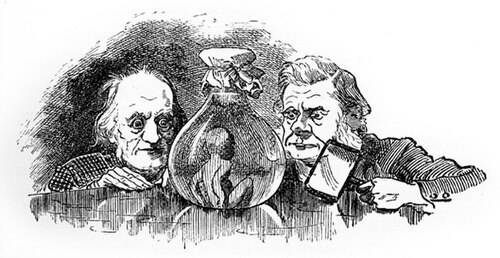
Does a water baby exist? By Edward Linley Sambourne – The Water-babies by Charles Kingsley, Public Domain, https://commons.wikimedia.org/w/index.php?curid=4601924
Unfortunately, there were few legal protections for young girls working in domestic service, as their work was not covered by the same legislation as factory workers. My maternal grandmother was put in service at about twelve years of age. My mum thought that she was younger than this, but the 1891 census found her aged eleven years, still living at home, and listed as a scholar. The 1870 Education Act, and the 1880 revision, aimed to reduce child labour by insisting that all children between the ages of five and ten years, must attend school. In the 1901 census my grandmother Dora was working as a domestic servant, in a sizeable terraced house in Stoke Newington, with steps to the front door, and a separate entrance for “downstairs”. By this time, she may have been working as a servant for nine years, so was sufficiently experienced to work on her own. Mum told me that as a young girl, one of her first roles was to pluck a goose. As an animal lover, she was repulsed by this. She was told in no uncertain terms that she must, and sobbed as she followed the instruction. Her first posting was thoroughly miserable.
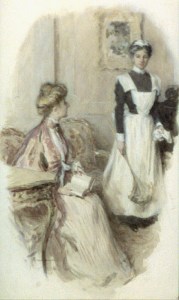
The uniform of the domestic servant By William Thomas Smedley – Cabinet of American Illustration, Library of Congress Prints and Photographs Division Washington, D.C.; http://hdl.loc.gov/loc.pnp/cai.2a14818, Public Domain, https://commons.wikimedia.org/w/index.php?curid=2270620
Domestic servants were also subject to strict rules, and yet, there were few protections from the behaviour of their employers. My paternal great grandfather, George Betts, was the illegitimate son of a servant girl and the master of the house. I know very little of the circumstances. George’s mother, who I was led to believe was an Irish girl named Mary, was disappeared, and presumably returned to Ireland. George’s paternal grandmother was very taken with him and he remained in the family home. My dad told me of a photograph of George, wearing a miniature sailor suit, with a blackboard and stylus hanging around his neck, every bit a proper scholar. George’s grandmother died but his father did not want the embarrassment of a bastard child any longer. George entered the unofficial adoption system, thankfully into the arms of a good family, the Betts, whose name he continued to use throughout his life. When his father died, unexpectedly, he was remembered in his father’s will. However, proud George wanted nothing from him. George’s family tried to persuade him – money was money after all, and they mattered not about its origins. Stubborn George dug in, and chose not to claim it. He wanted nothing to do with the father who had wanted little to do with him.
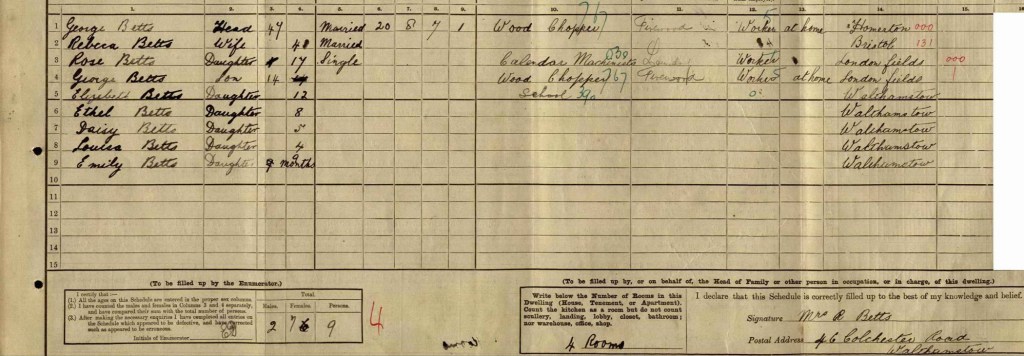
George Betts was recorded as a wood chopper in the 1911 census
George’s independence continued into his working life. George was a costermonger, an independent tradesperson who sold his wares from a barrow. George sold what people needed – coal, wood, fish, these three commodities I am certain of due to census records, but I believe that he sold an even wider range of products. My dad was a particular favourite of his grandfather and was often happy to help with his trade.

Selling cats meat in 1901
My other paternal great grandfather was one of the lowliest of traders, selling cats meat. Whenever he could work, he did, but life was hard. Eventually he took employment as a public lavatory attendant – a valuable, but undervalued role.

Great grandfather David Taylor working as a lavatory attendant in 1908
Grandad Albert worked as a builder’s labourer after returning from India, having served in the Dorsetshire regiment. He had received medical training in the army and later consolidated this to eventually work as a nurse. Grandad Charlie sailed across the Atlantic with the Canadian Pacific Railway Steamship Company and then served in the Cycle Corps before starting a coffee stall and eventually, his own cafe. The grandads both strived for betterment. Employment was a progression. Grandad Albert wanted me to train as a doctor, but I recognised early on that I was not going to achieve the A level grades required, or probably have the sticking power necessary to be successful.
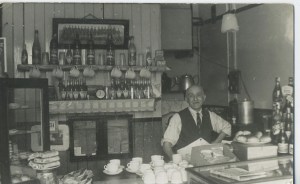
Grandad Charlie in his cafe
I began working on Saturdays when I was thirteen. There were, and still are, protections for young workers but working in a florist’s shop was challenging in cold weather with a permanently open door and my hands frequently in cold water. I learned much in those early years. I dealt with customers – some happy, celebrating a birth or wedding, others sad, planning a funeral. The cash register had no mechanism for calculating what change to give, and of course, no card payments. I learned to think and calculate quickly and how to handle money. I was often asked to drop a bag of money in the night safe. The security advice I was given was to run to the bank.
When I reached the age of sixteen, I could take a job in a larger shop as I met their minimum age for employees. I began working in a large retail store, with a warehouse, within the building of a former department store. It was luxurious being within a warm showroom, with a heat curtain behind the entrance door. A large number of my colleagues were of a similar age and we worked together very well. I looked forward to Saturday morning because I knew that we would be planning meeting socially too.
Unfortunately, this job was also my first experience of redundancy, at age sixteen. The last in, were also the first out. This was to be my first taste of this cruel process.
I was determined to find another job – and quickly. I had become accustomed to a regular income. I was able to buy clothes, shoes, records, makeup. I was an independent young woman of means!
I did find another Saturday job and continued my working habit even when I started university. It seemed that there was casual, part time work, for everyone as long as you could convince your employer of your excellent work ethic, reliability, trustworthiness, and honesty.
In the twenty first century, we have forgotten how valuable these early work skills are. Young people spend more time glued to their screens and schools focus on targets, GCSE results, residuals and value-added measures. Vocational courses are sometimes viewed as less valuable and have been off-limits to pupils in the previous drive to increase the number of pupils achieving the English Baccalaureate. Some of the best schemes that I have been involved with during my long career working in Education, have been those that have brought employers into the classroom, or the classroom to them.
I believe that young people need to have a goal and that educators should help them to recognise the steps needed to reach it. If opportunities do not exist, they should be created. Entrepreneurial skills will be vital, as well as understanding modern technology. I have been witness to many change in Education but now, the most drastic is needed. Many skills and trades cannot be performed by automated systems or AI. Many roles still need direct human communication, such as the caring professions.
There is no doubt that the advance of AI is changing some job roles and removing others. But just as my forebears struck out on their own, providing products and services that people needed, these roles still exist. We must not fall into the trap and “write off” a generation by highlighting what they yet cannot do, instead we should emphasise the skills that they can.

