
By Christine Swan
In April. I returned to Southwark for my next theatrical foray. More precisely, I watched the musical Lifeline at the Southwark Elephant, in Elephant and Castle. I knew this to be about the life of Sir Alexander Fleming, about which I knew very little, other than his significant discovery. We meet Fleming after the recent death of his wife, and are transported to his carefree Scottish boyhood, and the kindness of his colleagues to coax him out of his grief.
The set of Lifeline at the Southwark Elephant
Set against this backstory, is a modern-day parallel tale of a young musician taken ill, while on tour, and ending up in the hospital of his former partner. He develops an infection that is resistant to antibiotics. A young girl does also, but her infection responds, his does not, and he dies.
There is a moral in the tale of Lifeline. a number of the performers are healthcare professionals, and this is their story too. Fleming warned that penicillin was indeed a wonder drug, but, if overused, bacteria could become resistant. He was warning of this in the 1950s, and this is our reality today.
A marvellous and emotional performance. Each healthcare professional introduced themself at the end of the performance and the audience responded withe warm applause. This is an excellent show and I hope that it is revived soon.
My second theatre visit in April was less entertaining. I visited the Young Vic Theatre for a performance of Arthur Miller’s Broken Glass. This event features a highly anxious performance revolving around a woman who is paralysed by a mysterious condition. The lighting is harsh. Actors shout their lines. Goldfish swim in circles – but why were they there? We sit sideways and the stage is in front of us. Some characters wait in an ante room. I am a regular theatre goer but did not feel comfortable with this performance. I worried about the goldfish. If I wasn’t enjoying the bright lighting, then darkness, followed by sudden bright light, loud voices and noises, I’m fairly certain that they didn’t too. Not for me, thank you.
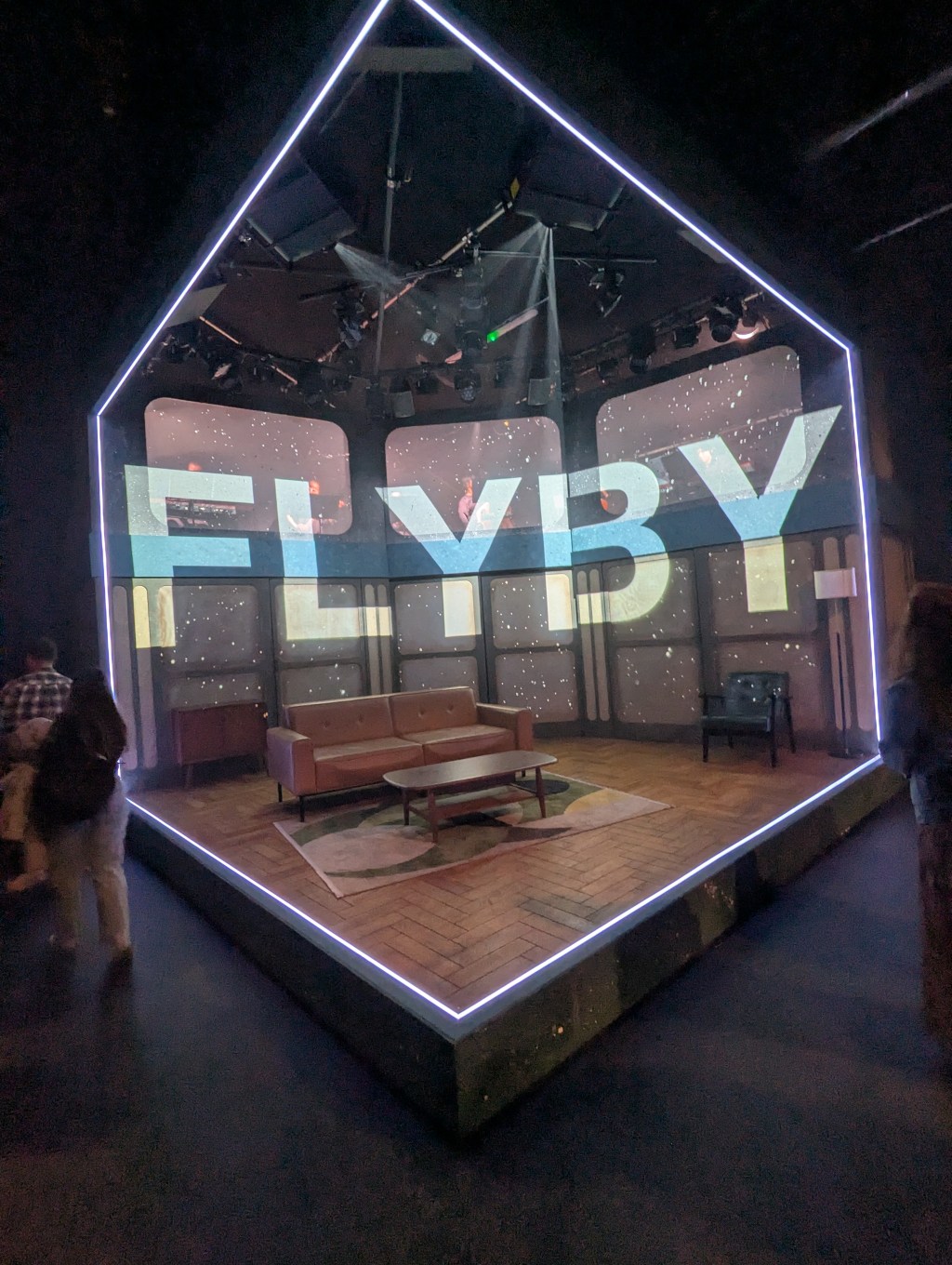
I returned to Southwark in May, firstly to watch the musical Flyby at the Southwark Playhouse. This was a futuristic tale of an astronaut and his loved-up relationship that goes wrong. And when it does, his solution is to flyby and off into deep space. This was an enjoyable celestial jaunt and worthy of another orbit.
The clever set design and lighting of Flyby at the Southwark Playhouse
In the same weekend, I also watched a little offer from the same theatre. For those not in the know, the Southwark Playhouse has two theatres: the Little and the Large. Flyby was playing in the Large, and The Wasp was playing in the Little. As with the play that I had watched at the Finborough Theatre, this performance consisted of just two actors. Their interplay in this case was well-crafted and littered with twists and turns.
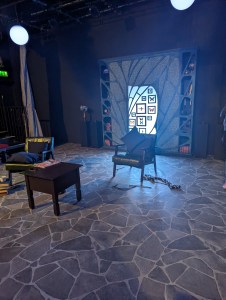
The Wasp played in the Southwark Playhouse’s Little theatre space
In June, I finally watched a play that I had hoped to see in 2025, at the Almeida Theatre. Thankfully, 1536 located to the Ambassador’s Theatre to play to a large audience. Women react to the news that Anne Boleyn has been arrested and placed in the Tower of London. Each woman’s fate is intertwined with a man’s but, as is established, it is the woman who will pay the price. Anne Boleyn of course, paid the ultimate price because, whether the rumours were true or not of her infidelity, she had to go. The bonds between the three featured women in the play, is a strong sisterhood, but betrayal stretches this to its limit.
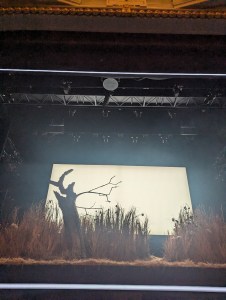
A close seat at the Ambassador’s Theatre for 1536
All of the actors give incredibly powerful performances. The story is very much told from the female perspective, and the males don’t come out of it terribly well. We know very little about them other than in their transactional dealings with the women and the chaos that this brings. The audience could not fail to be moved by the incredibly emotional performances by the three leading women. A stunning piece of theatre, reminiscent of Rebecca Brewer’s Coven, which I watched at the Kiln Theatre in 2025.
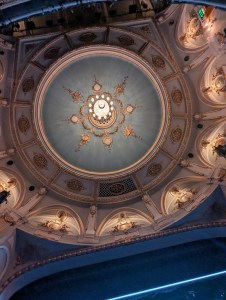
The stunning ceiling at the Ambassador’s Theatre
My second play in June was something completely different. Every two years, the Park Theatre hosts a series of fundraising performances called Whodunnit. In this case, it is the fourth edition in the sequence. The twist is that the regular cast know the play, the plot, the characters, lines and stage directions, and the mystery celebrity performing that night, does not. They are furnished with an ear piece, through which they receive lines and directions. The play always involves dancing which adds to the comedy value.
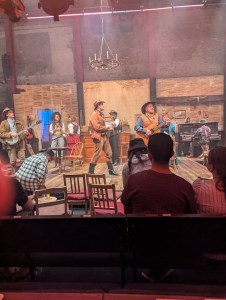
The cast were entertaining the audience as they took their seats for Whodunnit4 at the Park Theatre
On this occasion, the theme of the play was a western and the mystery celebrity was the delightfully sporting, Jason Isaacs. An additional twist is that audience members can enter a ballot to win a starring role in the play, also without knowing the plot, lines or directions. Jeff the barman became an instant hit with the audience and became a legend in his own lifetime. Whodunnit is lighthearted fun and the plot became a little lost along the way, but none of us minded. After the show, Mr Isaacs took questions from the audience, including one from me, which definitely gave me food for thought in my approach to helping trainee teachers develop their own, unique, teacher character. Whodunnit is incredibly popular and also an important event in the calendar. I am fortunate in that I can attend the theatre regularly, but many also run outreach and community programmes that engage young people and under-represented groups in theatre and performance.
As a former m,ember of a Theatre In Education group, the benefits of engaging young people in the dramatic arts are manifold. They grow in confidence and learn how to express themselves in a beneficial and developmental way. Im truly believe that theatre is for everyone.

