
By Christine Swan
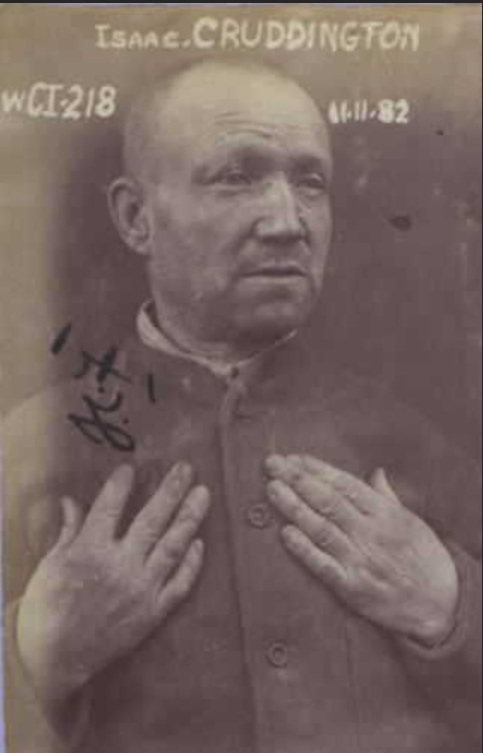
Sometimes, it is hard to know where to begin. During my family history research, which has extended over twenty years, a name leaps out from the page, and conjures an image. In the case of Isaac Crudgington, I do not need to employ my imagination because I have seen early photographs of the man. He looks every inch a Dickensian convict. With close cropped hair, and a stubbly face, a smirk that almost says: “I never did nuffin gov’ner!”. His hands are against the course prison jacket, in a gesture of mock surprise at finding himself incarcerated again.
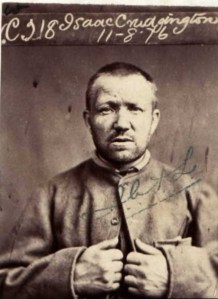
Isaac Crudgington 1876 – HMP Pentonville
Isaac Crudgington was Daniel’s younger brother. He was born on 11th June 1832 and baptised at St Mary, Whitechapel. The site of the former church is now in Altab Ali park, it having been destroyed during the Blitz of 1940. Isaac’s parents, John and Frances, lived in nearby North Street, now Brady Street. In the 1841 census, Isaac is shown as being part of a large family of Crudgingtons, a middle son, although Daniel had already been transported to Australia, although this was to be the year of his return to England.

Isaac’s baptism record at St Mary’s Church, Whitechapel
The earliest record I have found of his criminal activity is in 1851, when he was incarcerated for fourteen days. This set a pattern that was to be repeated regularity of crime, capture, trial and short sentence. This clearly had minimal impact on Isaac’s behaviour. The first newspaper report I found dated from 1858, which recounted his committal to the Worship Street Assizes for not one, but three offences. The first was for distracting a delivery man and then jumping onto his cart and stealing fourteen pounds of sugar, a precious commodity in the nineteenth century. Isaac’s second offence was breaking the window of Mr Eastorgle’s shop in Brick Lane, Spitalfields, and stealing a dozen pairs of boots. The final charge related to a horrific assault on one Emma Cox on Whitechapel High Road. His grievance with her was that he believed that she was the cause of Isaac’s brother being incarcerated. My research hasn’t extended to which brother, as he had five, and they all seemed to be invested in the family trade.
In 1859, Isaac was convicted at the Chelmsford Assizes for horse stealing in Romford and sentenced to five years in prison. He was transferred from Springfield gaol to Millbank. From there he was moved to Portland gaol in Dorset. A visit in 1861 was not allowed as he was on report, but in 1862, he did receive a visit from a brother and sister in law. Was this Daniel and Ann? I suspect it could have been.
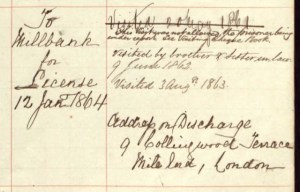
Could it be that Daniel and Ann Crudgington visited Isaac in Portland prison?
Described as troublesome and indifferent, Isaac was returned to Millbank to be licensed for released in 1864. In April, he found time to marry Elizabeth Passingham, who will warrant another post as her criminal record would almost rival Isaac’s. The happy couple were married at St Matthew’s, Bethnal Green. It really was a marriage of two like types. Their daughter, Frances, was born a year later and baptised in St Mary’s, Newington.

Frances, daughter of Isaac Crudgington and Elizabeth Passingham, born 1865
You may have thought that marriage and a family might have tamed Isaac, but that wasn’t the case. , In 1865, Isaac was arrested for burgling a neighbour in Walworth who manufactured soap. His neighbour recognised him during the raid and Crudgington acknowledged this: “You know me well enough – I’m Ikey Crudgy!” Despite this recognition, Isaac Crudgington’s identity was checked against the bumps and scars on his head, which were declared not to match, and he was judged to be not guilty, which I find astonishing.
In October 1868, Elizabeth and Isaac went to the Charlton Fair for a day out, but for the Crudgingtons, it was also an opportunity. The pair purloined two rifles from the shooting gallery and Isaac was seen loading these into a cart. Despite this being a serious offence, I was unable to find details of their sentencing.
In 1870, a man, presumably wealthy, was watching some men gambling with cards on Borough High Street. In typical distraction theft, Isaac bumped the man while his co-conspirator, stole a pocket watch. You may, as I do, assume that this was a less serious offence than stealing rifles, or committing a serious assault, but no, for this offence, Isaac was sentenced to seven years in prison with seven years of police supervision. I can only assume that the victim had influence, power, and or wealth. Although a challenging character, with a hard life, and impossible manner, this seems out of step with previous sentencing. He was admitted to Pentonville prison to serve his sentence although, it appears that he did not serve the full term.

A physical description and Isaac’s address on release – which was the home of Daniel and Ann Crudgington, his brother and sister in law
Teachers often get frustrated by pupils who rack up multiple detentions and check their calendars for the next available slot, which is usually several weeks into the future. Isaac was evidently a free man by 1876 because he was convicted again for stealing and this time, given a five year term. He was sent back to Pentonville prison and it is here that the first photograph of him was taken. He was at some point moved to the austere and remote location of HMP Dartmoor, where the second photograph was taken. I know that he was still in Dartmoor when the 1881 census was taken. It appears that he was released on licence to his brother, Daniel’s address, 30 Baxendale Street, Bethnal Green. However, he breached his conditions and was rearrested in 1882 and sent to Romford gaol.
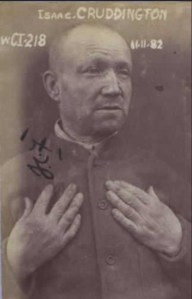
Isaac Crudgington in 1882, Dartmoor prison
There were many ways that Isaac Crudgington’s life could have ended. It appears that by 1890, he had found honest work as a dock labourer. While carrying a case of syrup, two cases of brandy fell from a ship that was being unloaded, and crushed Isaac’s neck, causing asphyxiation. Isaac was fifty eight when he died. His brother Daniel, my third great grandfather, lived for two more years.
I would estimate that Isaac had in excess of twenty convictions, and probably committed far more crimes than the ones that he was convicted of. Victorian crime and punishment did not rehabilitate criminals. It seems that nothing could change Isaac, except death. If he could time travel forwards, and read this post, what would he make of it? He was notorious, but now is a Victorian curiosity. Hard times, difficult lives, and having little to lose, led to desperate people.
More information
You can read about Isaac Crudgington’s trials at the Old Bailey here: https://www.oldbaileyonline.org/search/keyword?given_name=isaac&surname=crudgington&text=crudgington#results

 Awful Rigours and Wretched Pay
Leave a reply to lindawatts Cancel reply