By Christine Swan
One of the biggest challenges faced by genealogists is that of researching ancestors where you only know half of the story. I recently read an article in Who Do You Think You Are magazine, on this very theme. This prompted me to reflect on my discoveries and minor research triumphs when, at last, another piece of the puzzle is laid down.
On my maternal side of the family, finding out about my ancestors has been straightforward. Couples were married, children came along, some more quickly than others, but, I can follow the family line without too much digging.
My paternal side has been more of a headache. Both of my great grandfathers were illegitimate, and even further back, the phrase “it’s complicated” describes the situation perfectly well. Therefore, my research is not completely reliable or whole. My late father knew his grandfather, George Betts, very well, and was a favourite grandchild. He told me many stories and anecdotes that painted a vivid picture of him. So much so, that he lives in my memories as mapping those spoken words to a virtual manifestation of them. George’s wife, Rebecca Betts, doted on my father, and the whole family idolised her for her kindness and generosity, never realising that she too, was illegitimate.
However, my father did not know his paternal grandfather, David Deighton Taylor, as he had died nine years before he was born. We have a photograph and I can confirm that he physical resembled my own paternal grandfather Albert, who I can recall now, with his thick silver hair, leathery skin, nicotine-stained fingers, and regimental tattoos.
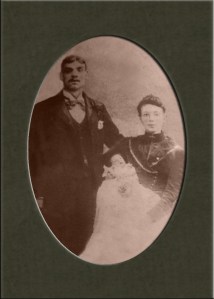
My great grandfather, David Deighton Taylor
In modern times, families raise children and as long as there is love and care, children can thrive. In my many years of working in the field of education, I have learned that it doesn’t matter what that relationship is, as long as there is plenty of love and care. Even this week, we have learned of more terrible stories where babies were wrenched away from their birth mothers and kept in church-run baby homes, where untold died of preventable disease, almost without trace. Mothers were treated as outcasts and shamed, leading to a lifetime of trauma and guilt, that no apology can erase. It is only now that we recognise their dreadful mistreatment, and the weekly episodes of Long Lost Family on television, leave me a blubbering wreck of happy tears.
Buit what have I learned about my own Victorian era ancestors and their lives? David Deighton Taylor was a curious name to me. When I began on my quest, I noticed that this was how he had addressed himself at the time of his marriage to Julia Cooke, in Bethnal Green in 1893. Taylor is an incredibly common family name, but Deighton less so, and therefore more attractive for a researcher. At that point, I did not know who his mother was and have never found a birth record. On David’s marriage certificate, he named his father as David Taylor, a builder. I have found no record of this person and suspect that this is a lie. It would have been humiliating to have left this field empty on the marriage record and I can imagine the vicar of St Peter’s, Bethnal Green, asking the question, and him reaching for an answer. David definitely knew his mother, Mary Ann, but she had died of Tuberculosis when he was eleven years old. It was after this date that his life was thrown into chaos. David’s stepfather, William English, sent him to the workhouse and married his domestic servant. For over ten years, he was in and out of institutions, initially the Metropolitan Board of Guardians school, then the workhouse and infirmary. Marriage was the key to family life for David, but even that was cut short by Tuberculosis.
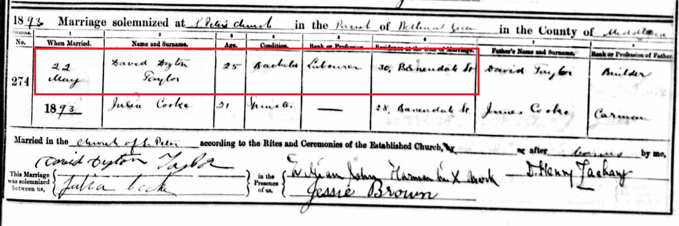
David’s marriage record led me to the name of Deighton (or Dyton)
Mary Ann herself, appeared to be illegitimate too. As I recounted in my last post, Daniel Crudgington married Jane Vincent in 1842, after his return from Australia. This was the year of Mary Ann’s birth, and she continued to use her birth surname, Deighton, at various points of her adult life. Her mother, Ann Deighton, married Daniel Crudgington in 1844, in a marriage which I believe was bigamous on his part. Mary Ann was not baptised until 1853, and her birth date given as a respectable 1845 – one year after her parents married. Was Daniel actually Mary Ann’s father? I suspect yes and my reasoning is based on the fact that he left Jane and chose to marry Ann. If Ann became pregnant and then gave birth to Mary Ann, she was, as far as I am aware, his first born. He stayed married to Ann until she died, even though there seemed to be several reasons to assume that this was not always a happy union. David described Ann as his grandmother and Daniel as his grandfather, and continued to live with the latter until his death.
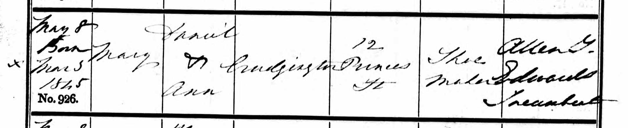
Mary Ann was baptised in 1853 but actually born in 1842
My other great grandfather, George Betts, was the son of a domestic servant and her master. I know very little of his mother and father. I know that his birth name was Mead, which I suspect was his mother’s surname. My father told me that George’s paternal grandmother doted on him as her grandson, and saw that he was well-provided for and educated. My father remembered seeing a photograph of young George, dressed in a miniature sailor suit, with a slate board to practise writing. When his grandmother died, George was unofficially adopted into the Betts family, William Betts, his adoptive father, a tripe dresser. As far as my father was aware, the Betts were a good family, and he thrived. Years later, when his biological father died, he left a legacy for his son, but George refused to claim it, despite protestations from his children. He wanted nothing further to do with the name Mead. Unfortunately, this also caused him difficulties when he needed to claim disability benefit as he developed cataracts which slowly caused blindness. There were no official records of George Betts – only George Mead, a name that he had not used for over seventy years. No records existed of his adoption or that his name was ever legally changed.

George Mead listed as a “visitor” in 1871, but ten years later, he was listed as a son to his adoptive parents
George’s wife, Rebecca, was also illegitimate. I was shocked to discover this but, despite searching for the birth of a Rebecca Bull, I was unable to locate a matching record. Instead, I found a record for a Rebecca Mayes born in September 1869. No father’s name was provided, and the occupation field was left empty. Eliza Rosina Mayes had decided to go it alone, with the support of her family. Rosina married William Henry Bull in December 1870. Rebecca was listed as his daughter in the 1871 census, and I suspect that this was true. I am unsure why it took over a year to marry Rosina. Maybe Rebecca was unaware that she had been baptised with her mother’s name. My father never knew and would have been absolutely horrified.

Rebecca Mayes baptism record of 1869, one year before her mother married
More than one hundred and fifty years later, none of this matters. Life was difficult enough for Victorian women, but a single woman with a child attracted stigma. She was a fallen woman, an unfortunate, immoral, and impure in the eyes of Victorian society, but I see instead, strong women, who managed, survived and did their best with what they had. The woman that I worry about most, was George Betts’ mother. I imagine a young domestic servant, pregnant, afraid and abandoned.
I acknowledge that my illegitimate ancestors would have faced more challenges, as did their mothers. The purpose of this blog was to remember them and to share their stories. I hope that in some small way I have recognised their struggle.

