By Christine Swan
In my previous post, I had outlined my research of the Ferré family, as far as I knew. Last Saturday, I travelled to Lille by Eurostar train from St Pancras International. The trip to Lille is very short so I still had a whole afternoon to fill when I arrived mid-morning. After checking into my hotel, I decided that it would be better to travel to Tourcoing on Saturday, rather than on Sunday. Based on my previous experience of finding many facilities shut on Sunday, I thought this provided the best chance to find the town open. Therefore, I booked my ticket in the SNCF app and took the short walk to Lille Flandres station. My journey time was only about fourteen minutes as Tourcoing is considered to be a suburb of Lille heading in the direction of Belgium.

Inside the little offshoot of Lille Flandres station for suburban trains
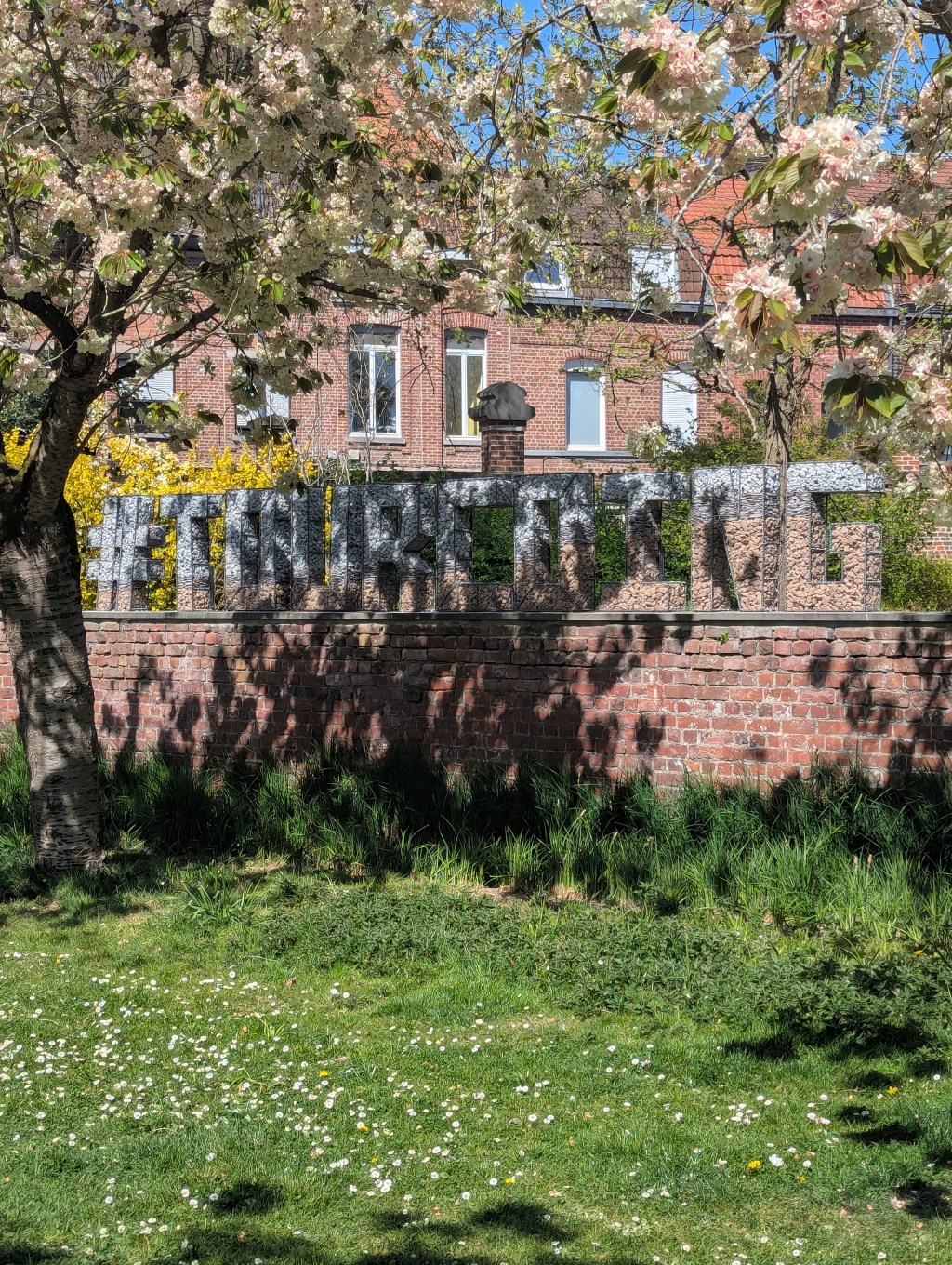
I had read some rather negative reviews before I visited but let me dispel these here. I disembarked at a quiet but obviously French railway station and began my walk into the heart of the city. I imagined my ancestors walking, perhaps in a cart pulled by a horse, or on horseback. They might have overtaken me on my way along the quiet street in the warm spring sunshine. Do not underestimate Tourcoing’s charm, it has a great deal to make it worthy of an afternoon’s visit.

Eglise Saint Christophe dominates the view walking towards the centre of Tourcoing. A shopping centre is on the left.
Tourcoing hasn’t always been French, but has since Roman times, been associated with the woollen textiles industry. All aspects of the production were undertaken within the city. I believe that this is the industry in which my ancestors were employed. There is a high chance of this anyway, but I also know what happened next, that some of the Ferrés fled to England and worked as weavers of silk, first in Canterbury, and later in Spitalfields.
Most of the impressive buildings date from far later, after Tourcoing became part of France in 1688, and are of the typical French baroque style.

The Chamber of Commerce building in the classical French style but was actually built between 1903 – 1906

The equally impressive Hotel de Ville
The time was now in the designated déjeuner period, so most of the smaller shops were closed. The market was also just wrapping up – the colourful fruits and vegetables were loaded back into boxes, and then into white vans. Bunting fluttered in the gentle breeze, signalling everyone to slow down – it is lunchtime, a time to eat, drink and rest.

Bunting butterflies flutter over Rue Saint Jacques

Time to drink coffee, eat cake and engage in a little people watching
Suitably refreshed, I continued my wandering. I was fascinated by gable end brickwork and saw this repeated in several different towns during my stay. We all know that triangulation is an engineering principle that strengthens structures by allowing forces to be spread, but, I had never seen this applied to brickwork in such a manner. I assume that its function is also decorative. Upon researching this after my visit, I could find photographs similar to mine, but no descriptions of the technique nor its name.

Interesting gable end brickwork
I decided to head towards the botanical gardens as the weather was beautiful and it was still in the quiet lunch period. I stumbled across an impressive part of Tourcoing’s industrial past, which was a former woollen cloth mill, now part of the University of Lille’s collection of buildings.

An historic woollen mill, now a university building, that forms part of a walking history trail around Tourcoing
There are many signs of Tourcoing’s industrial past. I’m not a fan of facadism but I was pleased to see this factory frontage preserved with modern residences behind.

The preserved frontage of an Art Deco fabric factory in the Rue de Chateau
I continued walking towards the botanical gardens but sadly, these were also closed, but the grounds were open to the public. It proved to be the perfect place to sit for a few minutes and enjoy the sunshine.

Tourcoing’s botanical gardens are the perfect place to sit and unwind
I continued my walk through the town but the afternoon was wearing on and I had arrived not long before the museum was due to close. I would very much have liked to look around the Maison Folie Hospice d’Havre which includes a convent and hospice dating from the thirteenth century, and catered for the poor of Tourcoing. The Ferrés certainly would have known of it. Part of the buildings are more recent. Of course, the nuns would have been Catholic and The Ferrés were Calvinist Protestants.

The Maison Folie Hospice d’Havre hospice
I walked back to the station, in the late afternoon sun. I had not noticed the memorial plaques outside when I arrived but they were very thought-provoking and sad.

Tourcoing train station

There are a number of thought-provoking and sad plaques outside of the station entrance. We must never forget.

This plaque commemorates the Train de Loos – the final train deporting political prisoners and resistance fighters left on 1st September 1944, just prior to the liberation of Lille
Plaques also commemorated SNCF workers who died during war. I stood and read each one. Tourcoing has a proud history. I thought about the children, being sent to death camps. Resistance fighters who were so close to liberation, but instead were sent to their deaths. It is important that we learn from the lessons of the past and the events that led to these awful acts.
I walked to the platform that I was departing from and thought about all of the people who had left Tourcoing under desperate circumstances. I cannot possibly know the conditions under which the Ferrés left but as I boarded the train back to Lille, I felt very glad to have visited, and appreciative of my own freedoms.
More information
Tourcoing tourism and architecture – https://www.tourcoing-tourisme.com/cat_art.asp?rubrique=architecture&categ=2
Tourcoing industrial heritage trail – https://www.tourcoing-tourisme.com/brochure/plan%20patrim%20tcg%20ang%20hd.pdf
The Train de Loos (in French) – https://fr.wikipedia.org/wiki/Train_de_Loos
All photographs taken by the author

