

By Christine Swan
I find London endlessly fascinating. I watch a large number of theatre productions and, as I no longer live there, I tend to stay for a whole weekend to make the stay worth the journey time. I will watch two plays, in different venues, so try to choose a hotel equidistant between the two theatres. Alternatively, my hotel is selected because of its close proximity to a convenient underground line. Although there are parts of London that I know like the proverbial back of my hand, some since childhood, others are new and unexplored territory.
Last weekend I stayed in Hammersmith, a short distance from the permanently busy Talgarth Road. As a student of the University of London, but based in upmarket Chelsea, I loved the faded glory and grandeur of Kensington. Brompton Cemetery was one of my favourite haunts to walk, and to think. A number of my friends lived in South and West Kensington, in short-life tenancies. Builders who were improving one of the tall, grand, white houses, so reminiscent of the area, may have been in the process of converting one apartment but run out of money to complete it, or perhaps they had not yet started but needed some income from their investment. Students, living essentially out of a rucksack, with few belongings, simple requirements and, in those days, a student grant, were perfect temporary tenants. Short-life properties were advertised on the accommodation noticeboard and scrutinised by us to find the best place at the lowest price. Some had a magnificent fitted kitchen, but just a toilet, shower, but no sink, in the bare-rendered bathroom. It mattered not, if the price was right and you could reach uni easily, it was the perfect temporary home.
Sundays were spent eating a pastry and strong coffee at a local patisserie, wandering to Hyde Park, and then taking in a museum or two. I don’t remember any queues at the Natural History Museum, or the V&A, but now it feels like queuing for the now defunct Oxford Street sales. Those were the days. I miss them.
So it was that I found myself wandering through West Kensington, Holland Park and Kensington High Street last weekend. The enormous department store, Barkers, used to dominate the latter. I would often walk down Young Street, along the left side of the Barkers building, to enjoy the delicious odours emitted from the on-site coffee roastery, before losing myself in the pretty little streets and squares of that part of Kensington. I often aspired to living there when I found employment, without realising that property prices would always be wildly beyond my means.
I do try to visit new places and this was my agenda for last Saturday. I noticed that two museums were conveniently within walking distance, so set off from Talgarth Road, to explore.
My first stop was Leighton House, just to the West of Holland Park, former home of the artist and sculptor, Sir Frederic Leighton. The house took just under thirty years to complete and it becomes apparent why as soon as you enter the grand property. On display are wealth, opulence and reproductions of architecture and decoration, from the artist’s extensive travels and practical requirements. The Arab Hall stuns you with its brilliance – how can something so magnificent exist in a London home? The fountain and perfectly placed couches reveal this as a place of relaxation and contemplation, as well as a stunning place to greet your guests. The host told me that the Arab Hall caused quite a stir in nineteenth century London.
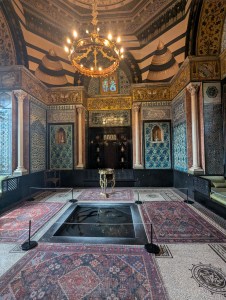
The Arab Hall of Leighton House
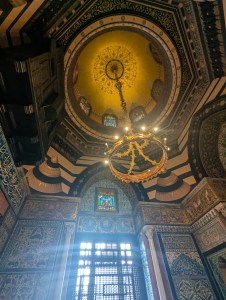
Look up! The incredible beauty of the Arab Hall leaves you stunned
The main hall echoes the peacock blue tones and is adorned by a stuffed representative of the species. Every aspect of this property is different, elegant, and perfect.

A peacock forever stands guard of the staircase
Leighton was one of the Pre-Raphaelites, and his home is a treasure trove for fans. There are also exhibition spaces for paintings and sketches from Leighton’s travels, as well as contributions from other artists. Leighton House is not just a museum, it is also a gallery. Upstairs, there is also a performance space where recitals are held.

Shades of ruby red in the dining room

A grand space upstairs that also serves as a gallery
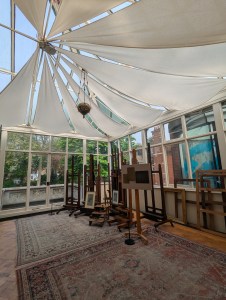
The winter studio dates from 1889 and was an addition to the original house

Leighton House seen from the garden
There is a shop, cafe, and garden. If the weather is fine, as it was for my visit, tea and cake can be enjoyed outside. I noticed that a number of bookworms were secreted around the garden, lost between the leaves of their books, seated on benches and deckchairs around the tranquil garden. It is hard to comprehend that Kensington High Street is just a couple of minutes walk away.
Sambourne House is the other side of Holland Park entrance, a few minutes walk away. It is one of the tall, white, terraced houses that I spoke of earlier, that are so characteristic of this part of London. Confusingly, the entrance to the museum is “below stairs” and so, after the grandeur of Leighton House, I was now relegated to using the servants’ entrance. Leighton House is accessible to wheelchair and mobility-limited visitors as it has a lift, however, Sambourne House does not, and the stairs are steep in places. A discount is offered for visitors going to both sites. There is no cafe or garden at Sambourne House, but there is a small gift shop.
Sambourne House was the home of Edward Linley Sambourne who was an artist of a different genre to Leighton. He worked as a cartoonist for the satirical magazine Punch but was also a pioneering photographer. He encouraged family members, servants, neighbours and visitors, to pose in costume, for his photographs. By tracing around the outline of the image, the basis of a cartoon drawing could be formed.
The immediate impression going from Leighton House to Sambourne House is that there is less space. Rooms are more typical middle-class Victorian clutter than acres of glamour and aesthetic proportion. The guides are very knowledgeable and happy to answer any questions as well as giving you a verbal summary of the room. Going upstairs from the servants’ areas and kitchen, original William Morris wallpapers decorate the walls. Many modern reproductions can be purchased today, but these are original prints, dating from the 1860s. Although they are discoloured by light and age, how wonderful to see original and authentic decoration!

Original Victoriana and William Morris wallpaper on walls and ceiling
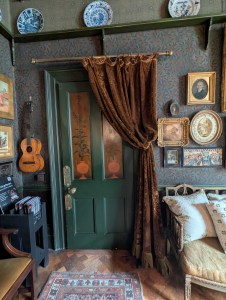
Each door has a painted frieze. With the velvet portiere curtain and cosy aesthetic, this is a definite “steal my style” moment for my own home decor
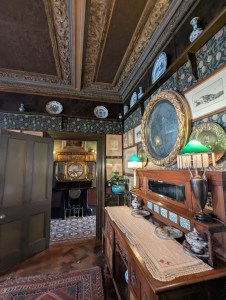
The house is largely unaltered since it was first occupied so is a wonderful source of inspiration

No room for a greenhouse or a fish tank? Build one into a window space!

Cartoons and other artwork, decorate the stairs
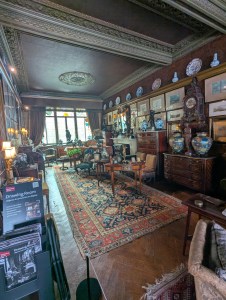
A grand drawing room upstairs

An airy and light Victorian bedroom
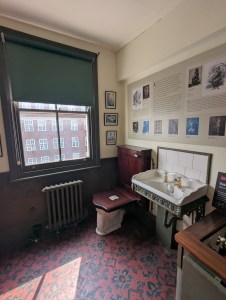
The modern luxury of an indoor, plumbed bathroom, with a reminder to visitors not to use
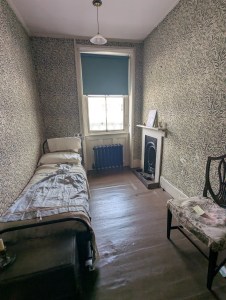
The simplicity and starkness of a maid’s bedroom

The artist’s studio

The exterior of Sambourne House, seen from the street
There certainly are a lot of stairs and on ending your tour of Sambourne House, you still have to step up to street level again. It is a hidden treasure, time capsule of a museum, and a fantastic place for owners of period houses, to seek inspiration. Its authenticity and cleverness definitely makes it worthy of a visit. It is also valuable because it is by far, the best collection of original Victorian decor that I have seen. I came away brimming with ideas.
I decided to take a walk around Holland Park before returning to Hammersmith. Firstly because I was in need of another cup of tea and perhaps, another piece of cake, and secondly, because I was in need of a sit down after negotiating the heights of Sambourne House.
There were a lot of dogs in Holland Park that seemed to be of the mind to do the exact opposite of their owner’s instructions. “Come here Fido!” seemed to result in the hound’s pursuit of a new playmate, and “No!” resulted in whatever was the opposite action to yes. I decided to seek out a more quiet area, so headed for the Dutch Garden.
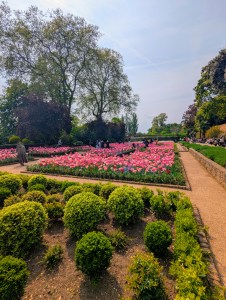
The Dutch Garden in Holland Park looking wonderful in the sunshine

Tulip mania in the Dutch Garden
Mentally refreshed, I headed to the cafe to refresh the body with a pot of Earl Grey and a delicious lemon Lamington. The perfect end to a perfect mid-morning to mid-afternoon Saturday. I recommend both museums to you wholeheartedly.
More information
Useful information for visiting Leighton House and Sambourne House – https://www.rbkc.gov.uk/museums/plan-your-visit
Guide to both museums – https://www.rbkc.gov.uk/museums/
I had afternoon tea at the Holland Park Cafe – https://www.daisygreenfood.com/location-hollandpark

