


By Christine Swan
In a week that saw both daytime and nighttime temperature records smashed in the UK, we need to take a long, hard look at ourselves. I make no apologies for this post appearing controversial to some, but we need to take stock of where we are and where we are heading. Without being over-dramatic, our survival depends on it.
I take an annual holiday to the South of France where I bask in warm temperatures, safe in the knowledge that I can retreat to my air-conditioned apartment when it all gets a bit too much to handle. The French have perfected warm climate living with balconies, pavement cafes, window shutters, lunchtime siestas, and moving productive times to early or late. However, even this week la canicule has hit France very hard, with temperatures rising into the forties Celsius. Stories have dominated the news and chat shows. How much heat is too much to handle?

We do expect high temperatures on holiday
Back in the UK, we soldier on, largely without air conditioning. Some schools have closed, some for half days, avoiding the hottest part of the day, and many have relaxed usually strict uniform rules. That said, a boy in a school local to me, was sent home recently for wearing his PE shorts to school on a non-PE day.
The human body is adapted to manage in a range of climates but, as temperatures rise above the mid- thirties Celsius, and humidity increases, our usual mechanisms become less efficient. Our body temperature is about thirty-seven Celsius and our homeostatic systems regulate it to that level. Sweating cools the skin as evaporation of it takes away some heat. The tiny blood vessels, capillaries, in our skin, receive maximum blood flow, acting like a whole-body radiator. We naturally seek shade if possible, and seek a cooler spot. We tend to eat less, but drink more to replace water lost as sweat. In temperatures above thirty-seven degrees Celsius, cooling down becomes life-saving.

Narrow streets and tall buildings create shade from the sun
It is difficult to stay cool when you cannot choose where to work. Some school classrooms become very hot, workplaces have no maximum working temperature, older public transport networks become a cauldron. Cities designed around stone, concrete and glass, become a furnace. We need to serious look at establishing safe working practices and a legally enforceable maximum temperature for those employment sectors “at room temperature”, and enforce protection for workers who regularly have to work at higher temperatures e.g. in the metalwork and baking industries.

Unlike us, this Komodo Dragon has few options to thermoregulate
It is easy to slip into heat exhaustion, a potentially serious condition. It becomes difficult to regulate the body’s temperature, and the core value begins to rise. Sweating may be profuse and the sufferer may feel dizzy and disorientated, possibly nauseous. It is important to act quickly. My own experience, while on holiday in France, was on a day when the thermometer hit forty degrees. I went the beach and, as it was so hot, paid for a spot with sun lounger and umbrella. I had a bottle of water with me, about one and a half litres if I recall. My tactic on very hot days is to go into the sea, come out and dry by evaporation. However, on this particular day, the sea temperature was in the high twenties, so the cooling effect was less.

It’s less fun having fur when it’s hot
I ran out of water. I bought a small bottle of Orangina from the man who wanders between the sun loungers. It clearly wasn’t enough. The day was still with no noticeable wind at all. I felt quite sleepy and didn’t have the energy to drag myself into the sea, only a few metres in front of me. I woke up feeling very confused. I also felt exceeding hot. I took my things and staggered back towards the apartment. Before I reached it, I purchased a two litre bottle of Fanta. I got back to the apartment, drank a considerable amount of the sugary orange pop drink, turned the air conditioning up to maximum, and promptly fell asleep again.
When I awoke, I felt a little hungover, with a mild headache, but clarity had returned. On the sun lounger, I almost felt as if I was watching myself from the outside, but now, I felt “myself” again. I remained in the cool until later in the evening, when the temperature had abated a little.
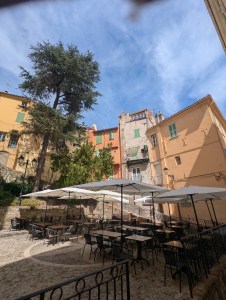
The tables are set for al fresco dining
My little episode was a wake-up call. This week I have been commuting with four smaller bottles of water. It is not a long journey, and I can refill at Birmingham New Street station, but carrying extra bottles was an altruistic move for my fellow travellers. In France, I have been given water by the guard if a train is delayed or the air conditioning is not working – a very rare occurrence! In the UK, we should have water fountains/ bottle fillers at EVERY public transport hub.

A changing climate may mean that Mediterranean plants will grow more readily
We also cannot hop from our air-conditioned car, to our air-conditioned workplace, on to an air-conditioned supermarket, and finally an air-conditioned cinema. It isn’t solving the problem, it’s masking it. Instead, we need to heed this wake-up call. We need to make real change and quickly. Global temperatures have increased since the beginning of the industrial age, but change has hastened more recently. In developed countries, our appetite for energy is voracious. We use AI as a new plaything to generate an image of us as a rock star, or we ask it trivial questions, without so much as a thought of the energy consumption. We don’t consider the colossus data centre behind it, consuming land and water that could be used for housing or agriculture. We have become convinced that we need it and must have it.
There are campaigns to block developments of solar or wind farms as unsightly, or unnecessary, and a belief that non-polluting hydrogen, produced from oil, is somehow better than…..oil. Water companies have run out of water, and provide it in plastic bottles, and yet somehow, this seems quite normal. We cannot even take a dip in the sea to cool off, for fear of catching gastro enteritis.
This uncomfortable week should make us think, to ask questions, and to take small actions. I regularly see parents sitting in a large SUV, with the engine running to power the air-conditioning, waiting to pick up their child from school. I can see the irony in this. We can all do our little bit, or not. Hopefully a week on a hot planet will drive home some uncomfortable truths.
p.s. The UK record daytime temperature has just been exceeded again today.

