
By Christine Swan
I have a particular love of being transported somewhere else for a couple of hours, punctuated by relaxing conversation, good food, and the occasional G + T. My own performing career took a different direction when I qualified as a teacher, performing five times a day to a decidedly unappreciative audience. Apart from a touch of university and provincial am dram, that was the limit of my repertoire. I still love the theatre, and I love the London theatre scene best of all. I particularly enjoy “off West End” productions because the major, big budget, extravaganzas receive a lot of patronage. Smaller theatres will often try something more bold and edgy, which may not fly with a mass audience who may prefer the familiarity of a well-known production.
In 2024 I managed to see twenty four theatrical productions. There has been a tendency to ‘musicalise’ a number of stories – some of which are successful in my humble opinion, others less so. My test is, do the songs “stick”? Are you still humming them when you leave? Can you still remember them the following morning? Unfortunately, in some cases, I can’t. Perhaps as a consequence, I have sought out fewer new musicals this year.
As 2024 draws to a close, I decided to select and share my highlights with you and to reflect on time well spent.
My first highlight was from March when I saw the new musical Cable Street at the Southwark Playhouse. I had expected to enjoy the story as an East Ender myself, but, it exceeded even my expectations – it was marvellously joyful. My late mum was a young woman at the time when Moseley was rabble-rousing his way through the East End. She was very fearful of the spread of hatred through neighbourhoods that had previously been a community of diverse peoples. Cable Street crystallises that time, when money was scarce but hardships were shared. The spread of hate and division resonates as well today as it did in the nineteen thirties. As we would hope, love and solidarity win the day and harmony is restored. Despite the potentially grim subject matter, this is an uplifting tale and one that is important to tell to a new generation, as a warning of past history being repeated. The songs are very memorable, with each character’s personality projected to good effect – the staccato rap of the young Jewish boxer’s frustration, the Irish ballad sung by the female lead advising to move with the times. Clever musicality, clever lyrics, a fantastic show.
It was sold out when I attended and I had a chance to congratulate one of the actors afterwards in the bar – “You’re gonna need a bigger venue!” I quipped. And so it was that in September, I watched Cable Street again, this time at the Southwark Elephant just a short walk from the Playhouse. Most of the cast were the same and I enjoyed the performance just as much as the first time. My immersion was only slightly marred by a large handrail in front of my end of row seat, and an odd triangular space for my feet. I made a mental note not to book that particular position again. However, I send my warm compliments to the cast, orchestra, and production team, Cable Street was a top highlight of my year.
Having expressed my ambivalence about musicals, and am just about to review another, my second highlight was a classic. I watched Fiddler on the Roof in early August at the spectacular Regent’s Park Open Air Theatre. I would urge any theatre fan who has never visited, to definitely book. You do have to be optimistic regarding the weather but be prepared if your hopes are not realised. The show really does go on, no matter what.

The magical experience of the Regent’s Park Open Air Theatre
I need not have worried, I visited the theatre twice this year, and on both occasions, the weather was divine. When I watched Fiddler, I was accompanied by an old school friend and had booked dinner as part of the ticket. If you are thinking of booking, at least once, you must try the dining experience. There is something magical about eating in the grounds of the theatre. The sun was bright but just beginning to set, it was still comfortably warm and the food was perfect. Dessert and drinks are served during the interval although I have to confess, speedy consumption is required before the show restarts.
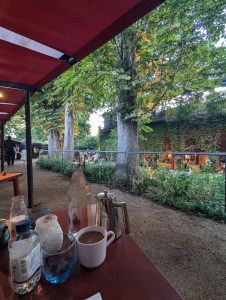
The covered dining is a special treat – highly recommended
Fiddler on the Roof is a classic singalong musical and many well-loved songs feature in the first thirty minutes. The temptation to join the chorus is strong, nearly as strong as when I watched Cabaret last year. The set was cleverly designed on two levels which allowed a field path to be created for entry, exile and burning fields. A unique feature of the Open Air Theatre is that lighting technicians need to accommodate changing ambient light levels. The night that I visited was clear. Initially, the sun provided ample light but, as it set and night fell, a lone fiddler, quite literally on the roof, was very emotive. The fields “burned” under red light with theatrical smoke. The music, dancing and singing brought joy, sadness, pathos and love. This was a wonderful retelling of a much loved tale.
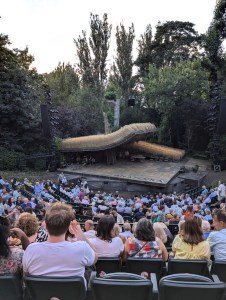
The innovative set of Fiddler on the Roof

Leaving the Theatre via the illuminated park
Park Theatre’s annual fundraising Whodunnit unscripted comedy was a surprise hit with me in May. I have a problem with comedy. I am immune to many things that will cause people to howl with laughter, so I approached Whodunnit with a degree of scepticism. As we munched pizza in the upstairs bar, I told my friend “It’s Harry Hill”. The USP of Whodunnit is that every night a different celebrity takes on the guest role, without any prior knowledge of the script. But surely they talk and share crib notes? Apparently not. Harry was hilarious. A highlight was when he had to take part in a dance without having any awareness of the steps. This is my kind of funny and I chuckled away merrily. On a serious note, smaller theatres are often of limited means so this skit provides helpful income and included an audience with Harry Hill and an auction for items which included one of his signature high-collared shirts. The bids were extravagant and far beyond this humble teacher’s budget.
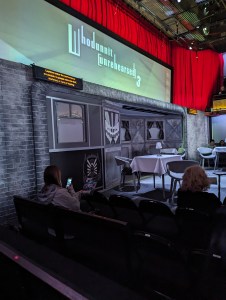
The set of Whodunnit 3 at the Park Theatre
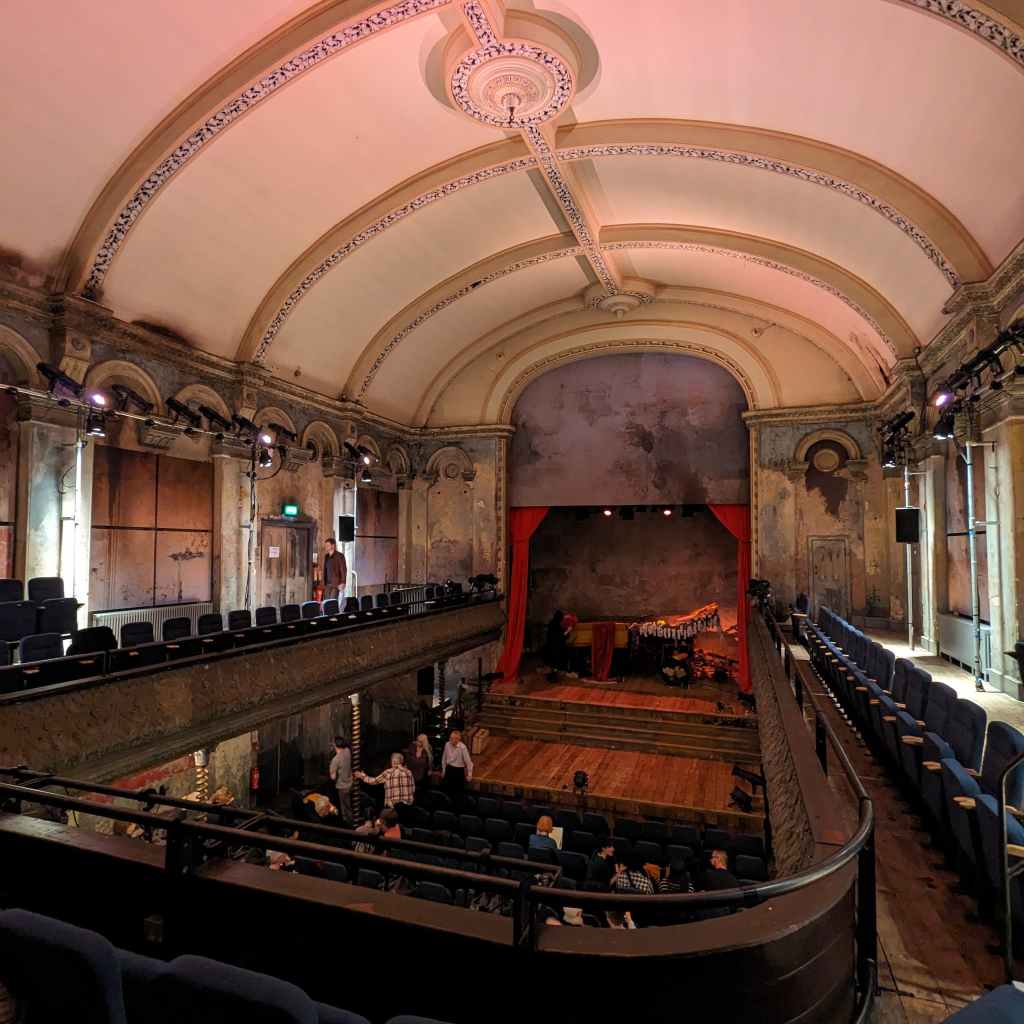
My final picks for this review was A Midsummer Night’s Dream in April at Wilton’s and the moving performance of Shakespeare’s Romeo and Juliet at the Malvern Festival Theatre in May, both by the Flabbergast Theatre Company. Wilton’s was busy but I still had time to look into their history room before the performance and to tell whoever would listen, that my ancestor, Nelly Elena Estelle, had performed there twice in her career.
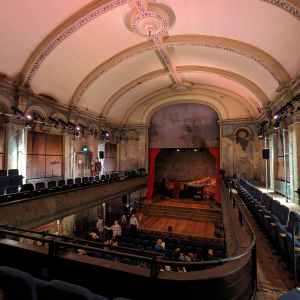
Midsummer Night’s Dream at Wilton’s Music Hall
For the Malvern event, I booked dinner in the theatre restaurant before the performance. The Theatre was closely associated with famous local resident, George Bernard Shaw. He began the Malvern Drama Festival in 1929, which continued, except during wartime, until 1965. Shaw’s friend, Sir Edward Elgar, lived in nearby Worcester focused on the development of music in the locality, and Shaw focused on promoting the dramatic arts.
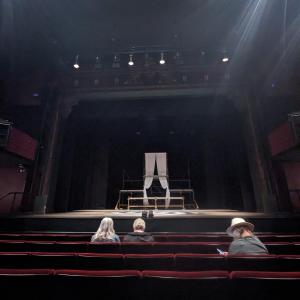
Flabbergast Theatre’s Romeo and Juliet at the Malvern Festival Theatre
When the performance of Romeo and Juliet was about to begin and people were invited to take their seats. To my disappointment, the audience was very small in contrast to the performance at Wilton’s. The majority of diners had clearly headed for the cinema. I felt embarrassed for the performers to play to such a small number of people after a packed theatre I had witnessed a few weeks before. I put this to back of my mind and immersed myself in my favourite of Shakespeare’s tragedies, the play that I studied for my GCE O Level, the play that I first saw starring Sir Ian McKellen and Francesca Annis. Flabbergast perform authentically, Lennie Longworth (Juliet and also an skittish Puck in Midsummer Night’s Dream) is a superb performer who plays the roles with her entire being. The whole cast were excellent and made for clear highlights of my year.
I am currently planning my viewing for 2025. London theatres continue to be well-patronised but with rising costs, this needs to continue to keep smaller venues on their feet. Provincial theatres face additional challenges. For me, there is no substitute for watching a play at a theatre, or indeed a film at a cinema. I don’t subscribe to streaming services because of this. I have had some splendid, memorable evenings and am always grateful for the privilege of being able to enjoy them. We can fill our houses with physical items but to fill our hearts with beautiful memories, is richness indeed.
More information
Cable Street at the Southwark Playhouse and Elephant – https://southwarkplayhouse.co.uk/productions/cable-street/
Flabbergast Theatre – https://www.flabbergasttheatre.co.uk/portfolio-2-1
Regent’s Park Open Air Theatre – https://openairtheatre.com/
Wilton’s Music Hall – https://wiltons.org.uk/
Malvern Festival Theatre – https://malvern-theatres.co.uk/

