
By Christine Swan
In this second review of 2024, I recount my life and times between July and December.
July was not quite the summer month that I had hoped for. Although there was some good weather, it was changeable and frequently unsettled, including for my annual visit to the Vale Wildlife Hospital Open Day in Gloucestershire and to the Cuan Wildlife Rescue Centre in Shropshire. Despite the clouds, it was pleasant to support these worthy charities and to catch up with friends. On the return journey from Cuan, we took a slight detour to revisit the ancestral seat of the Crudgington family, in the tiny village of Newton, between Bridgnorth and Telford. Parking up outside of the small farmhouse, I had intended just to snap a few photographs from the road, when a small upstairs window was flung open, and a head popped to ask us our business. The head belonged to the current resident of the property and I attempted to explain, realising that it sounded rather ridiculous, that my ancestors had lived in the property some four hundred years ago. “I’ll come down”, he said and we had a very interesting, extended chat about the place. The current resident was indeed very knowledgeable about the area but less so the Crudgingtons. Four brothers travelled to London about three hundred years ago, to make their fortunes, but instead found poverty and criminality. My three times great grandfather, Daniel, has been the subject of three of my blog posts, and here I stood, in the place where his own forebears came from. The farmhouse is known for its black and white timber frame and herringbone brickwork. “It is haunted”, the current owner cheerfully related and proceeded to tell me of several unexplained events. I was very grateful to him for being so generous with his time on a Sunday afternoon, when I am sure that he had better things to do. Hopefully my contribution in the form of the tale of the Crudgingtons was of interest. One of the most notable stories was the will of John Crudgington, dated 1599, where he bequeaths his son the: “Witch in the kitchen”. This most likely relates to a doll or poppet for the purpose of warding off evil spirits and protecting the house.

Newton farmhouse – ancestral seat of the Crudgington family
In the middle of the month, I had the absolute pleasure of meeting one of my American cousins, who was visiting the UK with her church choir. We met in London, where the party had travelled to do some sightseeing. Unusually, the weather was warm and I waited in St James’ Park, with my book, just before the changing of the guard ceremony was about to start. I realised that if I didn’t move, I would be separated from the rest of St James for some time, so I decided to make my way across the road and negotiate the static crowds, while I was trying to move as quickly as I could, oblivious of the spectacle that was happening on the other side of the road. I tried to be as polite and unobtrusive as I could be but I felt the pressure of the imminent arrival of my cousin, and her not knowing her way around terribly well and being separated from the rest of her party. I turned the corner, and there she was! We walked from St James to Piccadilly to have lunch.

They are changing guards at Buckingham Palace
The Bull family emigrated to New York at the very start of the twentieth century. William Henry Bull junior was the eldest son of my great great grandfather with the same name. My cousin is my contemporary of this branch. It is always exciting for me to meet new relatives but, of course, you do wonder what you might have in common and how you will get along. I needn’t have worried. Although we are separated by almost four thousand miles, we found that conversation came easily and discovered that we had so much in common. We talked about everything, our careers, family, achievements and losses. We shared a bond, not just DNA, but friendship too. We did manage a quick bus tour before arriving at St Paul’s Cathedral, which was the meeting point for my cousin’s party and meeting the coach to take them back to Cambridge.

We’d never met in real life but parted as friends
We said our farewells and I walked westwards, through Holborn before catching the tube to Harrods – the trip we had planned to make but had just run out of time. I purchased the Harrods branded tote bag that my cousin’s daughter had asked as a souvenir, and popped it in the post when I arrived back home.
My car MOT was due to the end of July so a trip to Birmingham was planned for the purpose. While my car was being services and undergoing its annual health check, I stumbled across the West Midlands Police Museum in Steelhouse Lane, based in the former lock-up, essentially, a small short-stay prison. This is a fascinating little museum that is well worth a visit. I had not previously seen it advertised but it really is hiding its light under a bushel. The interior is unaltered from its original purpose, with each cell housing part of the exhibits. Birmingham is now nationally, and internationally, well-known for the infamous Peaky Blinder gang. The real Peaky Blinders are here, along with their stories and news stories about their trials and incarceration. The staff are very helpful and informative and the visit was a great way to eat into the hours while waiting for my car – which also passed its MOT!

Learn about the real Peaky Blinders at the West Midlands Police Museum
August heralded my annual trip to my beloved France. The night before I travelled, I saw Fiddler on the Roof at the Regent’s Park Open Air Theatre, which was an absolute triumph. I resisted the urge to sing along, although the temptation was strong. The use of space and lighting was very clever. There was space for the fiddler to fiddle, but also to provide a field to “set ablaze” with theatrical smoke and red lighting, and also to provide a route for the sad exodus as the finale – marvellous!

Getting ready for the performance of Fiddler on the Roof
The following morning I travelled to France, first to Paris and then on to St Raphael. I stepped off of the train into the still very warm, evening sunshine, into my home from home, my paradise, my rest. Work is a distant memory, troubles and worries, melt away. That is everything that a holiday should be, and the reason that I keep returning to this place. My son joined me after a couple of days and it was a delight to show his partner our favourite places. I’ll be back, of course I will. Leaving is only ever temporary.
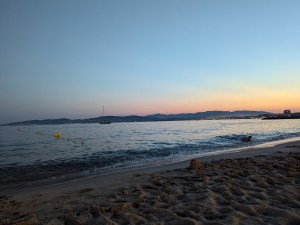
I will never tire of this view. Plage Veillat, St Raphael

The cool back streets of St Tropez
September brought the start of the new academic year and an intensive period of work. We did manage to fit in a trip to Witley Court just before term started. I had not visited this year so going back was overdue. The famous fountain was firing, which echoes the extravagance of the Foley and Dudley families prior to the devastating fire of 1937 which laid waste to this opulent country residence. Fortunately, the attached baroque church was saved as it was separated from the house by a corridor which acted as a firebreak. The Perseus and Andromeda fountain was a centrepiece for the gardens and was restored to working condition by English Heritage, who now manage the property. When I first moved to Worcestershire, it was plundered and vandalised before being managed and cared for. Originally, water was pumped by a steam engine to a hilltop reservoir to service the fountain, but now, a modern electric pump performs the role. The main jet can reach 30 metres in height and roars like a steam train to the delight of visitors. It takes some minutes to reach this height so most people settle on the grass to enjoy the spectacle in some comfort.

Magnificent Witley Court and gardens

The stunning Perseus and Andromeda fountain but without the main jet firing
Our local Museum and Art Gallery hosted a dinosaur exhibition which made for an interesting visit. I have always been fascinated by these ancient and very diverse reptiles that once dominated the Earth. Their huge size is almost incomprehensible. I recall one of my lecturers telling us that Tyrannosaurus Rex would have been able to peer in at the top windows of our Biological Sciences building but would still be able to peer down into the lecture theatre. He could then wander the short distance to Stamford Bridge and take in a football match, without needing to purchase a ticket. Alas, there wasn’t a T. Rex exhibited at the Art Gallery, but one can imagine.

The dinosaurs invaded Worcester Museum and Art Gallery
September brought more theatre trips and the brilliant Open City Open House Festival, which is the subject of another post. This is becoming an annual “must” for me, and I enjoy this weekend immensely. I cannot recommend it highly enough.

The Open House Festival allows visitors to explore London – this is the Sir John Soane Museum
As autumn began to show its face in October, the exceedingly rare sight of the aurora borealis was visible across the whole of the UK – even in my own back garden!
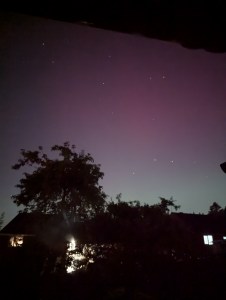
The aurora borealis was visible even in the city
I travelled to Leiden during half term to explore my ancestors who fled to, and then from, the Netherlands. I learned a great deal about the wool weaving industry and improved my spoken Dutch somewhat.

The Weaverhuis Museum, Leiden
After my break, I returned to work, teaching and visiting schools which occupied most of my days. I can sometimes pick out a special view on my travels and a couple of these are below. It is so convenient to carry around a camera in your pocket, always ready to snap a beautiful and memorable view, wherever you happen to be.

Historic Friar Street in Worcester
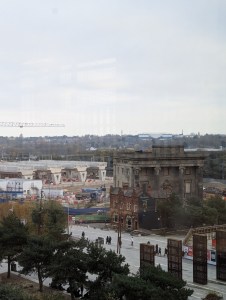
HS2 taking shape, with the historic Curzon Street Station to the left of it
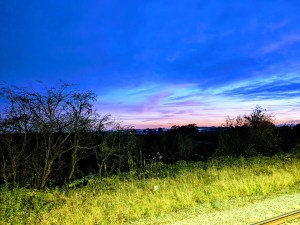
Spectacular sunset seen from Worcestershire Parkway station
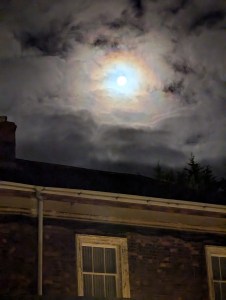
The winter morning moon over Worcester Shrub Hill Station
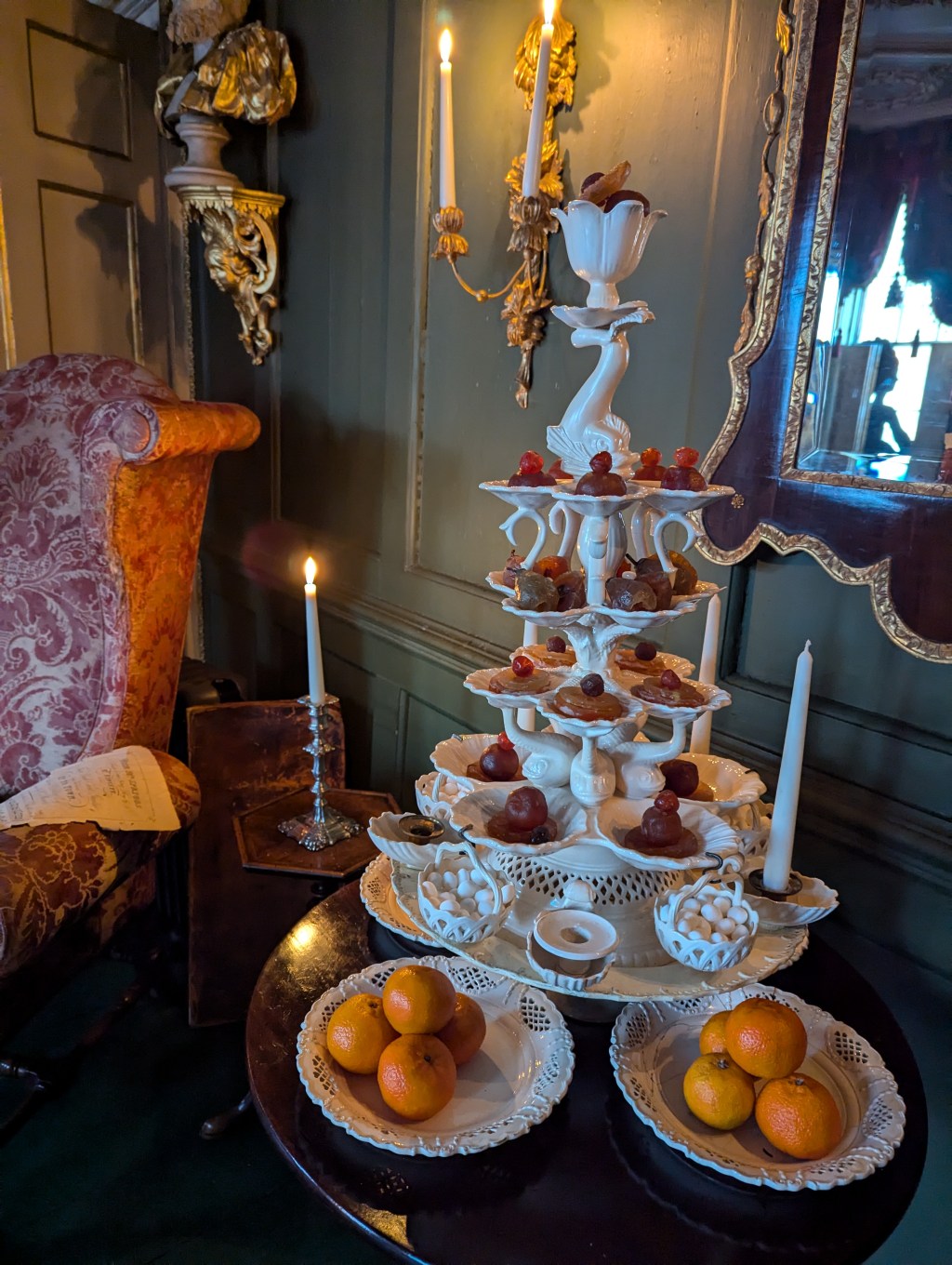
November rolled into December and the first snow fell. Theatrical highlights included The Ungodly at the Southwark Playhouse, The Forsyte Saga at the Park Theatre and the wonderfully festive A Christmas Carol at The Old Vic. I supercharged my festive spirit by visiting Dennis Severs’ House and the Charles Dickens Museum in Doughty Street which were both dressed for Christmas. The former is delicately lit by candlelight and real fires which adds to the authenticity of the experience, even though, as a visitor, you move through the imaginings of Dennis Severs and the fictional Jervis family.

Dennis Severs’ House dressed for Christmas

Charles Dickens Museum dressed for Christmas
The year is now rolling towards its end and I raise a glass to all of my friends, family, readers and acquaintances. Wishing you a very Merry Christmas and a Happy New Year. Here’s to 2025 and all of the adventures that lie ahead.
More information
Vale Wildlife Hospital – https://www.valewildlife.org.uk/
Cuan Wildlife Rescue – https://cuanwildliferescue.org.uk/
West Midlands Police Museum – https://museum.west-midlands.police.uk/
Regent’s Park Open Air Theatre – https://openairtheatre.com/
Southwark Playhouse – https://southwarkplayhouse.co.uk/
The Old Vic Theatre – https://www.oldvictheatre.com/
English Heritage Witley Court – https://www.english-heritage.org.uk/visit/places/witley-court-and-gardens/
Worcester City Museum and Art Gallery – https://www.museumsworcestershire.org.uk/museums/worcester-city-art-gallery-museum/
Dennis Severs’ House – https://www.dennissevershouse.co.uk/
Charles Dickens Museum – https://dickensmuseum.com/
Open City Open House Festival – https://open-city.org.uk/open-house-festival
All photographs by the author

