
By Christine Swan
I thought long and hard about whether to post this article. In a week of zoo-focused controversy, where a Danish zoo have requested pets for their carnivores to consume, and the Born Free Foundation, quite rightly have questioned the wisdom of keeping great apes in captivity, as there is no doubt that it isn’t a natural habitat. I was told by a keeper that “bored is good, because it means that the animal is relaxed.” I’m not sure that I agree. I don’t think a leaf cutter ant colony are that bothered that they are being scrutinised and photographed several times a day, nor the spider in a comparatively huge enclosure, free to spin its webs above people’s heads.
To see an animal in its natural habitat is an absolute privilege. If we can’t do that, there are wonderful videos that show us life from the bottom of the sea, to the top of the mountains. Do I need to see it live, in a box?
I haven’t edited the article since I wrote it, but did decide to post it. I invite debate about the place of zoos in twenty-first century cities but I do agree that conditions are improved from my previous visits many years ago.
When I was a university student studying in London, I had a free pass to visit London Zoo to assist me with my studies. I remember attending a lecture there. However, I’m not sure how I feel about zoos. I decided to take a trip to see how I feel now and whether the benefits of conservation and breeding programmes outweighs the fact that these are captive animals, even if they were born in this condition.
The weather was beautiful and although there was a queue to enter, it cleared very quickly. My Bee-vive keyring drew some attention from the bag-checking man. I explained the idea that you can save a “downed” bee by giving it sugar water and that the little vial allows you to provide bee first aid on the go.
I walked past the bronze statue of Guy the gorilla and stopped in my tracks. I was transported back to being a small child and walking through those same gates, excited to see the animals, and especially their most famous gorilla. Even then, I think I recognised that these majestic animals, that are so closely related to us, should not be kept in small spaces to be ogled at. This was also the era when London Zoo hosted polar bears. Poor Guy, he was a magnificent animal. I bought a postcard of him when I visited as a child, I can picture it now.
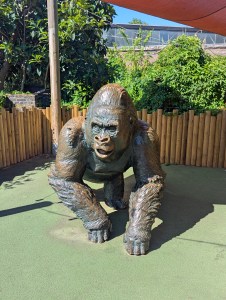
Guy the Gorilla
As a contrast, my next stop was the David Attenborough Komodo Dragon House. I cannot think of a less friendly, and less-like-us creature than a komodo dragon. They strut around being venomous and biting things but looking rather awesome. Fortunately, this one was exceedingly photogenic and posed beautifully.
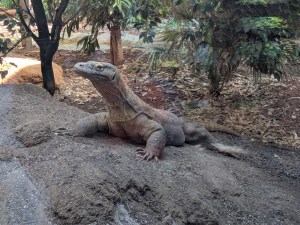
Komodo Dragon – it doesn’t look real does it? I can assure you that it was!
I did visit the gorillas who have a much improved accommodation area from poor old Guy. An adult female looked proudly at me through the glass. Our eyes met, and then she looked away. What was going through her mind? What did she see as she sat serenely, while the little ones played nearby?

I tried so hard to connect with the female gorilla but she didn’t seem as keen as I was
On this hot day, the tigers were nowhere to be seen. I’m sure that they were relaxing somewhere shady and a little more cool. In their enclosure, there were lots of places to lie down, or hide, thinking which of the gawping humans might be the most tasty…….

This grey heron wasn’t one of the exhibits as such, but he seemed very friendly
My next stop was the reptile and amphibian house which contained a good selection of venomous and non-venomous inhabitants. I enjoyed watching the chameleon picking its way along a branch, resplendent in bright colours, and the tiny poison dart frog in royal blue livery.
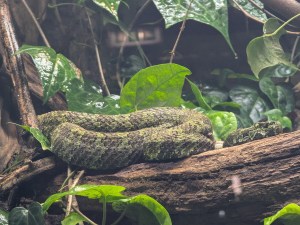
Mangshan Pit Viper
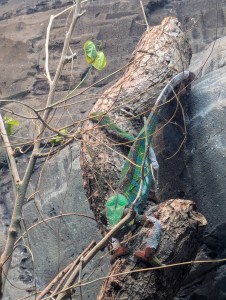
A stunningly coloured Chameleon, slightly obscured by branches
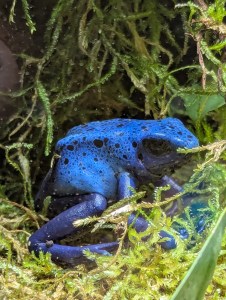
Dyeing Poison Dart Frog

Emerald Tree Boa
The London Zoo penguins now have a magnificent beach and pool area to swim and waddle about in. I was quite shocked to compare this with the original, now listed, penguin enclosure, which was tiny in comparison. Watching the Humboldt penguins swimming with such speed and grace under the water, was mesmerising. After watching them for a while, I visited the mock African village that houses the lions. A male lion was lazily chomping on a piece of meat, oblivious of onlookers. He was in shade but I was in blazing sunlight, so I decided to retreat into the critter house.
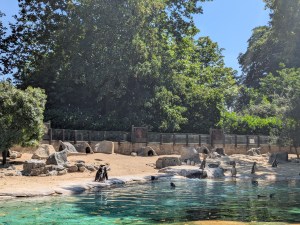
Penguin Beach on a hot day

Clumsy on land but effortless in the water – a Humboldt Penguin
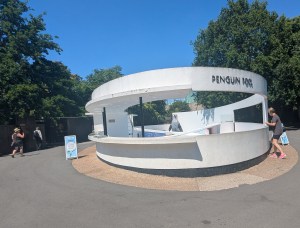
I had forgotten how small the original Penguin Pool was
There were a number of spider exhibits, including a talking spider, who explained the benefits and usefulness of our eight legged, multi-eyed friends. I believe in live and let live and would never deliberately harm any spider, but, I can’t quite bring myself to love them (sorry spiders). I noticed that there were fewer visitors in this area and even less in the walk-through golden orb web spider exhibit. In fact, apart from the keeper, I was alone. There is something just a little unsettling to look up, and see spiders over your head, at your side, in front of you and behind. Their webs are beautiful but they’re not terribly friendly. “Are they venomous?” I enquired of the keeper. “But of course, all spiders are venomous! The bite from these is a bit like a wasp sting.” I made my excuses and put some distance between myself and these particular arachnids.

Spiders – everywhere you look
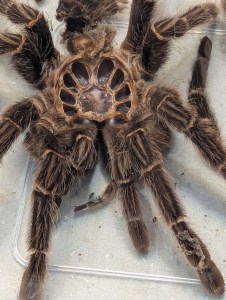
Not dead, just outgrown. A discarded tarantula carapace
Spider carapaces, leaf cutting ants, scorpions in darkly lit enclosures, and enormous bird eating tarantulas, made me feel a little creepy-crawlied out, and seeking animals with a more friendly face, fewer legs, and just two eyes.

Hidden in the trees – until he started squawking! A Black-Capped Squirrel Monkey and his orange
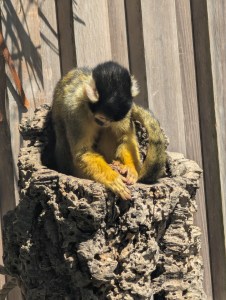
There’s definitely more fruit in here somewhere
The black-capped squirrel monkey walk through area was quite charming. There were not many visitors here either but I don’t think that this was because the tiny primates were not appealing. In the trees, they are well camouflaged but they have additional feeding areas where they can be better seen. This species was previously much exploited by humans because of its small size. I can remember squirrel monkeys being used to lure children to be photographed with them at seaside resorts. The environment of London Zoo is also not their natural habitat but the keeper explained that enclosures were designed to be approximately the same size as their natural territory. The animals certainly appeared relaxed and were more intent on finding food than looking at the humans gawping at them.

In the tunnel I saw this incredibly photograph of a small child photographed with a Komodo Dragon in 1913. The Health and Safety issues here are quite astounding.
I walked through the tunnel to the northern part of the zoo complex. The tropical house was stiflingly hot and humid. A Golden Lion Tamarin looked down on me from a lofty perch. A fruit bat groomed its leathery wings occasionally glancing over at people walking past. On the ground level, more Tamarinds were resting while industrious, scampering mice, ran across their meal of fruit pieces.
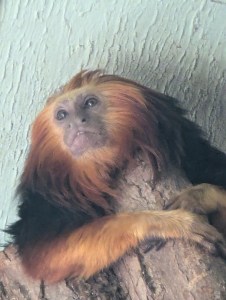
A Golden Lion Tamarin surveys from on high
The nocturnal area is my favourite part of the entire place. It always was but I was pleased that enclosures here seemed larger than I remember. If this is my favourite area, then my favourite animal of all is the Sumatran Bush Baby. These delightful creatures hop, skip and jump about on their back legs, twitching their ears and constantly alert. Their huge eyes and ears scan for tiny movements. their hand-like paws grip on small branches right side up, then upside down, with equal ease. Then, with a leap, they jump off into the darkness. I adore them!
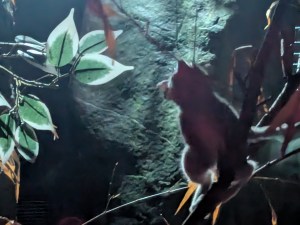
A Sumatran Bush Baby caught in a rare moment of stillness

Those big eyes – adorable!

A Pygmy Slow Loris takes an afternoon nap. Suprisingly, a venomous primate!
The ring-tailed lemurs were also feeling the heat. Initially, I was unable to see them but then I found a large huddle, slumped in a wooden shelter, feeling the heat and deciding that the best thing to do, was nothing.
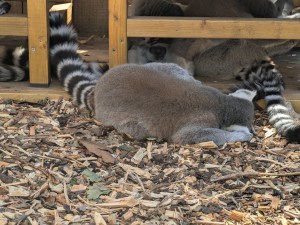
The best way to spend a hot afternoon – these Ring Tailed Lemurs have the right idea

Quite!
I walked to the large animal enclosure but the afternoon was wearing on, and I had to return to my hotel ready to attend the Regent’s Park Open Air Theatre that evening. Walking back through Regent’s Park, I considered my day. It’s such a privilege to see these wonderful creatures up close but should they be there? The zoo was very busy with families. Children were asking questions, observing the animals and excited to see them in real life – rather than from the other side of a screen. There have been numerous improvements in habitats and space. All of the animals that I saw, seemed relaxed and yet I am still conflicted.
All photographs by the author
More information
London Zoo – https://www.londonzoo.org/

