
By Christine Swan
The Gaffe family have proved to be a bit of an enigma for me I am fairly certain that Claude Gaffe was born in France but, despite subscribing to, and searching, a French ancestry site, I am no nearer to solving the puzzle. When Claude died in Canterbury in 1718, his burial record uses the name Claudius. To add further intrigue, Claude’s late wife, Judith du Hamel, I believe was born in the Dutch city of Leiden. When I searched Dutch ancestry records, Claude did not appear to be very popular forename, however, when I searched for Claudius, this returned a huge number of results, but sadly not a Gaffe, or variant thereof.
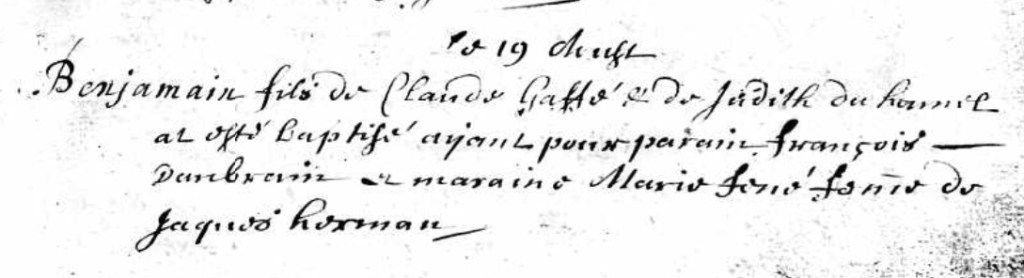
The baptism of Benjamin Gaffe in 1688, in St Alphage, Canterbury
Claude and Judith’s son, Benjamin interests me greatly. He was born in August 1688, and baptised in the Huguenot church in Canterbury. Witnesses were a maternal uncle and Marie Ferre – a member of the family that Benjamin would eventually marry into. He was one of nine children that I have discovered. He married Susanna Ferre in 1712. The couple had five children while living in Canterbury but then moved to Bethnal Green. I have previously described how I used Benjamin’s last will and testament to discern a little more about the family. For example, I know that Benjamin was living in what is now Fleet Street Hill. Unfortunately, this part of Bethnal Green has been completely bisected by the railway but has become a graffiti art outdoor exhibition space. There are no buildings remaining whatsoever so to begin to get a feel for the domain of the Spitalfields silk weaver. I believe that Benjamin and his family moved to London in the 1730s, during the reign of George II. This was also the era when Irish weavers arrived in London having escaped the decline of linen weaving trade.
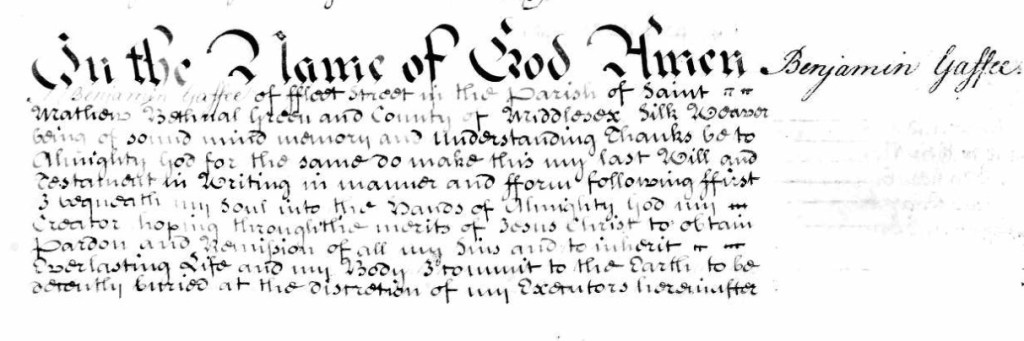
The first section of Benjamin Gaffe’s last will and testament
Benjamin appears to have been successful enough to be able to provide for his family, even after his death. As I mentioned in my previous post about the Gaffes, before his own demise, Benjamin had lost two of his sons in early adulthood – Benjamin junior and John. John was my seventh great grandfather, and the father of Esther Gaffe who married into the Deighton family.
Descendents of Huguenots who wished to make a financial claim from the French church poor relief fund, needed to prove their heritage by providing documentary evidence. I have discovered claims from the late nineteenth century and as late as 1920, from people claiming kin with Benjamin Gaffe and, his father Claude – in one case, listed as Claudius. One claimant stated that Claude fled France in 1685 – a very precise date. This was the year of the revocation of the Edict of Nantes, spelling the end of religious tolerance towards the Huguenots, and a catalyst for so many to leave. How could this claimant have possibly known that Claude arrived in England at least fifteen years prior to this? The simple answer is that they could not and probably gave a date which was well-known.
One claimant was another Benjamin Gaffe, a cordwainer who was going blind and also suffering from dementia. He was moved to Homerton Infirmary, where he died. He had apparently indicated that he wished to be buried there and his son, daughter, and some other inmates were permitted to attend. It seems that this Benjamin Gaffe had also returned to Canterbury, at least temporarily, to ply his trade, perhaps before returning to London. It seems that relatives from over one hundred years ago could still be useful in claiming poor relief.
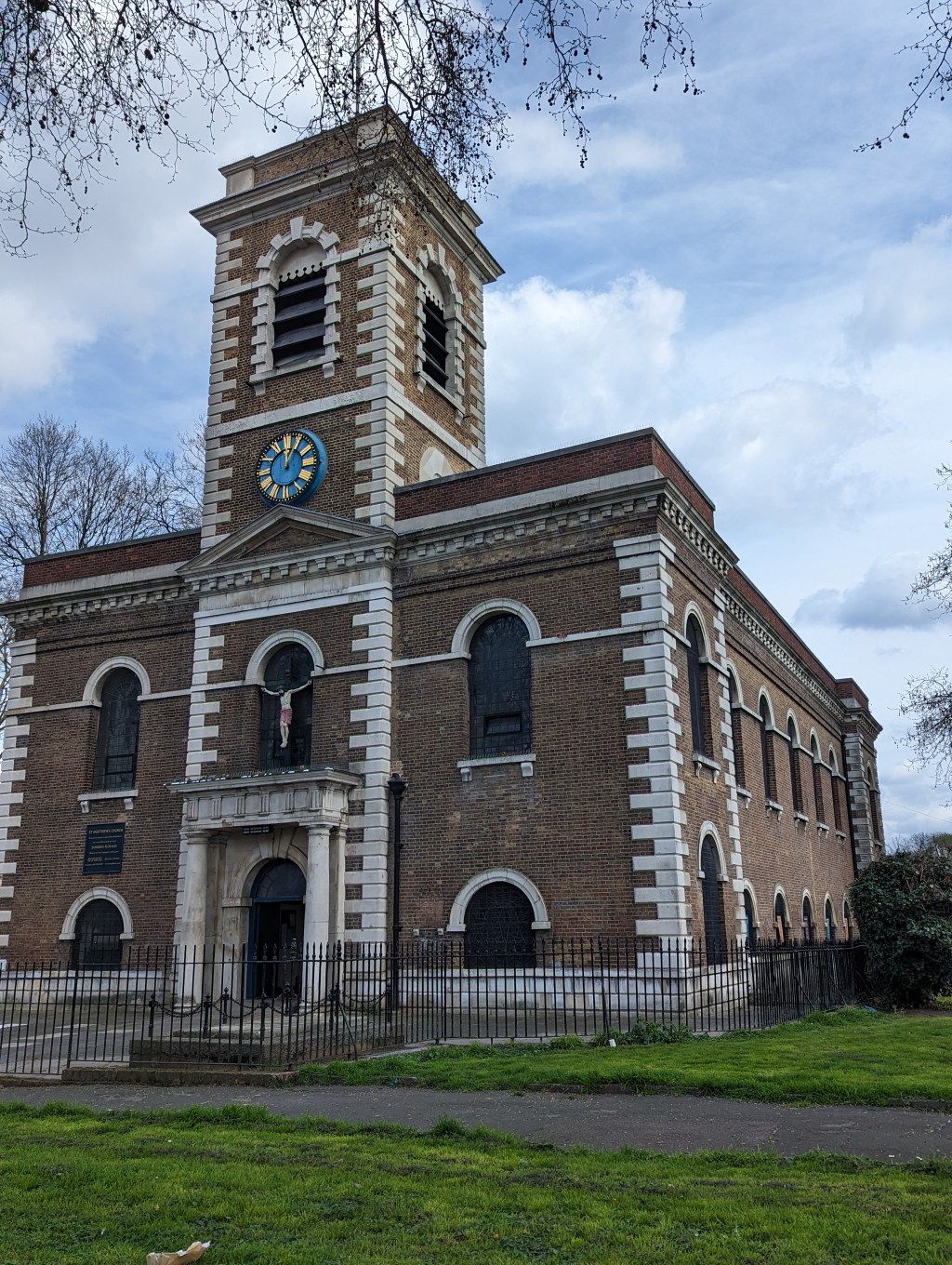
Benjamin Gaffe, my eighth great grandfather, wrote his last will and testament two years prior to his death, and was buried at St Matthews Church, Bethnal Green. In his will, he makes clear his affection and provision for his family, including grandchildren. After his death, England went to war with France and King George III became king. My link is via his granddaughter, Esther, who married Richard Deighton, and the family name of Gaffe was lost from this branch.
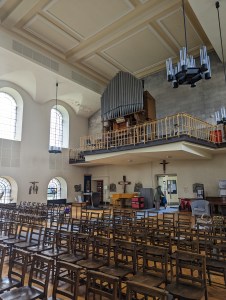
The modern interior of St Matthew’s Bethnal Green was installed after the original was damaged by a WWII bomb
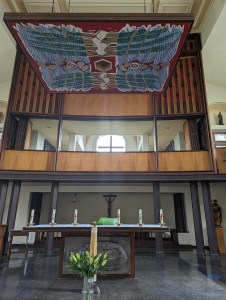
The modern altar
Perhaps because I cannot find a precise origin, this is the reason why the Gaffes intrigue me. There is always something more to discover and I will continue to do my best to try to discover it.

