

By Christine Swan
As I have discovered with other families, my Londoner roots did not begin there. On my maternal side, the name Apthorp has a long history. Up until a few years ago, the Apthorp Society celebrated all things Apthorp in all of its guises. With an ‘e’, or without, it was an interesting English name and rather a talking point. Or was it an English name? One suggestion was that ‘Ap’, which means ‘son of’ in Welsh, had its origins in times when warlords traded land for peace, and the ‘son of Thorp’ gradually took an anglicised form. Whatever the origin, there are not a lot about.
My London branch of the Apthorps worked as wheelwrights and coach smiths, shop keepers and billiard markers. My great great grandfather lived in the area of the infamous St Giles rookery and, my great grandfather, in Covent Garden, which was very different in the nineteenth century to how it is today. Visiting these areas in the twenty first century, we see the trappings of modern life – shops, restaurants, and the always-busy Oxford Street. The St Giles rookery was the site of Gin Lane, pictured in the famous Hogarth engraving of the same name. Covent Garden is now a bustling hub of designer shop, eateries and street entertainers, but was the haunt of prostitutes, their pimps, gambling and drinking dens, the haunt of criminals rather than tourist shoppers.

By William Hogarth – GinLane.jpg, Public Domain, https://commons.wikimedia.org/w/index.php?curid=3516658
William Henry Apthorp’s father was Henry Welch Apthorp. His middle name was the maiden name of his grandmother, Hannah Welch. This seemed to be a not uncommon practice, as my paternal great grandfather frequently used Dighton as both a surname and also a middle name. Perhaps the Welchs had only daughters so adding their surname preserved it and allowed it to be passed on to the next generation. Henry Welch was born in the Cambridgeshire town of St Ives in 1771. He was not the first Henry Welch Apthorp as it was a name that he shared the name with his father, and a brother, who had been born four years earlier, but had not lived to see two years. In 1769, the Welch Apthorps actually lost two sons, Henry and Jonathan.

The bridge over the Great Ouse, with its chapel – St Ives, Cambridgeshire
The family lived in the Hurstingstone hundred of St Ives, which now is a modern housing estate, but would in the 1770s, have been farmland and possibly the village centre. The bridge across the Great Ouse river is old and interesting as it includes a small chapel. I found records that Henry was apprenticed as a butcher aged twelve but tragically, one year prior to this, his father drowned. Despite much searching, I have been unable to find a newspaper report of this event, so can only guess the circumstances. Was he attempting to drive cattle across the ford in a swollen river? Was he in a boat that capsized? I have only been able to locate an advertisement for the sale of the family property, including the Crown and Woolpack Inn, a slaughterhouse, and some other tenancies. It also wasn’t clear what would be the fate of his widow, Henry’s mother. However, by this point Henry had left home and was committed to the trade of butchery. St Ives was a stopping point for cattle being driven to the great London market of Smithfield. Henry Welch Apthorp would have known this, and indeed, he may have driven cattle himself.
At some point between 1783 and 1796, Henry Welch Apthorp moved to Smithfield permanently, the very centre of the London meat trade, and lived in Cow Cross, close to Smithfield Market. Smithfield has been a market since the Middle Ages and in Henry’s time, business was conducted in the open air. Cow Cross is a street name that indicates that it was on the route to market. In Henry Welch Apthorp’s day, it would have been chaotic, noisy, and smelly.
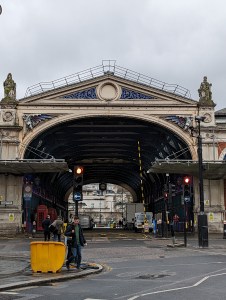
At Smithfield Market
In 1796, Henry married Sarah Cook at Saint Sepulchre Church, in Holborn, just a short walk from Cow Cross. The church stands just across the road from the courts of the Old Bailey, which was completed in 1795, one year before Henry’s marriage.
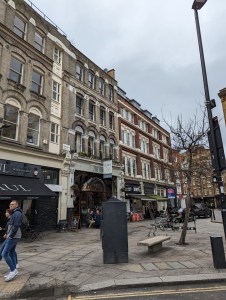
Cow Cross – now Cow Cross Street
Henry and Sarah’s first child, also Henry, was born one year later, but sadly, he did not survive a year. Their second child, Fanny, did survive to adulthood and married Francis Lynch in Christchurch Newgate. William Henry was born in 1803, and was my second great grandfather. He became a coach smith and wheelwright.

Henry William Apthorp’s baptism record
Henry Welch Apthorp died in 1807 aged just thirty-six, although the burial record states that he was thirty-four. His address was given as Sharp’s Alley, which was a turning off from Cow Cross that was a centre for the cat gut industry. It would have been a smelly and unclean place to anyone visiting but the area was cleared to develop Charterhouse Street and later, the Farringdon railway line.

Henry Welch Apthorp burial record 1807
As happens so often, I walk the streets of London in the shadow of my forebears and only later learn of how my and their stories interconnect. Smithfield is a very different place today, and will be yet again when the market eventually closes. I wonder what Henry Welch Apthorp would make of it all?

Around the Charterhouse area
More information
The Norris Museum, St Ives, Cambridgeshire – https://www.norrismuseum.org.uk/

