

By Christine Swan
In April 2025, I decided to explore one branch of my Huguenot and Walloon ancestors by travelling to Lille in Northern France. This is a very easy journey from London St Pancras, taking just over eighty minutes. I had read some less than positive reviews of the area that I chosen to stay but, I’d like to dispel these here. My budget hotel was perfectly placed, very welcoming and interested in my quest and reason for exploring the region.
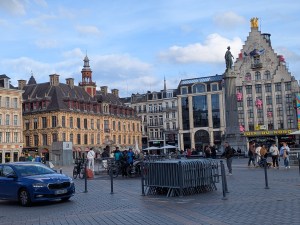
Lille was a very interesting city for my stay
After I had dropped off my bag at the hotel, I immediately went straight out to visit Tourcoing, a suburb of Lille, with a strong history of weaving and textiles production. Yet again the reviews had been underwhelmed but, in my experience, and with my motivation, it was a very positive trip. Tourcoing is well-served by the rail network and has a history trail to explore buildings associated with its industrial past. It also has a beautiful park with botanical gardens. There are many historic buildings to appreciate as well as excellent cafes to stop at on your wandering.

It was lunchtime when I arrived in Tourcoing, so it was very quiet

Tourcoing’s civic architecture matches that of Lille’s in terms of grandeur
Lille is very beautiful with museums and historic areas, magnificent baroque buildings, parks, forts, and interesting shopping areas and eateries. I discovered that, far from being a passively persecuted minority, some radical Protestant groups, conducted raids and ransacked the city which I had not been aware of. Lille is situated on the border between the Flemish and French peoples. It has existed under the rule of various Duchies, Kingdoms, and regimes: German, Spanish, French, German, and then French again. It has been besieged several times in its rich history.
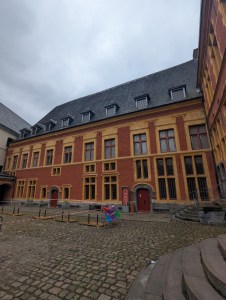
The Museum of l’Hospice Comtesse in Lille is well worth a visit
Lille was a fantastic place to visit with so much history to explore – especially if, as I do, you have ancestral links there. However, in my short stay, I wanted to squeeze in one more trip – to the town of Valenciennes. This is another part of my ancestral picture. Valenciennes also has a history rich in textiles. It is particularly noted for lace production. There are many remnants of its past, including fortifications and some of the oldest houses in the Beguinage – essentially almhouses for women, usually widows, who may have been lacemakers.
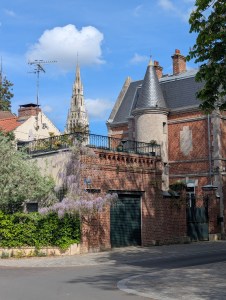
Valenciennes oozes history and has many surprises. It was not at all busy when I visited last spring ao is a great place for peaceful wanderings.
I don’t think that I would have visited Valenciennes, or Tourcoing, had it not been for family history research. My trip exceeded my expectations and reinforced the philosophy of just getting out there and exploring. I returned from my trip feeling better informed but also with a strong sense that I had yet again, walked in the footsteps of my ancestors, and had paid my respects. I do have roots in France – exploring them is my privilege.

La Tour de Dodenne was part of the original city’s fortifications
Later in April, I visited Leighton House and Sambourne House, both of which are under the stewardship of the Royal Borough of Kensington and Chelsea. A discount on entry is offered for visitors of both properties. Leighton House is an exotic dream, and was the home of Lord Frederick Leighton, artist. The house is astounding, and the Arab Hall, astounding. Stepping in from leafy Holland Park, visitors are transported into his vision, and every photograph that I took with my humble smartphone camera, a masterpiece of composition.
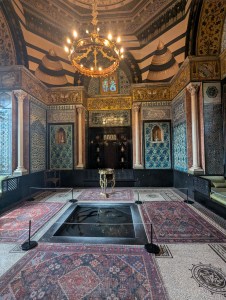
The Arab Hall in Leighton House is stunning
Just a short walk away is Sambourne House, the former home of Punch cartoonist, Linley Sambourne. This is a quite different vision to Leighton’s but no less impressive. The house is decorated most prominently with the designs of William Morris. Each room was, for me, a showcase of design. I adored the richness and simultaneous cosiness of each room. I found small aspects of practical features that I could consider deploying in my own period property. It was quite incredible to remember that the house had not been decorated since Sambourne’s occupation, which lends an air of authenticity not always seen. Rather than looking at a modern Morris catalogue of designs on a website, or a wallpaper pattern book, here it was. Not a modern reimagining, but an original installation. I emerged into spring sunshine inspired!
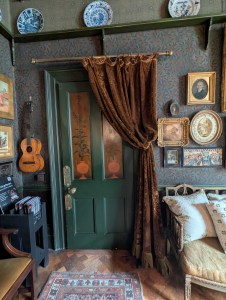
Sambourne House is a cosy inspiration
May brought more good weather although when I visited the Shelsey Walsh Hill Climb, the wind was rather chilly and the weather showery. Another trip to London allowed me to revisit my university days in Chelsea and South Kensington, including a visit to the Victoria and Albert Museum. I also visited Witley Court and Church, the latter with its incredible baroque ceiling paintings, but the weather had turned chilly again by the time I visited Harvington Hall.

The entrance to the Victoria and Albert Museum, South Kensington

In the orangery at Witley Court

The breathtaking baroque interior of Great Witley Church

The kitchen in Harvington Hall
I explored Camberwell at the end of May, in glorious weather once again. I intended to locate some houses that had been occupied by ancestors but, I always find myself overcome with awkwardness when I try to photograph them. I’m not sure if I am perceived as an estate agent’s photographer, a potential burglar casing the joint, or a curious and bizarre tourist. I attempted to gather the reminders that I needed without intruding although I do visualise current owners finding my blog and being bemused. I also called into the library and information centre in the Elephant and Castle, who were unable to assist me with my enquiries, but did recommend that I access the history centre in Borough High Street, which is on my list for 2026.
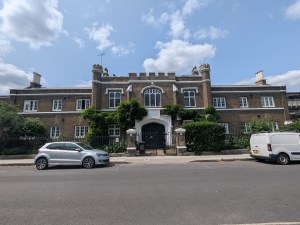
The Aged Pilgrims’ Asylum, Sedgemoor Place, Camberwell
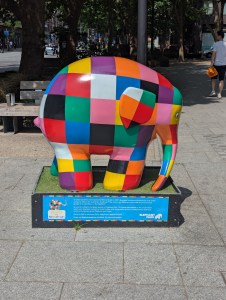
Elmer in Elephant and Castle
My trip to London in mid-June was very hot. However, I remembered from a previous visit that the Guildhall Art Gallery had impressive air conditioning, probably for the benefit of the paintings, but I could profit from it too on so hot a day. It was a wonderful relief from the stifling heat of the concrete jungle outside. When I ventured out into the afternoon sun, which was still baking the pavements, a group of Spanish tourists were taking a short stop outside of the Guildhall. Some were waving fans and guzzling from bottles of water, all were trying to stand in a small patch of shade. They may have heard that it rains a great deal in England and perhaps were not expecting Mediterranean heat in EC2!
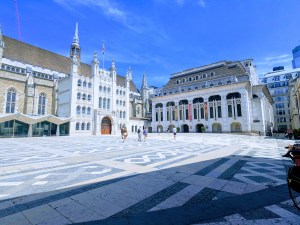
The Guildhall Art Gallery is a good choice on a stiflingly hot day
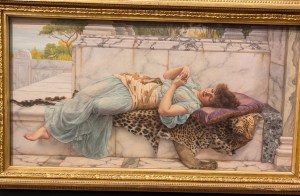
James William Godward’s The Betrothed. On this hot afternoon, even I felt like a lie down!
This concludes my reflection on last spring. I have spent some of the current week planning future trips into spring 2026. I still have many ancestral paths to travel, both in the UK and also in northern Europe. My New Year’s Resolution is to continue exploring – the unexpected, the revisited, and the familiar, all lie in wait. I am ready for this year’s adventures and very much hope that you will enjoy following them.
More information
Lille Office of Tourism – https://en.lilletourism.com/
Tourcoing Tourism (in French) – https://www.tourcoing-tourisme.com/cat_art.asp?rubrique=architecture&categ=2
Textile heritage walk around Tourcoing – chrome-extension://efaidnbmnnnibpcajpcglclefindmkaj/https://www.tourcoing-tourisme.com/brochure/PLAN%20PATRIM%20INDUSTRIEL%202016%20MEL%20.pdf
Valenciennes tourism – https://www.tourismevalenciennes.fr/en/
Leighton House and Sambourne House – https://www.rbkc.gov.uk/museums/
Shelsey Walsh Hill Climb – https://www.shelsleywalsh.com/
English Heritage Witley Court and Gardens – https://www.english-heritage.org.uk/visit/places/witley-court-and-gardens/
Great Witley Church – https://www.greatwitleychurch.org.uk/
Harvington Hall – https://harvingtonhall.co.uk/
The Victoria and Albert Museum South Kensington – https://www.vam.ac.uk/south-kensington
Guildhall Art Gallery – https://www.cityoflondon.gov.uk/things-to-do/attractions-museums-entertainment/guildhall-art-gallery

