
By Christine Swan
A week ago on Monday was, allegedly, the most depressing day of the year. Christmas and New Year are now distant memories, and summer days are a long way into the future. It’s easy to feel bleak and hopeless at this time of year but that’s not in my nature. Instead, I choose to count my blessings and to focus on all of the good things that I enjoy and feel thankful for.
Sunny days will soon be here again
Despite how it may seem, it does not rain every day. It was raining yesterday but today, for a large part of the day, the sun shone. As I walked home, I could feel the gentle heat of its warm glow, and the blue skies definitely lifted my mood. Even if it rains tomorrow, I know that the sun will be around for longer soon and the days are gradually becoming longer. I love sunny days ands warmer temperatures. Even colder days are more tolerable when the sun shines.
Chilly Worcestershire sunset
My afternoon walk took me past our local independent bakers. I know that we should all strive to resist sugary, chocolatey, delicious cake, but not can’t. I don’t eat it every day, and, during the working week, daytime food is unevenly spaced, and often eaten on the hoof. What a great luxury it is to sit down at the end of the day, with a pot of steaming tea and a slice of cake. I can hear cardiologists chiding me and wagging their fingers but, honestly, is there anything better? I would argue ” No”.
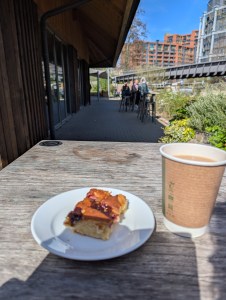
Tea, cake, sunshine – perfection
Another of my favourite things is being warm on a cold day. Although I have a central heating system, it is expensive to run and, in some rooms, has insufficient impact on the temperature. Three years ago, we decided to remove the gas fire that consumed a North Sea’s worth of gas and required an overdraft to pay the bill. We fitted a small log burner which instantly changed the climate in our living room. The first installation was minimal and didn’t permit sufficient airflow to gain maximum benefit. Last year, we decided to have the fireplace returned to its original footprint. The difference was striking. The cast iron firebox heats up to continue to radiate heat many hours after the glow of the final log of the night has dissolved into grey embers. With greater space around it, the fire worked far more efficiently, so we consume far less fuel. Being warm and cosy, with or without tea and cake, and even if the rest of the house is cold, is truly a great pleasure and definitely one of my favourite things
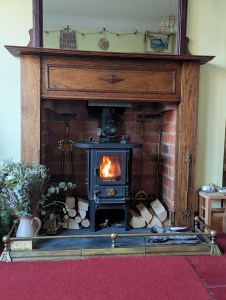
The remodelled fireplace
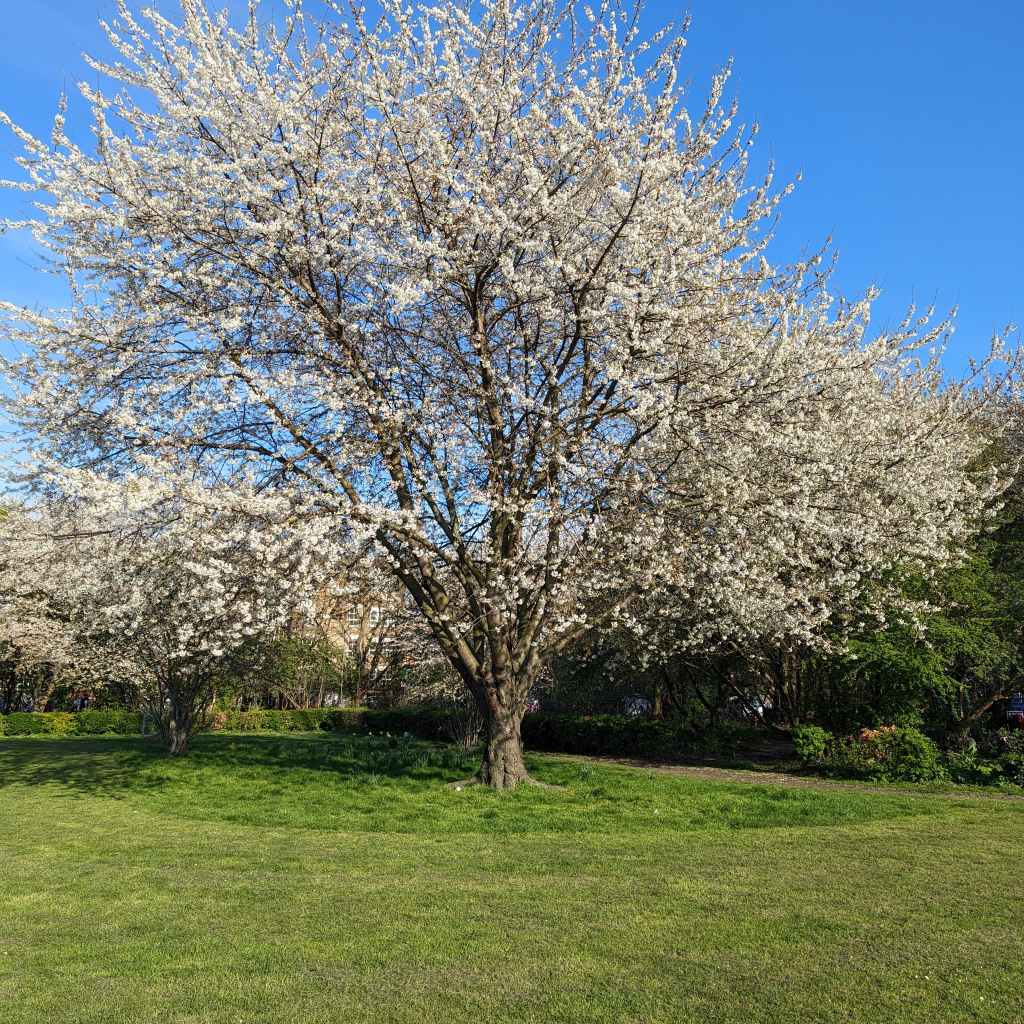
At this time of year, we are beginning to see the first signs of spring as brave snowdrops and snowflakes, push their green leaves and white buds through the frozen soil. They signify hope of better things ahead. I love to see spring bulbs appear. On my travels around the conurbation of Birmingham, or around London’s streets, it delights me to see plants growing in the most unlikely places, securing a foothold for nature and letting humans see that she lives everywhere. London parks are a delight in springtime so the first green shoots are a preview of things to come. Different species overlap their flowering season to provide a succession of waves of colour – white, yellow, blue, pink and red, as snowdrops give way to crocuses, daffodils and narcissus, muscari, chionodoxa, hyacinths, tulips and bluebells. Flowers lighten our mood and are a delight to the senses and a definite favourite of mine.

Tulip mania in Holland Park
Recently, I have been working far too many hours and feeling rather flat. The weather is cold and grey and I have more work than I can reasonably do in a millennium. Every day sees more tasks to be done with short deadlines, which leaves me feeling irritable and snappy. I cannot catch up, I have no time for myself, and I feel as if getting it all done is something that other people do with ease, but I fail at constantly.
So, I pick up my sports bag, and head off to my Kung Fu class. No matter how negative or stressed I feel, even if I resent the time I am giving up, when I feel that I should be working, I go to Kung Fu regardless. During the following couple of hours, a transformation occurs. I forget about work. My gnawing worries melt away. I only focus on here, and now.

Wing Chun Kung Fu is my stress relief
Practicing Wing Chun Kung Fu has been a vital part of my stress management strategy. It’s hard to have pent up anger when you are hitting or kicking a pad. The precise movements of the forms require intense focus. Techniques are practised on the left and then the right. Control of body and mind affects my mood, and no matter how I felt an hour ago, I feel serene and relaxed. I am in control. Everything else can be chaos, but somehow, it matters less. I wouldn’t stop practicing Kung Fu for all of the tea in China. Or tea, with cake.
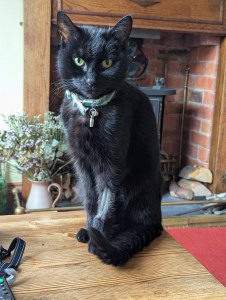
I couldn’t be without a cat
I have always had cats. People reliably tell me that they don’t bond with humans – only dogs do that. I think this is poppycock. I am thoroughly enjoying David Baddiel’s excellent Channel 4 series “Cat Man” as he is definitely of the same mind as me. Cats are one of my favourite things. Pictured is Simba, who has featured in a previous post.
Simba was very poorly just before Christmas. The vet diagnosed Chronic Kidney Disease, Stage 4, the worst kind. We brought her home to die over Christmas, or so we believed. Our hearts were broken. I slept downstairs with her all over the festive period. Christmas happened, but I didn’t want to celebrate. Simba was my late daughter’s cat. If losing a pet could be more painful, then this was the worst.
But, like Tiny Tim in Dickens’ Christmas Carol, Simba did not die. Although she still bears the bald patches from her emergency treatment, she is getting stronger every day. She is not an old cat and we hope that we have many more days together, although, every day is a gift, and something to be joyful for.
Hope is my favourite thing. Without it, we are lost. Even when things appear bleak, hold fast to hope. It lives in the smallest places, but if you believe in it, it can be as strong as a lion. When we named Simba, on Suzi’s insistence, we had no idea how she would live up to her name.

