By Christine Swan
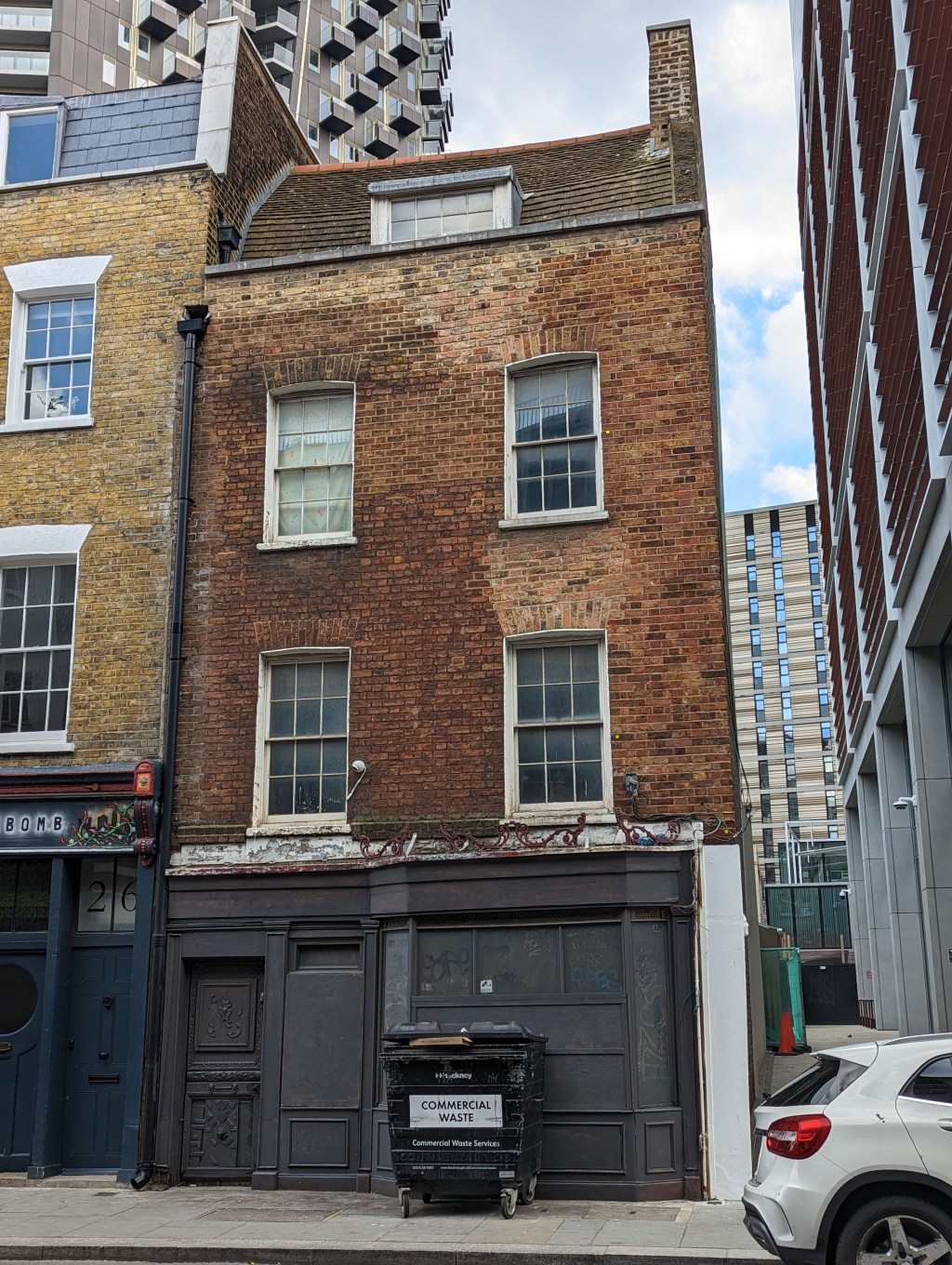
There is a little house in Curtain Road, Shoreditch, that I walk past every time I visit. Much like Ebenezer Scrooge’s house, it appears as if it ran up Curtain Road as a little house, and couldn’t find its way out again amongst the maze of luxury apartment blocks and offices.
Now that it is a very old house, it is Grade II listed, and stands but a few yards away from an Elizabethan theatre, where Shakespeare’s plays would have been performed. A new visitors’ centre will undoubtedly bring more people to walk past the little eighteenth century house, but they will not know everything of its history.
In my quest to visit places where my forebears lived, I have become accustomed to disappointment. Streets have been renamed, buildings demolished, and areas changed beyond all recognition by bulldozers, wrecking balls and overenthusiastic town planners. But, the little house in Curtain Road has become my touchstone.
I knew very little about my great, great grandmother, Mary Ann Deighton, who proudly bore her mother’s name, never to reveal her father’s. She lived in the little house in Curtain Road, Shoreditch, at least for a time, and I believe that my great grandfather, David Deighton Taylor, was born there. His year of birth fluctuated between 1867 to 1870, I believe, in an attempt to demonstrate legitimacy.
In 1868, Mary Ann Deighton was living in Curtain Road when she married William English. She claimed that her father was a John Deighton, which I believe is not true. Deighton was her mother’s maiden name. She was born about two years before her mother married Daniel Crudgington in 1844. Although she was baptised as a Crudgington, she married young to become a Brown, but then reverted to the use of Deighton.
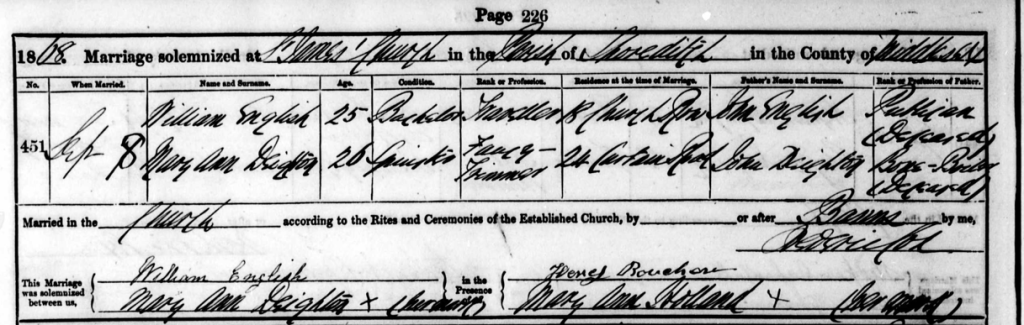
Mary Ann Deighton married William English in 1868
It is a recurrent theme in my Victorian ancestors’ lives, that names were temporary and that you could pick whichever is most convenient at the time, to avoid the rent man, the law, or domestic strife. But maybe it was also to establish your identity – the fact that Mary Ann was using her mother’s name has meaning to me.
Mary Ann married William English in St James, Curtain Road, which stood almost opposite the little house. John Thomas English was born in June 1869, and baptised in St Leonard’s Church, Shoreditch. This imposing church would have stood at the end of the road where the English household lived at the time – then William Street, now Rivington Street. John’s father, William, was a butcher, the trade that he had brought with him from Suffolk.
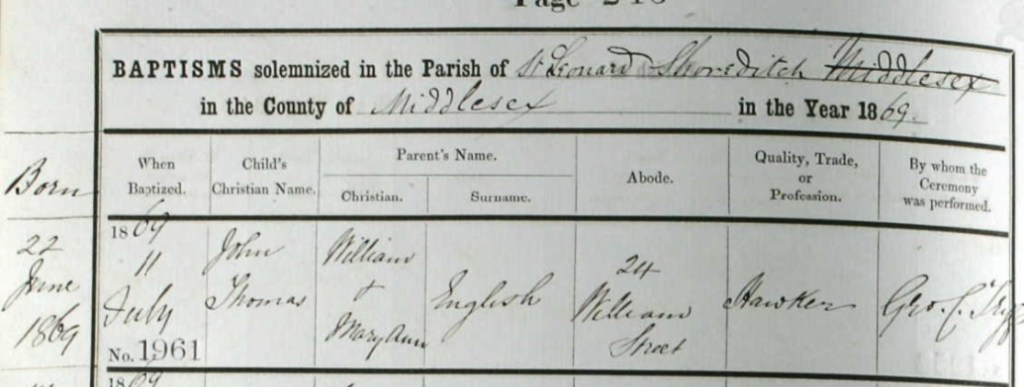
John Thomas English born in June 1869
In 1871, the English family were living in Henrietta Street, off Hackney Road, just along from the now-disappeared, Cordwainers’ Arms pub. The only remaining chunk of what was Henrietta Street, is Allgood Street. At the time of the census, John was one year old, David was four, and older half-brother William, ten. Their half-sister, Elizabeth, who would have been approximately six, was not there at the time of the census, but may well have been living with them. At some point during the 1870s. William moved further north to Frampton Park Road, Hackney but this move enabled a change of career, and for him to keep a livery stable, as well as being a butcher. David became a cats’ meat vendor so maybe there was a link between stabling horses and despatching those no longer fit to work.
Sadly, Mary Ann died of Tuberculosis in 1878, aged just thirty six, when David was eleven years old and John only nine. In the 1881 census, David is listed below John, even though he was chronologically older, but, he was no longer using the name English, instead choosing to use his mother’s name. It is after this point that David enters the workhouse system, not to emerge until he was taken in by his grandfather, Daniel Crudgington.

Mary Ann Deighton died in 1878
I have already told Mary Ann and David’s stories, but what became of John, my great granduncle? I lost track of him in the 1891 census but, he appeared again in 1892 when he married Louisa Jane Lea at St John’s church in Waterloo Road. Neither of this witnesses were from the English family, although his father had also moved to Lambeth Walk, a short distance away. John was working as a carman, which would have been a popular occupation in that particular locality, as I had seen North of the River at Euston.
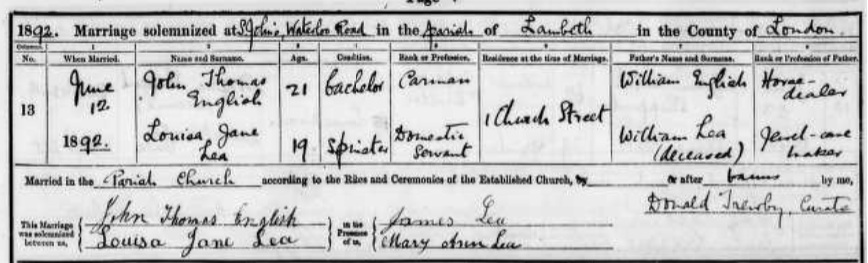
John Thomas English married Louise Jane Lea in 1892
Waterloo station’s history developed at a similar time, with increasing expansion during the nineteenth century. If they were still on good terms, William’s facility for keeping horses would have been very helpful to young John. His bride, Louisa, was employed as a domestic servant and was probably glad to escape to run a household of her own instead.
In 1892, the couple were living in Newport Street, Lambeth, which runs along parallel with the railway, with their baby daughter Edith, born just four months after the couple had married. Baby John joined them three years later, James the following year, and Henry three years after. Little Louisa came along in 1900. The family moved around the Lambeth area, never a huge distance from Waterloo, or from John’s father, William. It appears that John tried his hand at coopering as well being a carman – being flexible was probably a good option to maintain a steady stream of work.
In 1901, shows the English family living in Granby Buildings, a tenement block on Black Horse Road. By 1911, they had moved again, this time to Conroy Street, Nine Elms. Although this road no longer exists, I managed to locate the approximate area and could see that this new address still did not move them too far from the railway. The 1911 census provides a few more insights. John was still working as a carman but for an “emery works”. I discovered this to be the John Oakey and Sons Ltd. company works in Westminster Bridge Road. John Oakey invented sandpaper and manufactured a wide range of polishing and cleaning products. John most probably would have delivered products or raw materials, much in the same way as a white van deliverer might do today.
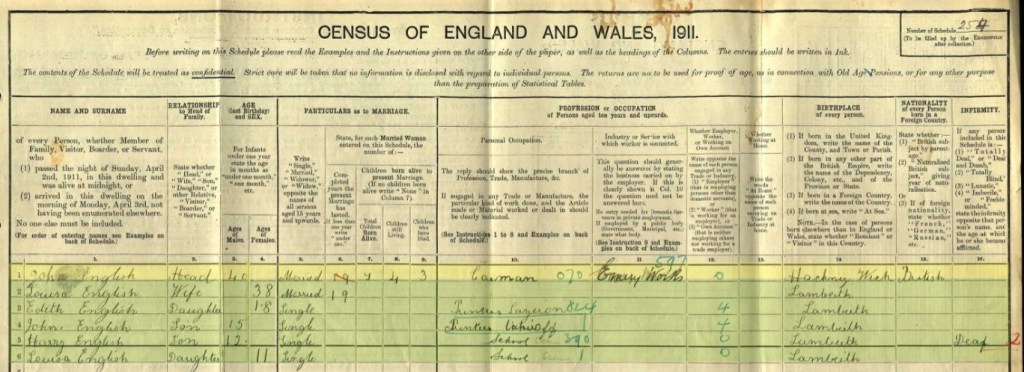
John Thomas English and family in 1911
The census shows that the couple had born seven children, but that only four had survived. Edith and John were both employed in the print industry. Perhaps they worked together as Edith was a “layer on” and John was employed as a “layer off”. The final insight was that Henry was a deaf child.
By 1921, just two children were still living at home – Louisa, 21, and Henry, 22. Louisa was working at the Sir Joseph Causton and sons Ltd. printworks in Clapham Road, and Henry was a bootmaker working from home. The family had moved once again, this time to Brooklands Street, Nine Elms. Here they stayed the longest, for about fifteen years in fact, before John and Louisa moved to Riverhall Street, just before John died in 1938.

