By Christine Swan
When I began to publish this blog, I made the decision to tell everybody’s story, despite how unremarkable they may appear. William was my great great grandfather, so I have a vested interest in his story, but, what is interesting from a social historian’s point of view is that I have a complete set of census records for him which provide a checkpoint for every ten years of his life.
This week, my husband attended a family funeral in Hadstock, just a few miles away in North Essex. The churchyard is full of his family, with a surname of various spellings, and he met with the school friends of his youth, who remained in the village for their entire lives. Such is the way sometimes, of tight-knit rural communities.
During the nineteenth century, horses were the mainstay of agriculture. For ploughing and transport, they were vital for heavy work in rural areas. As I have documented previously, my maternal grandmother’s family came from Helions Bumpstead, a small village close to Haverhill. Other members of her family lived in Castle Camps, a short distance away, but in the county of Cambridgeshire. Today, this remains a rural district, with wide open fields covering the landscape.
The Humphrey menfolk were agricultural labourers, and the women worked in trades and crafts such as making bonnets and clothing. In 1871, my great grandfather, Charles, and his wife Martha, were living with his father in law Stephen Malyon, in Helions Bumpstead. Just a few years later, Charles moved with the family, along with Stephen, closer to London – Walthamstow first, and then Leyton from about 1877. Upon researching the route, the family would most likely have travelled through Epping Forest and would not have passed through any major cities and would most likely have completed the forty-five mile journey by horse and cart. Stephen died in 1875, and was buried in Queen’s Road cemetery. At that time, Leyton was still quite a rural area.
As a tip for other amateur genealogists, prepare to be fluid in your acceptance of the spelling of a surname. My grandmother used Humphreys, but her father used Humphrey. His father used Humphry, and I have seen two different spellings on one marriage record – one from the curate, and one from the groom. As long as it sounded correct, it seems that phonetic spelling, of any combination, was accepted.
Charles’s father, William Humphrey, was born in 1828 and remained living on the Essex – Cambridgeshire border for his entire life. Researching Essex parish records, the same family names appear again and again. People were born, married and died all within a few square miles, and doubtless did not have the means to travel further afield.
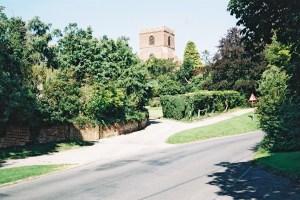
St Andrews Church, Helions Bumpstead
In 1841, William was thirteen years old and living with his parents, Thomas and Mary, and four other siblings, at Boarded Barn Farm. Although William was not listed as having an occupation, it is likely that he too worked as an agricultural labourer. I believe that the location is the current Board Barn Farm, on Camps Road. They lived with another family, the Mynotts, in the same location.
William married Mary Mizen in 1848 when he was twenty years old and his bride was nineteen. Mary’s occupation was a braider, which was a role carried out at home, weaving together straw to make a braid used for the manufacture of straw bonnets and hats. Charles, my great grandfather, was born in 1850, and in the 1851 census, Mary had graduated to the role of bonnet maker which would have provided a supplementary income to the family. Tragedy struck when in 1855, aged just twenty seven years, Mary died.
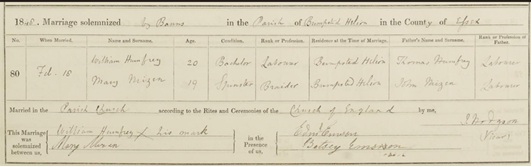
William Humphrey marries Mary Mizen in 1848
William was now widowed with two very young children but still needing to work. The 1861 census provided the solution that William found. His niece, Ann Mizen, was his eighteen year old housekeeper. Young Charles, now eleven years old, was also working as an agricultural labourer and William, for the first time, is listed as a horse keeper.

A horse keeper and a housekeeper in 1861
One year later, William found love again and married Rebecca Barber, one year his junior. Rebecca is listed as a spinster when she married aged thirty three, which would have been unusually late in the nineteenth century, The 1871 census provides an intriguing insight. Henry Barber is listed as William’s step son which implies that Henry was Rebecca’s illegitimate son. I have since confirmed this by locating Henry’s baptism record, with no father listed – only his mother. William and Rebecca also had four more children of their own- my great grandfather Charles’s half siblings.
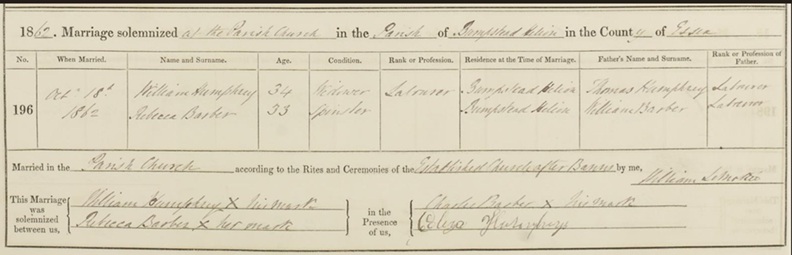
William marries again in 1862
One more child, daughter Edith, had arrived by 1881, and in 1891, the family appear to have moved closer to Castle Camps. The couple were living in a property with four rooms – relative luxury compared to the cramped conditions experienced by my London ancestors in the same census. They had one grandchild staying with them when the census was taken, little Ada, aged eight.
In 1901, William and Rebecca, now in their seventies, had moved into Castle Camps village. Aged seventy three, William was still listed as a “horse keeper of farm”. At this point, William would have been working with agricultural horses for forty years. These were most probably the gigantic shire horses, essential powerhouses of agricultural machinery, pulling heavy ploughs and other equipment. These gentle giants were William’s charges. I would like to believe that he understood them, cared for them – even loved them.
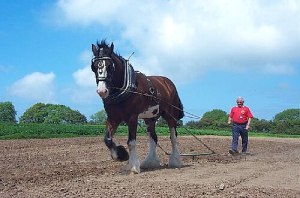
Shire horse By Garth Newton, CC BY-SA 2.0, https://commons.wikimedia.org/w/index.php?curid=9121987
William died in 1912, aged eighty four years, four years after his wife Rebecca. He was living in Linton but was buried in Castle Camps.
The Humphreys were very much part of the nineteenth century community of this little corner of the border between Essex, Suffolk and Cambridgeshire. The shire horses may have gone, but, in the time of rising fuel prices, maybe there will be horse keepers again?


Leave a Reply