

By Christine Swan
I had tried to walk to Cimiez in a previous holiday. Foolishly, I had not appreciated that what appeared to be a short distance on a map, was in fact, a long drag uphill. In thirty degree plus heat, and relentless sun, I would have been crazy to attempt this.
This year, I resolved to take the bus. From la Gare de Nice Ville, it is a short walk to the bus stop Roland Garros. What the map does not show is that it is up a short flight of stairs to an upper level road. However, beyond that, a single bus, number 5, will take you to the Museum of Archaeology and the Matisse Museum in Cimiez.
I had ready my Zou card and a couple of Euros, but in Nice, I needed a Lignes d’Azur bus pass, which I didn’t have. You need to buy the card for 2 Euros, at the time of writing, and then buy tickets to be loaded onto the card, For my return journey, I was much better organised, had downloaded the app and already purchased and downloaded by ticket – phew!
The bus journey reinforced my view that this is far too tough a journey by foot on a hot day. The bus was air conditioned and Google Maps showed me my progress towards my destination. As I discovered when I visited Grasse, taking the bus is preferable in every way.
The bus stops directly outside of the museums. The Jardins des Arenes de Cimiez opens into the Roman Arena and is free to visit. I took some photographs and noticed that there were small children clambering over the ancient walls of the Arena. As with other Roman remains in this region, these are very much in the public landscape, with every advantage and drawback that holds.

Roman Arena Cimiez
However, the treasured finds are within the museum environs. I purchased a four day Museum Pass for 15 Euros. This gives access to a host of museums, which you can visit. I thought that this represented good value because even if I just visited these two, I would break even.
The Archaeology Museum commemorates the Roman city of Cemenelum, with its impressive baths, early Christian chapel, and shopping streets. Within the air-conditioned museum building, there are a whole host of artefacts found during digs on the site. There is an impressive display of oil lamps, painstakingly restored pottery and glassware.

The museum houses a number of impressively detailed artefacts
There are also reproductions alongside original artefacts to help the viewer to visualise the object or person depicted. The basement of the museum houses a moving collection of memorial stones, with translation, funereal urns and sarcophaguses. Some of the memorials were incredibly moving, describing how much they loved and missed their deceased family members. Across the centuries and cultures, grief is a pain shared by all.

I found this memorial tablet very moving. It remembers Falvia Bassilla, who died aged thirty five years, three months and twelve days, and their daughter Aurelia Romula, and recounts how loved they were and how deep the grief of their passing

Emperor Hadrian, part statue left, through to reproduction of how he may have appeared, right
Another interesting display showed a Roman anchor and items associated with a nautical life. Although Cemenelum was not directly on the coast, Nikaia, the port of Nice, was not far.
I braved the heat to explore the external ruins, and source of the artefacts. The path is organised with information plaques and numbered stations to guide visitors. The path is a little uneven so caution is needed. However, there is plenty to see. This city had a number of bath houses – the northern, eastern and western. The most impressive part of building remaining is the frigidarium of the northern baths. The walls survived, at least in part because a small farm was built within it. Other parts of the site only have a few courses of blocks remaining
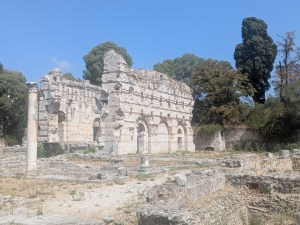
The frigidarium of the northern baths is the most complete part of the complex and is very impressive. It gives a flavour of the city of Cemenelum
There is an impressive stone path where shops and takeaway food stalls would have plied their trade. Cicadas rasped a noisy tune as I walked back into the pleasant coolness of the museum building. I took one last tour around before heading to the second of the museums in Cimiez.

The Cimiez site is extensive and impressive. Almost all of the whole city is exposed allowing visitors to visualise the structure.
The Matisse Museum celebrates the life and work of the famous artist. Housed within a striking red villa dating from the seventeenth century. In 1823, it was bought by Count Raymond Garin de Cocconato, who also sponsored archaeological excavations at the adjacent site. The beautiful villa provides an imposing and spacious gallery and exhibition space. A modern entrance funnels visitors into the museum, and the tour winds its way through its floors and white walled rooms.

Matisse’s Lady in the Blue Hat, painted during WWII after the arrest of his wife and daughter for being members of the Resistance.
When I visited, there was a very interesting exhibition showing the work of the late fashion designer Yves Saint Laurent, and how his work was influenced by that of Henri Matisse. It was a real treat to get so close to Saint Laurent’s sketches, fabric swatches, and finished creations. I was unaware of the influence of the local artist but the use of a collage of bright shapes and embroidery on traditional peasant-style blouses interested me very much. The selection of pieces and juxtaposition of then work of both artists, I found really well done. Although the museum was well-patronised, there was plenty of time to browse the exhibition. It was difficult to appreciate that the sun was blazing outside in the midday heat as the whole building was effectively climate-controlled and shuttered.

The stunning villa that houses the Matisse Museum

Matisse inspired dresses from Yves Saint Laurent
After purchasing a few souvenirs from the shop, I walked up to the bus stop and waited in the relentless heat for my transport back to Nice Ville station. At least this time I would be walking down the flight of steps, rather than up them!
I still had three more days to visit other museums in Nice, and so I resolved to plan another day of visits to get the best from my pass. This is a great way to explore the city, and also to escape the summer heat! Highly recommended.
More information
I travelled from St Raphael Valescure station to Nice Ville via SNCF Zou! regional trains – download the SNCF Connect app to buy tickets with ease.
I caught the No5 Lignes d’Azur bus from Roland Garros stop – this is about a fifteen minute walk from the station.
Nice Cimiez Museum of Archaeology – https://www.musee-archeologie-nice.org/
Matisse Museum – https://www.musee-matisse-nice.org/en/


Leave a Reply