

By Christine Swan
During the recent half term break, I visited the Netherlands as another of my flight-free, European forays. I had wanted to visit Delft because I had discovered an ancestral link in the form of the Blanchet family. I had heard that it was a beautiful city and so I jumped on a local Sprinter train to find out if it really was.

A blustery walk in Delft – with puddles!
Unfortunately, rain was a also feature of my break and this particular day was no exception. I decided that heading for the Royal Delft porcelain factory would be a good move to avoid the worst of the weather. The walk from the station was blustery, with big puddles to leap over. The factory is tucked within a residential area so it is beneficial to follow a map. One giveaway that I was close, was a Christmas tree type structure, formed of Delftware cups.

A magnificent tulipiere at Royal Delft
The visitor centre is well-organised with tours and lots of exhibits, many of these are absolutely stunning. I tried to ponder on how on Earth the most enormous pieces were constructed and fired. The guide who showed us around the factory, was English, and very knowledgeable. We were shown the areas where the clay was shaped in moulds, dried, and then fired. We could hear the rain beating down on the roof so I was really grateful to be in the warm factory with its cosy kilns. The difference between hand painted and transfer-decorated products was explained. The group were then allowed to see one of the artists at work, decorating a vase with delicate brushstrokes, expertly creating a piece that was similar to its siblings but, also unique because of the nature of hand painted work.

A Delftware grandfather clock? Why not!
I began to feel quite sad. We had the same in my adopted home town of Worcester. My local porcelain factory was world-renowned but sadly, sold and then closed. Parts of the factory buildings are now apartment blocks. The Museum of Royal Worcester is still open and definitely worth a visit. Volunteers are dedicated to preserving the brand by accepting donations or purchasing sets or pieces of genuine Worcester Porcelain, and then reselling them in the Museum shop to raise funds. However, the loss of the factory was devastating locally. One artist worked in Marks and Spencer and often lamented at the loss of their trade. I can cast my mind back to the heyday, when coachloads of American tourists would descend on the factory shop, buying huge dinner services, to be shipped to the US.

Inside the factory – moulds of currently made items
I talked to the guide about this. As soon as I mentioned Royal Worcester, she knew the story and how it ended. In fact, the Royal Delft factory had also struggled and, at some times, had held on by its fingertips. People tend not to buy huge dinner and tea services in modern times. However, Royal Delft porcelain does seem to have diversified and produces collectables, such as their Christmas bells and baubles, new editions are released each year. They also have the less costly Delft Blue range of transfer-decorated items. They have a fragrance, soap, pocket money items, right up to unique, hand decorated items that are works of art in their own right. Perhaps diversity is key, as well as opening up the factory and museum to visitors. I purchased a few pieces, including a beautiful hand-painted vase.

There is always time for Appel Taart and koffie – especially when it is raining outside
I managed to avoid the worst of the rain and walked back into the City, leaping over enormous puddles. Delft is well-served by shops and a market, which kept me amused and allowed me to buy a few souvenirs that I would be able to bring back. I have previously brought back spring bulbs from the Netherlands but guidance seems to have become vague again. Cheese is currently a definite no-no. I thought a Dutch house Advent candle and a string of wool-felt mushrooms was probably a safe bet, and also small and light enough to transport.
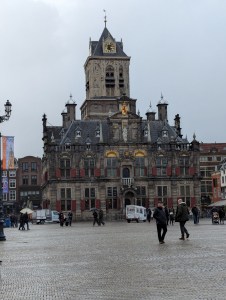
The town hall
My next stop was the Delft New Church, which really is not so new and dates from the thirteenth century. It is an immensely impressive building. The pulpit and congregation face sideways, and there is no altar. The most noticeable memorial is that of William of Orange, who has not one, but two statues. In the first, he is seated, and in the second, on his deathbed, wearing a nightcap. Around the memorial is a red carpet which charts the history of the church and the significant events in its history. Underneath the church are the Royal Vaults, where members of the Dutch royal family are interred. This part is not open to the public, although a model was available for visitors to view.

The New Church is situated on the other side of the main square
The church had seen its fair share of dramas, including being struck by lightning, which caused a fire. The original weather vane, complete with a brass cockerel and ball, which had been struck, was displayed, and reminded me of the Tottenham Hotspur logo. Apparently there is no link, but, to me, and my lack of sporting history, there was a passing resemblance.

The unfortunate weathervane
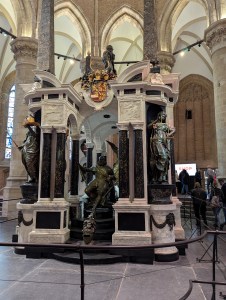
WIlliam of Orange’s memorial
I headed back out into the late afternoon, and headed off to see the famous Oostpoort, which is one of the original city gates, dating from the fifteenth century. With fairytale turrets and shuttered windows, it is beautiful structure. It was very quiet because the rain clouds were gathering again. I decided that it might be wise to head off back towards the station and then back to Rotterdam. I arrived back at the station just as the heavens opened yet again.

Oostpoort – the East gate into the City of Delft
Delft is full of old Dutch charm, with plenty of things to do and see. I was aware that I had not visited any Vermeer museums, but was now out of time. I think I would have enjoyed the city a little more without so much rain, but I did feel that I had begun to scratch its surface. None of the Blanchets were buried in the New Church, I did not feel the same intimate connection that I felt when I visited Leiden but I have more research to do on precisely where in the City the Blanchets lived. Delft is definitely recommended.
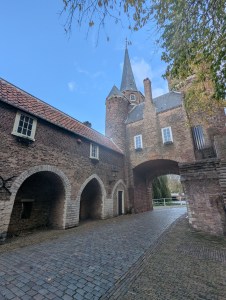
Courtyard behind the Oostpoort
More information
Royal Delft – https://royaldelft.com/
Delft New Church – https://www.oudeennieuwekerkdelft.nl/en/new-church/history/
Visit Delft – https://www.indelft.nl/en

 Awful Rigours and Wretched Pay
Leave a reply to Stephen Bumstead Cancel reply