By Christine Swan
I have been travelling back another four hundred years this week, to investigate the Ferré family, who were another of my Huguenot ancestors from north eastern France. Ferré can be spelled in a variety of different ways: Ferret, Feret, Ferre, or Feré but appears to have little to do with the elongated pet mustelids. Ferré seems to relate to the old Germanic word for family but also, interestingly, from Polish, where it refers to a metal clothing ornament, such as a brooch. The name therefore, could have been a trade name. One final meaning is derived from searching the term ferret which throws up the Latin for “little thief” – perhaps also another trade name! When searching for long distant ancestors, I have learned to develop an open mind about the precise spelling of a name and instead focus on triangulating first names, dates and family members. I suspect this is a throwback from my previous study of science which has given me a methodical and fact-driven research philosophy.

When is a Ferret not a ferret? By Alfredo Gutiérrez – Own work, CC BY-SA 4.0, https://commons.wikimedia.org/w/index.php?curid=4478158
Most of my French Ferré ancestors hailed from Tourcoing, which is a city north-east of Lille, and very close to the Belgian border. Historically, textiles were a key industry, primarily the production of woollen cloth. Its closeness to the border has also caused it to have been the site of major battles and accompanying change of ruler. It was Louis XIV who brought Tourcoing into the kingdom of France in 1688 but it has seen battle since, including both World Wars. As a follow up to this post, I will shortly be visiting Lille and Tourcoing to attempt to get a feel for the cities, although I do understand that wartime destruction has changed the face of the area and I am not hopeful that I will find many, if any, four hundred year old buildings.
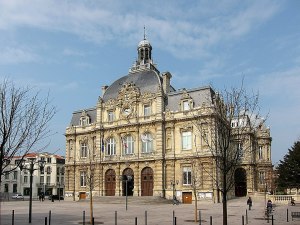
Tourcoing Hotel de Ville – By Velvet – Own work, CC BY-SA 3.0, https://commons.wikimedia.org/w/index.php?curid=14721340
The oldest Ferré ancestor that I have discovered is Christophe, born in Tourcoing in 1535. Unfortunately, I have no record of his address or occupation, as I was able to find in Dutch records, but I would imagine that his occupation was as a wool comber or weaver. This was the dominant industry of the area at that time so the probability is high. Christophe’s wife, Madeleine David, was four years younger than him. The couple had four children that I have discovered – all boys.
Their eldest son Pierre, married Marguerite Poilet in about 1585, and later, left France for England. This makes them amongst the first wave of refugees after the Saint Bartholomew’s Day massacre of 1572. The couple settled in Canterbury and had five children as far as my research has indicated. Pierre and Marguerite both died in Canterbury in 1601.
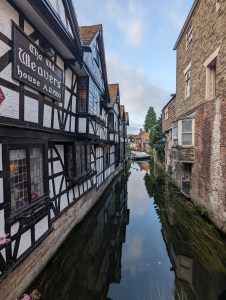
Old weavers’ houses in Canterbury
Their second son Vincent, is my twelfth great grandfather, was born in Tourcoing but must have travelled with the family to England as a child. Vincent married Martine Hache in Canterbury in 1614. I have discovered no fewer than ten children with a father of Vincent Ferré, although I have evidence that at least two died in infancy. Pierre was a popular name in the Ferré family but Vincent has been more straightforward to research.

Vincent Ferré marries Martine Hache in 1614, in Canterbury
Vincent and Martine’s eldest son, another Pierre, married Sara de Santhuns in 1644 and it was their second son, Jacques was my eleventh great grandfather. In fact, another Jacques Ferré, his eldest son was to be my tenth great grandfather. This particular Jacques was the father of Susanne, born in Canterbury in 1682, who married Benjamin Gaffé in 1712, joining two of my Huguenot ancestral lines. Susanne and Benjamin Gaffé left Canterbury, some time after 1723, for the East End of London. Canterbury had been Susanne’s home for five generations of Ferrés, and their refuge from religious persecution in France. By searching through the French Church records of Canterbury, names pop out of the page at me. I can see how families were linked by marriage – early on within their own community, and later on with the local population.
Benjamin and Susanne moved to Bethnal Green and joined the community of East End silk weavers. They would have begun to worship in St Matthews church, in English, rather than in a Huguenot church in French. Visiting the French chapel in Canterbury Cathedral helped me to appreciate the links between the French and English communities and how language and culture would have been very important to early refugees. Perhaps, over time, even within families where both parents were Huguenot, there was a desire to fully integrate. Did they stop speaking French? I do hope not.
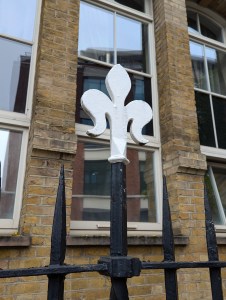
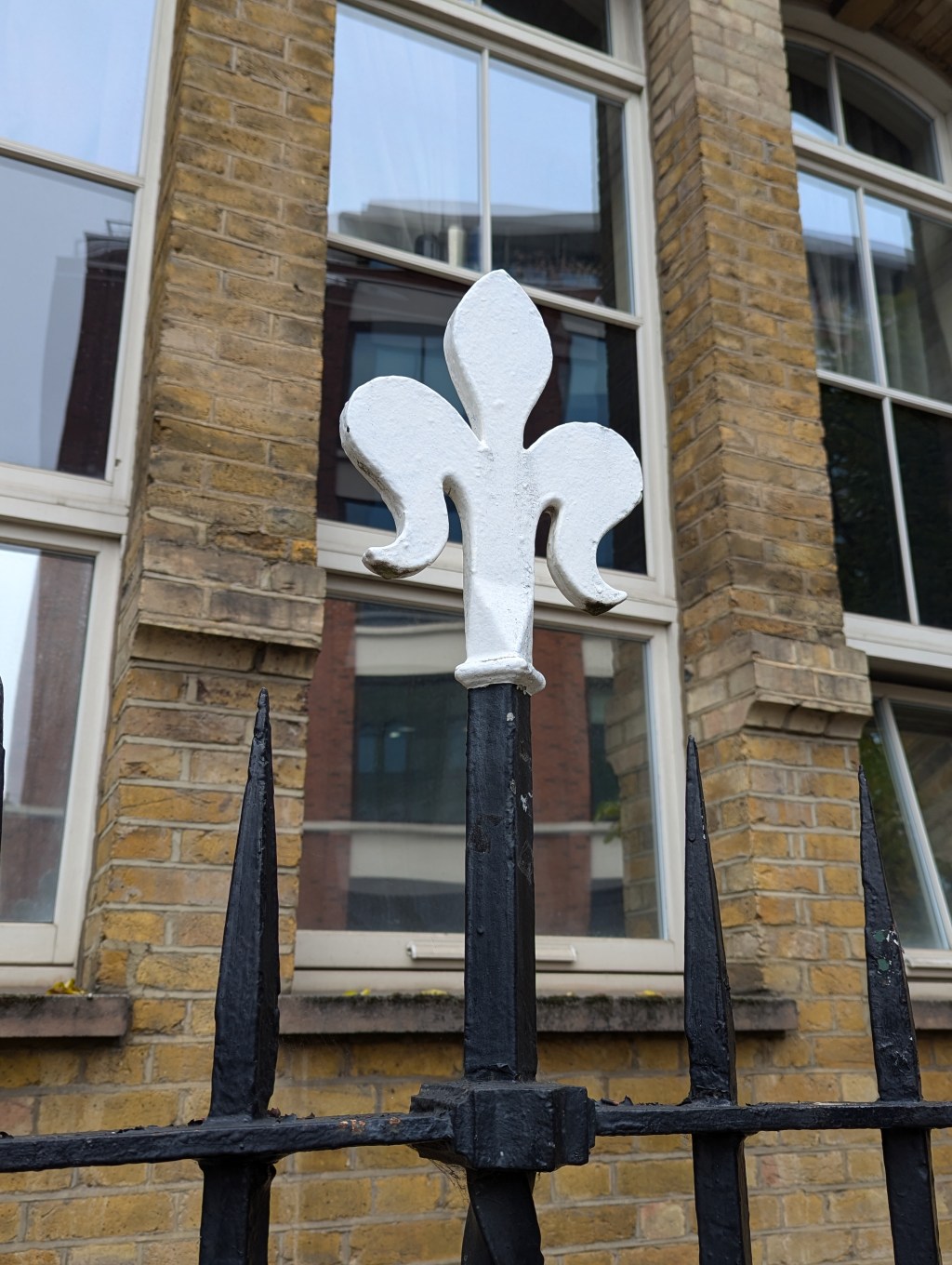
A fleur de lys motif in Spitalfields
I’m also surprised that the Fleur de Lys emblem used by Huguenots, has taken on new meaning to me too. I feel a link between the past and the present, where I have come from and where I am now. I do believe that this is part of the power of genealogy – we find connections with the past that teach us more about ourselves in the present.
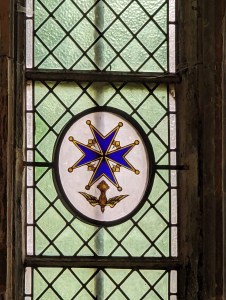
The Huguenot cross in stained glass – seen in the Huguenot chapel in Canterbury Cathedral crypt
I feel compelled to visit the places where the Ferrés lived and to imagine their arduous, frightening and unsettling journey to Canterbury. It would have been a great comfort to find a thriving community of French-speakers and the freedom to practice their religion without persecution.
Susanne died in 1754 and was the last of the Ferrés in my family tree. As a female, she used her husband’s surname. Ferré was anglicised to Ferry, although there are also some persistent Ferrets too.


 Awful Rigours and Wretched Pay
Leave a reply to Helz Cancel reply