

By Christine Swan
I have found that some of my ancestors have been very easy to research. This is especially true of the famous and the infamous but, the ordinary present me with a headache. Couple a commonly encountered name with an unremarkable life, and my challenge was set.
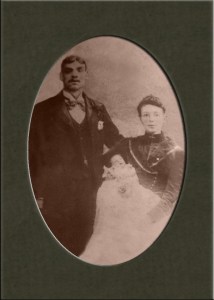
David Deighton Taylor and Julia Cook in 1896
My great grandmother, Julia Cooke, was born in 1873 in Bethnal Green. My father believed that she was Irish although I have found no evidence of this. Julia died of tuberculosis aged just 39, leaving my great grandfather, David, with seven children. Times were very hard and David also eventually succumbed to the same disease. The children were taken in by the Union and then scattered to the four winds in different types of provision and institutions. Their tales will be the subject of future posts. They did get to find one another again later in life and, by all accounts, the reunions were tearful and joyous.
I cannot find any record of Julia’s employment although, she is listed as a schoolgirl in 1881 and is absent from the 1891 census entry for the Cooke family in Bethnal Green. I suspect that she went into service and have a vague recollection of my grandmother telling me this. Julia married in 1893 and at time, gave her address as next door to her new husband, David Deighton Taylor, who was, at the time, residing with his grandfather, Daniel Crudgington, in Baxendale Street.
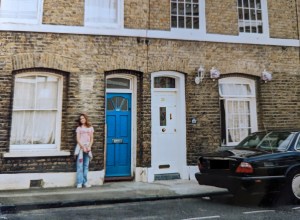
Neighbouring houses in Baxendale Street
Julia’s father, James Cooke, was a carman born in Blackfriars in 1843. When I first began researching him, I didn’t know a great deal about carmen. I knew that they transported goods via horse-drawn carts but that was about all I knew. I later found out that they were often employed by railway companies and could be likened to modern day delivery drivers – a kind of white van driver, but with a horse. It stood to reason that the family would live nearby to major railway stations of the day in order to procure work. James’ father, also called James, was born in Wheathampstead, Hertfordshire in 1804. As with so many of my family, at some point, he gravitated towards London to seek his fortune. In 1851, James, his wife Elizabeth, and their children, were living in Augustus Street, behind Euston Station. I visited last summer the day before I was travelling to France from St Pancras. I was in the area, so went for a walkabout. Unfortunately, there were no remnants of Victorian London that I could see. Augustus Street of the twenty first century is lined by tenement blocks both modern and recent. The area behind Euston was carved up by the grand plans of the now diminished HS2, causing an awful lot of disruption for not a lot of development. Euston has been the start and end point of many of my journeys but I don’t hold the modern lump in huge affection as I consider it an uninspiring slab and currently, an even more unattractive building site.

Augustus Street behind Euston Station
Euston Station first opened in 1837 but was rebuilt in the 1960s after massively outgrowing its original capacity and the Great Hall being damaged by a WWII direct hit. The 1960s obsession with new and shiny, led to the demolition of many of the original station features, including the famous entrance arch. Many campaigned to save it or move it, but it was just too big and so it was knocked down.
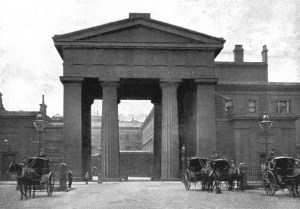
Euston station entrance in 1896 By Unknown author – http://www.ucl.ac.uk/sts/cain/projects/euston_grove/art/euston_arch_1896.gif, Public Domain, https://commons.wikimedia.org/w/index.php?curid=3056260
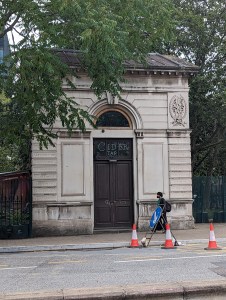
One of the two original structures that stood either side of the Euston Arch
The original station appeared to be a masterpiece of civil engineering and architecture, heralding the dawn of the Victorian age. By 1852 it was handling 52 000 parcels a month and was unable to cope with the demand without further expansion. James would doubtless have profited from this increase in trade and placing the family so close to the station made perfect sense. James the younger was 11 in 1851, and according to the census of that year, his occupation was as an errand boy. I am sure that any industrious person who sought employment at the station, would have been kept very busy.

Euston Great Hall – the roof of which was partly destroyed during the Blitz. By NWR – old postcard (reverse), Public Domain, https://commons.wikimedia.org/w/index.php?curid=7411616
James senior passed away in about 1855 and in 1861, his widow Elizabeth and the younger Cookes were living in Great Warner Street, Clerkenwell. I wonder what prompted the move but, James the younger was now a carman and Farringdon Station was to open in 1863 which was just ten minutes walk away.
The spelling of Cook, or Cooke, appears to be completely random – sometimes with an e and sometimes not. I guess as people were asked verbally for their name, the scribe spelt it as they saw fit thus I have documents approximately 30:70 Cook versus Cooke even though I can verify that the subject is the same. The Cooke family appeared to very much favour naming their children with names beginning with “J” and “E”. The senior Cookes were James and Elizabeth and their son and daughter took their names. James’ initial was represented by Julia, with James making an additional appearance as the middle name for their eldest boy, Frederick. The letter “E” was represented by the aforementioned eldest daughter Elizabeth, as well as Edward and Emily.
James the younger married Ellen in 1864 and they continued with the family tradition with Esther, Emily and Emmanuel, whose middle name was also James. Julia’s middle name was Ellen fitting the pattern perfectly. The only name that didn’t quite fit was Arthur although, even that name has appeared in my more recent family history. There was a gravitational pull towards Bethnal Green which is an area strongly associated with my paternal roots. Ellen’s age is another matter for debate. In some census records, there appears to be ten years between her age, and in others, fewer, even though I can confirm that this is the same person. Perhaps the person reporting who lived there didn’t know or perhaps there was an element of untruth. Either way, I assume that Ellen was approximately 20 years old when she married, as was James.

Blackfriars – birthplace of James Cooke junior.
The family moved around a fair bit over the decades but mostly in Bethnal Green. For at least ten years, they lived in Wilmot St, the tall set of tenements that stands now at the side of Weavers’ Fields. At the time that the Cooke family were in residence, this was a more densely populated area and the green space didn’t exist. In 1891, James is recorded as working as a furniture carman. This implies that he must have had a fairly sizable cart and, by implication, powerful horses to pull it. By this time, he would have had nearly thirty years of experience and would also have learned from his father, even though he passed away when James was in his teens. There certainly wouldn’t have been room to stable the horses in Wilmot St. Upon carrying out a little research, I stumbled across a house that had been developed from a Victorian stable close to Hackney Road. Mews, coaching inns and livery and bait stables would have all accommodated horses but I found it sad to think that working horses didn’t have the opportunity to run free on grass and my mind took me back to reading Anna Sewell’s Black Beauty which highlighted their plight in heart breaking detail.
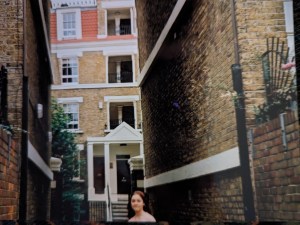
Wilmot Street seen from the path that leads to Weavers’ Fields

Wilmot Street
James died in 1892, leaving Ellen and the younger children. Over the ensuing years, she accessed relief from the Union and eventually moved to Essex. This was the end of an era: the last of the carmen in my family that I have discovered thus far, and another branch who moved further away from the centre of London.
Further reading
The worshipful company of carmen
Horses and carriages in the Victorian era
Smith, A. (1849) Carmen and coal-heavers – sketches of London life and characters
 Awful Rigours and Wretched Pay
