

By Christine Swan
Elena Estelle was one performing name of my great great aunt, Elena Ann Crudgington. She was born in 1854 in Bethnal Green to Daniel and Ann Crudgington and had a sister, Mary Ann, my great great grandmother.
In 1892, Elena was still performing with her husband, T. B. Brydge, in the Brydge Sketch Combination as Nellie Estelle. However, she also had a solo enterprise and was listed for the first time as a ballet mistress, organising and choreographing dances for the pantomime at Morton’s Theatre, Greenwich. This became an annual focus for Elena and in 1894, she began using the performing name of Mlle Elena Estelle. This later became “Madame” rather than mademoiselle as an indication of her seniority and status. She was still Nellie Estelle for the comedy pieces and some dancing but, I suspect, strived to be taken seriously as an academic dancer.
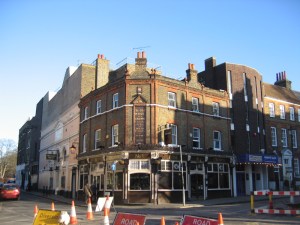
The Greenwich Theatre – one of Elena Estelle’s pantomime venues By Burnley at the English-language Wikipedia, CC BY-SA 3.0, https://commons.wikimedia.org/w/index.php?curid=15597108
In 1895 she began advertising ballet tuition at the Bridge’s new home at 31 The Waleran, Old Kent Road. These are an impressing set of flats that built in 1891. My father told me that theirs was a grand place, big enough to host family and social parties, doubtless attended by their celebrity friends. He explained that they were wealthy and generous enough to support some of the less well-off members of the family, including my great grandfather, David Taylor, Elena’s nephew and Eliza Sloper, her niece. Sadly, her sister, Mary Ann, had passed away in 1878 before Elena’s star had ascended. Unfortunately, the endless round of touring and living in theatrical short-term accommodation wouldn’t have made it easy to stay in touch with family, let alone be available as practical help. Moving into The Waleran, and putting down some roots, would have helped even though the travelling and touring didn’t cease. Dance tuition at least made some element of staying put possible. According to my grandfather, David Taylor, was fond of dressing as a cat, and had himself performed in pantomime as the same. I have no way of verifying this fact but it may indeed be true. I dread to think what the suit was made from, but my father often told me of the costume parties that the Bridges held in their flat and how David would pose, with the cat costume’s tail draped nonchalantly over his arm.

Waleran flats on the Old Kent Road By Shaun Ferguson, CC BY-SA 2.0, https://commons.wikimedia.org/w/index.php?curid=13450097
Elena continued dancing in her own right but increasingly worked in collaboration, either with children that she had tutored in pantomimes, or in trios and quartets, such as the Elna Trio and the Excelsior Quartette. She devised ballets for pantomimes and received specific praise for these – “The charming ballets were received with enthusiasm.” In 1908, a case was heard in Southwark County Court before Judge Willis K. C. between Elena and William Dodsworth, the father of one of her 16 year old dance apprentices, Nellie. Elena was claiming the sum of £2 ,16 shillings and 8 pence for breach of contract. Nellie was contracted for two years to be instructed in the art of dance and that Elena would receive one-third of her salary during that time. The arrangement appeared to work well for the first two engagements but then, before a third, the father said that he wanted his daughter to have a holiday and then to put her into service. However, Elena suspected that he had arranged the third theatrical engagement behind her back thereby saving her portion of Nellie’s salary. The father denied this and claimed that Elena was the one trying to “sub-let” his daughter. How very unsavoury! William claimed that he didn’t want his daughter to perform on the stage. Nellie was asked by the judge if she enjoyed the work, to which she replied that she did but that Elena “knocked the girls about”, including breaking an umbrella by hitting one of her pupils with it. Nellie claimed that she worked the third engagement with the full knowledge of Elena but only now was she claiming her commission. Nellie then suggested that it was her father who was under contract with Elena so, if she kept the money herself, that would be an acceptable solution. The judge was impressed how young Nellie had contrived to use the law to her advantage. Eventually, Nellie confessed that Elena had, in fact, never struck her. Elena claimed that the umbrella was used to raise a pupil’s arm rather than to batter them. On summing up, the judge explained that Nellie’s father was indeed under contract and that she should complete the full two year term with Elena. The newspaper recorded where laughter in the courtroom had interspersed the proceedings including one episode about the umbrella. Elena said that it was still an umbrella and wasn’t broken yet while laughing to the assembly. Elena knew how to work an audience – any audience. We have to bear in mind that by 1908, she was a well-known figure locally and probably nationally, as she had been performing for forty years at that point. Elena was awarded the commission that she was seeking plus costs and Nellie was still under the contractual obligation entered into by her father. Elena was a shrewd businesswoman with the confidence to stand her ground and state her case. It is left to my imagination to fill in the gaps of her standing with grace and elegance in the courtroom, using humour, where appropriate, to give a winning performance.

1901 census record showing both Elena and Tom giving their occupation as Music Hall performer
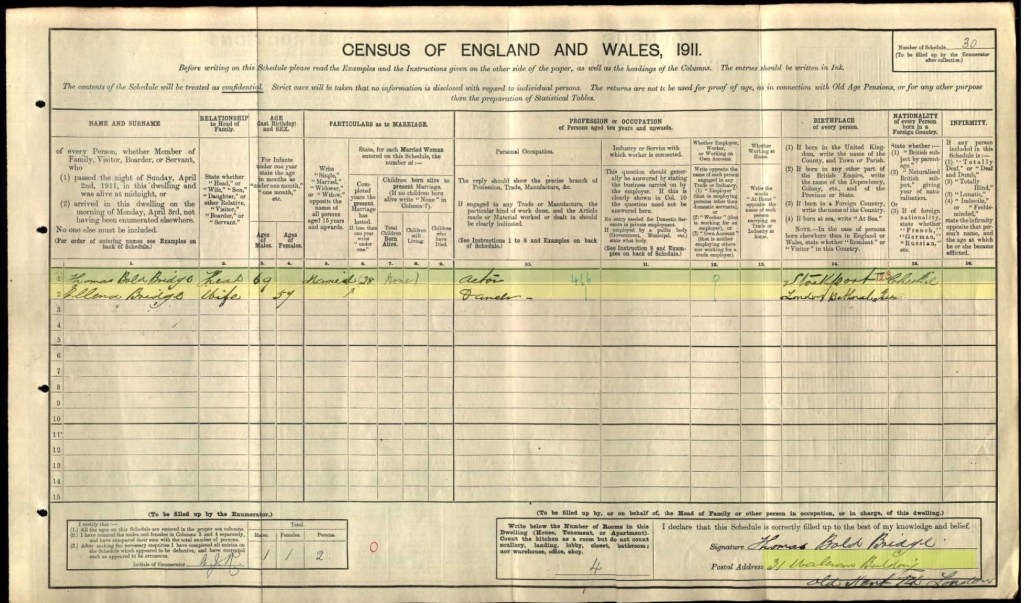
1911 census record with Elena’s profession listed as dancer and Tom’s as actor
During the next few years, teaching dance became a major source of income, punctuated by designing and choreographing ballet sequences for the pantomime season as well as providing a troupe of dancers for the same. In 1913, Tom and Elena moved to 16 Brighton Terrace, Brixton. This imposingly tall four storey terraced house, with a basement, was almost next door to the 1500 seat Empress Theatre which opened on Boxing Day 1898 and sat on the corner of Brighton Terrace and Bernay’s Grove. Sadly, this theatre no longer exists as it was demolished in 1992 after following the familiar path of theatre to cinema to bingo hall to decline and dilapidation. However, in its heyday, what better place for the couple to live but next door to a popular theatre. The London Borough of Lambeth was the residence of many famous stars of the Music Halls, many of whom gravitated to Brixton. When they moved to Brighton Terrace, Elena was 59 years old and Tom would have been 71.

Empress Theatre Brixton By Unknown photographer (1910) – Scanned from a postcard in my collection dated 1910, Public Domain, https://commons.wikimedia.org/w/index.php?curid=129749206
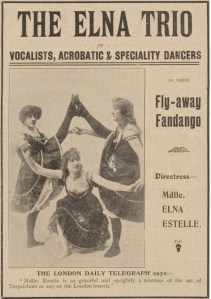
The Elna Trio 1902 – Newspaper image © The British Library Board. All rights reserved. With thanks to The British Newspaper Archive (www.britishnewspaperarchive.co.uk).
On 1st March 1917, Thomas Bold Bridge died aged 75. He and Elena had been married for 33 years. He was interred in the City of London Cemetery in my paternal family grave, purchased by Elena’s father, Daniel Crudgington. Tom and Elena had no children together but he did have a daughter with his first wife. Present at the graveside would also have been his and Elena’s theatrical family. The couple had taken in lodgers who undoubtedly would have brought in an income but also provided some human company after Tom had departed. A comedian called Jollyboy Mack gave his address as 16 Brighton Terrace in 1917 and in 1921, an unemployed Belgian telephone assembler and his wife were recorded as living with Elena as boarders in the five rooms that she occupied. Elena continued to advertise her services as a teacher of all styles of stage dancing in The Stage, but these cease in 1923. She also posted regular memorial notices in The Stage remembering her dear husband: “Never forgotten by his sorrowing wife, Elena Estelle.” To compound her sorrow, a great nephew, William Nelson Sloper, was killed on the battlefields of France in 1916. His mother, another of Elena’s nieces, died before receiving his war medal in 1921, so instead, this was posted to Elena as his sole living relative.

Service record showing Elena as the sole living relative of William Nelson Sloper killed on the Somme in 1916

Still advertising her services as a dance teacher in 1923
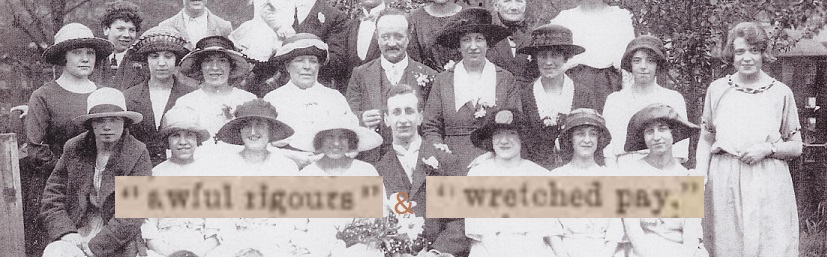
Elena passed away on the 17th June 1934 aged 80, of senile decay and myocardial degeneration. I guess by the detailed cause of death that there may have been a post-mortem examination prior to her burial alongside her husband, father, nephew and niece. There will be a large number of Music Hall families who are unaware of the interesting lives led by their forebears. Whilst we may not always understand or approve of the types of entertainment that the Victorian theatregoers enjoyed, it was nevertheless part of the history of the popular entertainment industry and every performer had their place. Elena’s story is one of making the best of your lot and defining who you are and who you want to become. The Theatre was part of this. It enabled social mobility, just as it can today. It was hard work and gruelling schedules but, as Elena stated, certainly not always awful rigours and wretched pay. As a professional, Elena knew the significance of studying and perfecting a craft. My respect for her is immense and I hope that in some small way, I do her memory justice.
Further information
The British Music Hall Society – https://britishmusichallsociety.com/about
The fascinating Loughborough Road interactive map covering the residents of this Brixton street – https://www.layersoflondon.org/map/collections/loughborough-road-histories
The brilliant Into the Limelight blog – https://intothelimelight.org/
The story of pantomime from the V&A – https://www.vam.ac.uk/articles/the-story-of-pantomime
 Awful Rigours and Wretched Pay