

By Christine Swan
There used to be a Sunday newspaper magazine article and a Vogue feature on it – what are the contents of your bag? I don’t know why these articles appealed to me so much but I found it fascinating. What were they reading? Which lipstick do they wear? What is their signature scent?
As a canny Londoner and public transport user, I’m always quite cautious about bags. A friend of mine had an evening bag snipped from her shoulder without her feeling a thing. I have seen pickpockets deftly working their way through a flood of commuters getting onto an underground train and couldn’t quite believe my eyes. I did use various handbags for work but I have never really craved an expensive designer version that might attract the wrong kind of attention. Many would say that this is a foolish position to take and that one is never fully accessorised without a beautiful bag, but I disagree. Much like the high-heeled shoes that I used to live and die in, as I have aged, I had ditched things that are uncomfortable, don’t serve a useful purpose or fit into my life as it is now.
Cargo trousers with clever pockets, a battered old Harris Tweed jacket, a hoodie with no fewer than thirteen different places to store items, provide ample storage for a quick trip. I always know where everything is and can feel its outline, so know that it is safe.
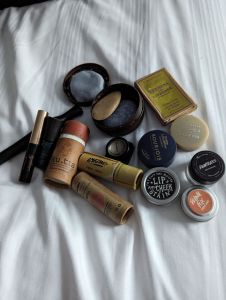
Longer journeys require more storage so I invested in a secure backpack and front sling bag. I travel quite frequently so always leave my bag half-packed. I can be ready to go in under fifteen minutes because most essentials are already in place. I have a duplicate set of make up items and a space-saving washbag. I discovered the joys of solid shampoo and conditioner bars, toothpaste and mouthwash tablets, a folding hairbrush and mirror, solid moisturising bars and perfume, as well as that most readily available solid product – soap. I use a number of sunscreen products including zinc oxide based sticks. I’m always looking to cut back, cut down and cut out. Instead of my washbag expanding, I am always working on the challenge to shrink it.

Another adventure awaits
I also have a few other essentials that I have refined from years of solo travel by rail. A suction sink plug is one. Sleeper train cabins often have a sink but, unhelpfully, often lack a plug. I also have a clever door lock but a bunk bed ladder on a train and a chair in a hotel, also does the job. A mini-torch is helpful even if just to find a light switch in the dark. I use a bicycle front light which is tiny but very powerful. A mini-notepad and pen allow me to write thank you notes and leave a tip. It’s a pleasant part of my day to think that I am making somebody else’s.

A few years ago I discovered packing cubes. These are usually colour-coded and allow you to organise and squish your clothes into tiny spaces. The compression usually prevents the need to sit on your bag and pull furiously at the zip, doing it on a small scale several times is far easier. Winter trips are always more bulky than summer. Trips to warm places are easy. I pick a few coordinating items and then wash and wear every night. Sarongs are wonder-garments for warm climates. They are a scarf to prevent sunburn, a dress, a skirt and even a towel.
I learned quickly that another essential is mosquito repellent. The temperate variety didn’t appear to be effective in Southern Europe but the tropical version does the job. Leakage of the oily gloop is a potential nightmare that dissolves pigments and stains clothes. I transport mine in a thick polythene bag in the outside of my backpack. However, it works and I am slathered night and day. I can’t remember the last time I was bitten by a mosquito. Similarly, sun protection is another product that I will not skimp on. I also carry a large, foldable sunhat.
My front crossbody bag is perfect for tickets, cards, passport, key cards and phone. It’s right there, within hand’s reach and yet you are free to hold on when travelling on public transport, or to consult a map.

For really long journeys, I do take a suitcase but I confess that this does make me feel more vulnerable and less mobile but, I always leave with it only half-full. My summer holiday usually coincides with the end of the summer sales plus I always need room for presents. My problem with suitcases is that you so obviously look like a tourist. Like a tortoise trundling along, I do feel hindered and slowed down. There is never anything of great value in my suitcase but to lose your clothes would be an inconvenience to say the least.
I always have a book to read, in fact, long train journeys and beaches, are the places where I read the most. To sit on the sand and watch the sun set with a good book and a glass of wine is, for me, the finest way to spend an evening. I buy a few pre-loved books at the Vale Wildlife Hospital summer open day and fete, and then read them throughout the year. I then pass them on to work colleagues or friends to informally review and compare notes.
Power on the move is another essential. I have a lithium battery and USB charger plug, the latter with clip-on adapters for UK, US and EU travel. As a mobile phone is my sole electrical device, this is all I need.
A more recent addition to my backpack, that I carry everywhere I go, is a small, orange teddy bear, kindly given to me by a friend from her recent trip to South Korea. This is also where my daughter taught English for two years. The bear has a clear pouch on its tummy to hold a photograph. I have one of my daughter laughing and sharing a joke, while she was still living at home. This is how I want to remember her. She adored travel and we had planned to do more together. In her short life, she visited the majority of western and southern Europe and a huge chunk of the East, a large swathe of South East Asia and had the Americas in her sights. Teddy travels with me as a most treasured possession. Wherever we go, we are never strangers. We always take a small piece of who we are in everything that we carry. Home can be wherever you are.
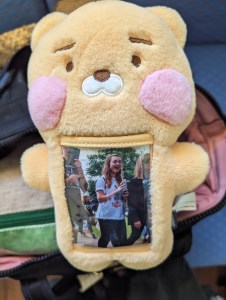
Teddy
 Awful Rigours and Wretched Pay