

By Christine Swan
Thomas Bold Bridge married Elena Ann Crudgington on the 10th March 1883 at St Peter’s Church in Bethnal Green. For Elena, this was her first marriage but for Tom, this was his third. Initially, Tom continued to perform with Tom Rice as Rice and Brydge but in May, he began performing with his new wife as Brydge and Estelle. The act appears to have been a huge success, with the pair performing musical sketches for the next twenty years. Whilst Elena continued with her ballet and teaching of the same, Tom’s pursuits turned to the charitable.
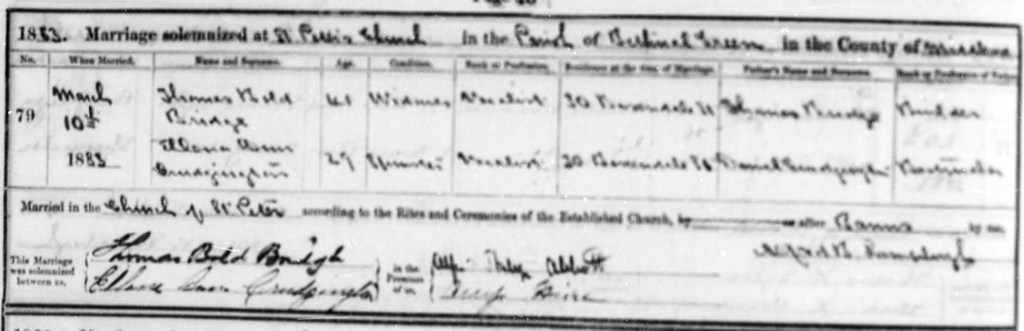
Marriage of Thomas Bold Bridge and Elena Ann Crudgington in 1883
The couple performed together through the 1880s, travelling around the country together and in 1890, the Tom developed the Brydge Sketch Combination featuring Elena as well as other performers in his employ. This was a successful venture and although initially, sketches appear to have been written by other authors, eventually Tom began writing these himself.
In 1889, Tom began assisting with the organisation of the annual Music Hall Sports event to raise funds for the Music Hall Benevolent Fund. This event consisted of a series of conventional running races as well as novelty events such as the egg and spoon race and blindfold horse and jockey race. By 1890, Brydge was a member of the executive committee, and the next annual sports event, the second, was held on 15th July at Stamford Bridge. Various other fundraising events were organised including collections at theatres, an annual dinner and smoking concert, a plain and fancy dress ball, to which none were admitted free, including the press, much to their dislike. However, these were charity events and attempts to raise funds were maximised. All of these became annual events and the press of the day record how funds were distributed to needy cases including paying for funerals and relief for bereaved families.
Music Hall Sports 1896 https://www.youtube.com/watch?v=dU_u1tIpeDQ
Just as today, Victorian newspapers of the day appeared to delight in gossip. One of the key criticisms appears to be that performers, who were members of the Music Hall Benevolent Fund committee and chair, did not always attend fundraising events. The assembly was largely comprised of theatre owners and agents. There seemed to be a lack of understanding that, due to their busy careers, performers were often indisposed. Their work was gruelling, often with multiple performances each evening, frequent travelling and touring, taking them away from London, which was the centre of most of the events. From poor weather at the Music Hall Sports, to changes in the committee, and criticism of fundraising and distribution, newspapers did not appear to have much of a good word for the work of the Music Hall Benevolent Fund. When a number of senior representatives attended a funeral, and the cab driver took them to the wrong cemetery, the press accused them of “clowning around”. This drew angry letters in response, including one from Tom Bridge.
Another article in the Referee in 1892, denounced the meanness of the Fund and claimed that payments made to support staff, as opposed to performers, were too small. It seems that 1893 was more positive in terms of fundraising although there were still some grumbles regarding the allocation of relief. In 1894, the annual Music Hall Sports moved to the Agricultural Hall in Islington to escape annual the inclement weather that seemed to coincide with the event in previous years. This year, events were spread over two days which would have enabled more money to be raised, confident in the knowledge that the weather could do its worst and not spoil the occasion. By the Annual General Meeting in September of the same year, the balance of the fund had fallen to just £101. It appeared to be a constant struggle to raise funds, although lavish gifts of gold watches and silver cutlery were regularly presented to outgoing chairs. The annual dinner seemed an incredibly lavish affair with theatre owners, managers and agents, rubbing shoulders with officials from London County Council at The Venetian Room of the Holborn Restaurant . Performers were thin on the ground at the annual dinner, although I saw Tom Bridge’s name as having attended every sporting event and meeting. One article in the Boxing World and Mirror of Life stated simply that the incoming funds were too low and the management expenses too high. Some ingenious suggestions were made to increase contributions. A compulsory stoppage from performer’s pay, a penny on admission fees, swear boxes and a dog wearing a charity box on his collar were touted as ideas.
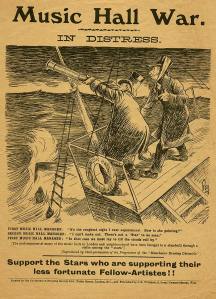
Music Hall War -1907 poster depicting the dispute between theatre owners and agents and the performers of the day – By Unknown author – V&A theatre museum, Public Domain, https://commons.wikimedia.org/w/index.php?curid=59615274
In terms of his performing career, The Brydge Combination was active between 1890 – 1898. The final performance of Brydge and Estelle appeared to have taken place in 1902. In 1911, Tom still gave his profession as actor in the census document. From locating tens of newspaper articles for each year that he was performing and active in fundraising, I could find none after 1910. Unlike Elena, who continued to teach dance, I was unable to find any evidence that Tom did.

Tom Bridge in the 1911 census
Thomas Bold Bridge passed away on 2nd March 1917. The announcements in the newspaper were warm but factual. I have not yet found a photograph of him to be able to picture him, as I have been able to with Elena. I can imagine his muted Northern accent when he was speaking naturally, although, I am sure that he was able to produce a whole range of different voices. Elena continued to post messages in The Stage every year on the anniversary of her husband’s death: “Never forgotten by his sorrowing wife, Elena Estelle.” They were a “power-couple” of the Music Hall, both had reason to be proud of their achievements, but together, they complemented each other in perfect harmony.
 Awful Rigours and Wretched Pay