
By Christine Swan
A few years ago, after being contacted by an unclaimed estates investigation company, my parents and I set about claiming my late great aunt’s residual to divide among her living nephews and nieces, including my father. My father recognised that I was best placed to do this with my extensive knowledge of our family, and our collective desire that the state should not hold on to poor Violet’s remaining funds.
Time was of the essence as she had passed away many years previously and there is a limit for claims to be made. The Government Legal Department publishes lists of unclaimed Estates and it is then up to surviving family to prove their relationship to the deceased. This I could easily do, thus circumventing the fees of the private company that alerted me to Violet’s Estate.
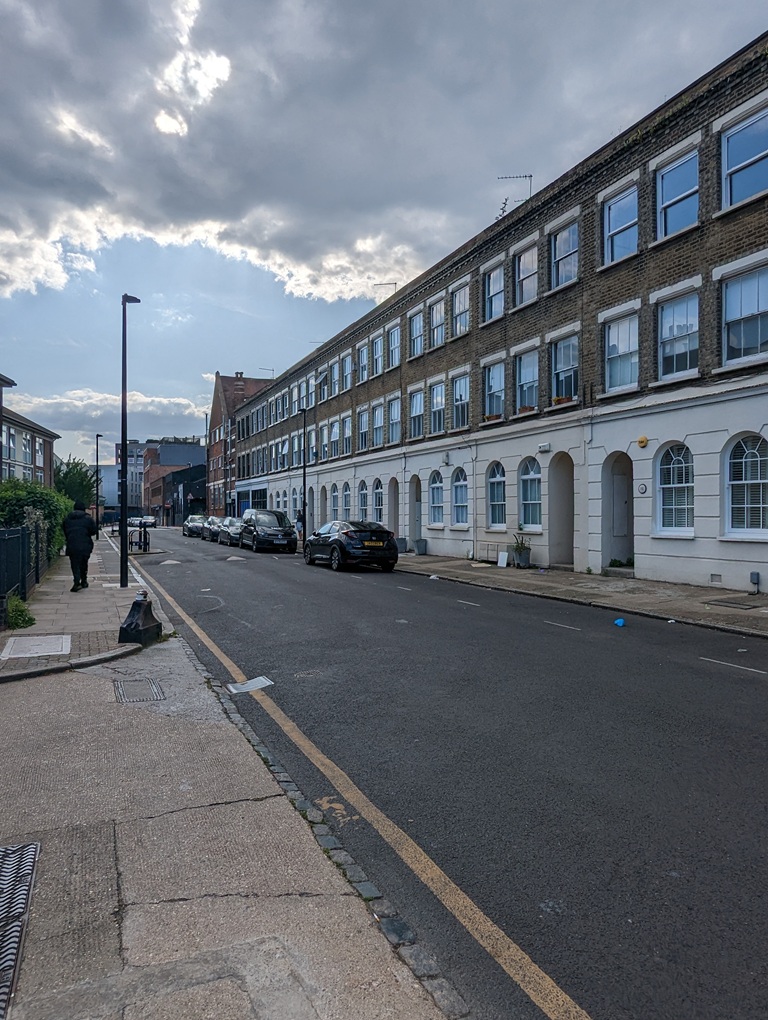
We knew that she lived in Hackney, and I had a last residence address. We became excited at the prospect of her having owned a property in, what is now, a highly desirable location. But that is not our family’s way. My grandfather’s siblings were poor people, scattered far apart by the authorities after their parents both died of Tuberculosis.

Violet was born in 1908
Violet was David and Julia Taylor’s sixth living child, born in 1908 in Bethnal Green, just four years before her mother died and nine years before her father joined his wife. Since Julia’s death, David had been unable to care for the children, and so, with no other relatives able to help, they were taken into the care of the Poor Law Union. It would have been a desperate situation. Tuberculosis was not a quick death and the children’s parents would have been ill and consumptive for quite some time.
The Taylor family lived in Wadeson Street, a short distance from Victoria Park in Bethnal Green, which had opened in 1845. Violet was baptised at Christ Church in Gore Road, facing the northern edge of the park. Violet was a summer baby and I visualise the family making their way through the park to the church, dressed in their Sunday best.
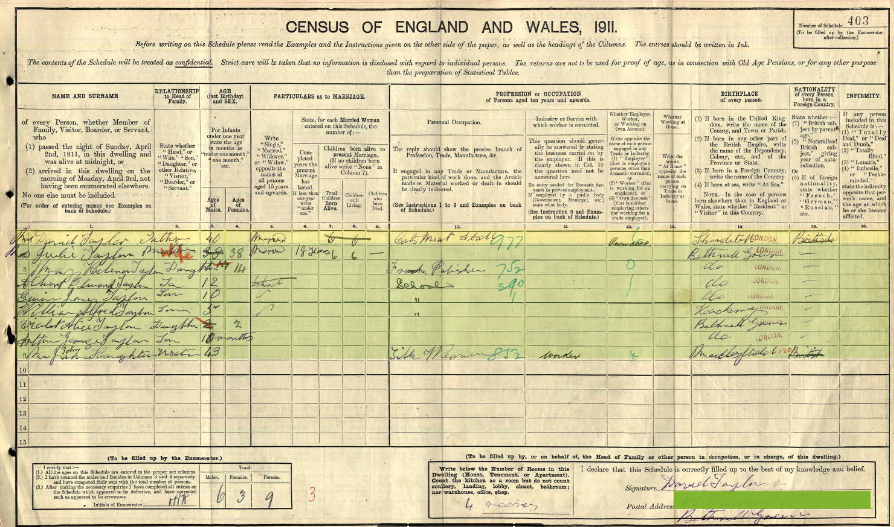
The Taylor family in 1911
In the 1911 census, Violet was two years old. Her father David was working as a lavatory attendant. Not a glamorous job but it would have provided more regular employment than selling meat for cats. Four years prior to this, Violet’s Uncle William had moved in with the family when he was dying of Tuberculosis and their generosity towards him may well have sealed her parents’ fate. Her mother, Julia, was to die just one year after the census was taken and four years after William had died.
Violet was taken into Bethnal Green Infirmary just two months after her mother died. She was then transferred to Park Hospital, Hither Green, which was run by the Metropolitan Asylums Board. Park was a fever isolation hospital and had separate wards for scarlet fever and Diphtheria. These two diseases were rife before vaccination of children, and both could have been fatal. Scarlet fever causes an extremely high temperature, which alone could prove fatal. Park Hospital was the largest fever hospital in the country however, in 1910, it was earmarked for closure due to declining numbers of cases. Better treatment led to improved outcomes and eventually, the use of antibiotics and immunisation against Diphtheria, conquered these diseases. Although not quite. As a young teacher, I developed a nasty case of scarlet fever which knocked me off of my feet. My doctor banished me from the surgery with a prescription for Penicillin and told me to isolate from everybody. Isolation is still a tool for controlling disease spread as we know from more recent times.

Violet’s entry into the care system, such as it was, began in 1912
For Violet, there was also a growing recognition that isolating children from their families may have been beneficial to their physical health, but not for their wellbeing. But, with her mother dead and her father needing to work, and in poor health himself, four months after arriving at Park Hospital, little Violet, just four years of age, was discharged to the workhouse. Here she was assessed, along with her younger brother Arthur, aged just two. Arthur was admitted to the infirmary, while Violet was sent to a home for “mentally defective” children. This may have appeared to have been a terrible choice, however, these institutions were much smaller than workhouse schools, and there was an attempt to create a more family-like structure.
There was one larger institution, the vast Darenth Asylum and Training Camp in Kent. It was a vast site, which accommodated a hospital and asylum, with schools and training facilities for those children and young adults who were considered to be “of higher mental capacity” and capable of being trained in a trade or skill. This was Violet’s lot. Diagnosed aged just four as being an “imbecile”, she appears in the 1921 census, aged thirteen, as being an inmate at the Darenth Training Camp. I use these terms in quotations as an modern educationalist where we have no place for labelling children as defective. Instead, modern practice is based around inclusion and recognising potential and fulfilment, rather than deficit and low goals.
My father remembered that somehow, in the 1930s my grandfather managed to find his sister Violet, now an adult. He was just a child but recalled to me the tears of joy at their reunion. Thereafter, she would visit him and his family for Sunday lunch which continued for many years. He couldn’t tell me when this regular occurrence ended but it may have been the intervention of World War II. My father joined the Royal Navy and family Sunday lunches became just a comforting memory of home.
Violet never married. She remained working in Hackney making fancy boxes. She may have been able to complete tasks at home but probably later worked in a factory. She remained living in Culford Road for many years, and died with no heirs in 1991. I feel appalled at the hand that Violet was dealt. She was institutionalised from a young age and only knew the company of family in her middle years. I would have liked to have met her and to have told her that her story mattered. She did not die a rich woman. After paying the hefty Government Legal Department administration fee, the residual was shared among my father’s surviving siblings. I felt satisfied that Violet’s Estate had been shared with family, rather than procured by the State. Violet had not died in debt – she had “got by”. I take comfort that our education system treats young people more humanely and recognises the benefits of keeping children in a home environment, through fostering or adoption. Violet could not have remembered her parents, and institutions became the only home that she knew.
Written with care and not by AI.


Leave a Reply