
By Christine Swan
Although I have now returned to work and the weather is turning its back on the summer, I still have plenty of stories to tell of my holidays. Before the end of August, I was excited to visit Shakespeare’s Globe Theatre for the very first time. Even I am surprised that I have visited prior to this year.
In truth, I have visited the Swan Theatre in Stratford Upon Avon, and, this year, watched A Midsummer Night’s Dream at the Regent’s Park Open Air Theatre. The evenings are becoming increasingly chilly so I was prepared for being somewhat exposed to the elements.
Tudor theatre-goers would have experienced similar conditions – the groundlings would have paid an affordable price but would have baked in the sunshine, and been soaked by the rain. London had a choice of venues, including the Curtain Theatre in Shoreditch, now the site of the new Museum of Shakespeare. The Globe was built on the southern banks of the Thames but was moved from another site in Shoreditch when the land owner called in the lease. The Theatre, as it was known, was demolished in 1598 but the timber carefully and stored in a warehouse, before being transported to the Bankside area on the southern shore. When rebuilt, this became the original Globe, just one year later, in 1599. It is believed that the first play performed was Julius Caesar.
The Globe burned to the ground in 1613 and William Shakespeare retired to his home in Stratford Upon Avon, to die in 1616, just three years later. The wooden construction and thatched roof caught alight
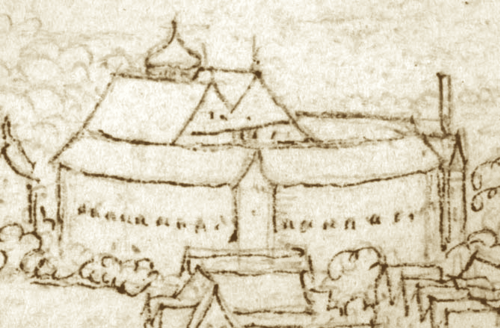
The Globe was rebuilt after it burned down. This is a sketch dated 1638 of the new building. By Wenceslaus Hollar – https://www.researchgate.net/figure/Wenceslaus-Hollar-The-second-Globe-playhouse-detail-from-A-View-from-St-Marys_fig16_254362678, Public Domain, https://commons.wikimedia.org/w/index.php?curid=149975427
It is incredible that the current Globe Theatre stands close to the site of the original. it is testament to the incredible vision and resilience of the late Sam Wanamaker who researched the original theatre, but sadly passed away before construction finished in 1997.
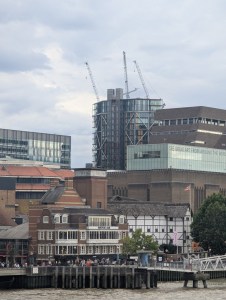
Bankside, including the Globe Theatre, from Southwark Bridge
I walked through the City on a warm late summer evening. Workers were standing outside every pub spilling out onto the pavements, along with their beer. I crossed Southwark Bridge and considered how much more difficult it would have been for early seventeenth century theatre goers from North of the River. They would only have had the choice of crossing crowded London Bridge, or, more likely, have crossed by ferry, rowed by many of the watermen working that stretch.
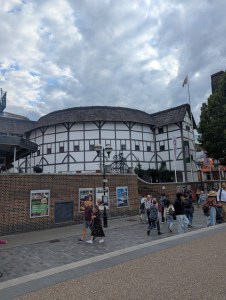
Arriving in Bankside
I arrived to enjoy the general hubbub of a pre-performance theatre. The entrance forum feels very modern, with attached restaurants, cafe, and excellent shop.
An announcement encouraged us to take our seats for the performance of As You Like It. I had booked a seat cushion so collected this first. “Please bring it back after the performance. “, was the final instruction. Seated patrons can either brave the wooden benches or, as I did, opt for a little more comfort. Groundlings mill about before the performance, and, as I discovered, some like to move about during too.
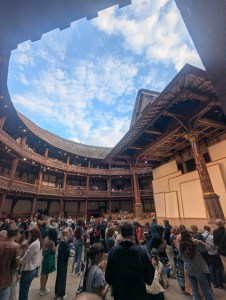
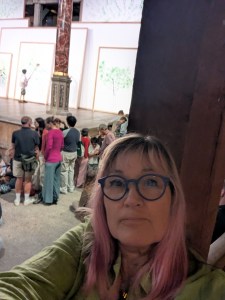
Before the performance
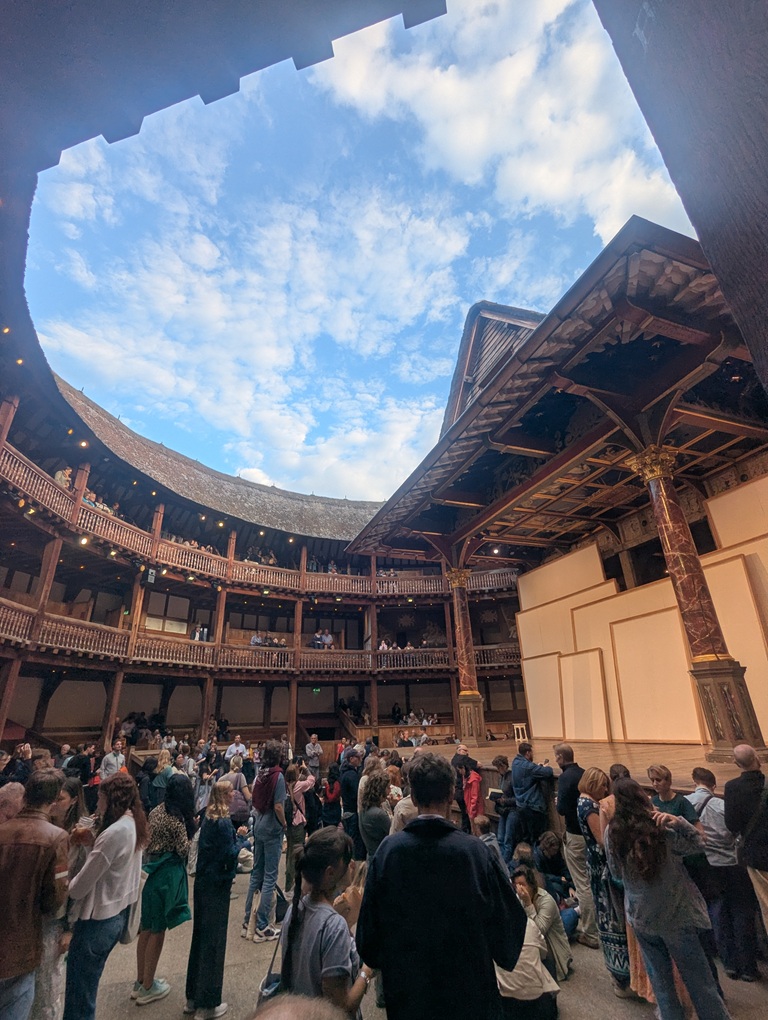
The auditorium is breathtaking. The plasterwork is decorated with ornate and delicate painting. The timber columns, thatched roof, and metal gutters are exceedingly impressive. They give visitors plenty to talk about and to look at, prior to the performance beginning.
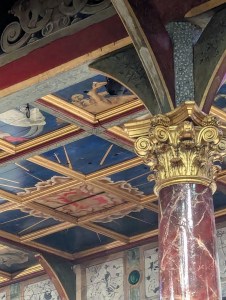
The detailing is exquisite
When the music begins and the actors arrive, we are transported to the most exaggeratedly embellished or Georgian era dress. Enormously wide skirts coupled with gravity-defying hair, transported viewers to the eighteenth century and muddled our minds and transports us somewhere else.
The play is beautiful, and fun. It is witty and results in everybody allocated their correct partner – “No sooner met than they looked, no sooner looked than they loved.”
As with other outdoor theatres, as the sun sets, the light shifts and the stage lighting shifts the focus and increases contrast. I never notice this in an indoor venue. The frequent passing of aeroplanes overhead is a minor distraction which the actors acknowledge with a joke.
The use of the set was very clever, turning white canvases into the Forest of Arden during the performance using paint, and then adding more leaves and flowers as the season blooms. This simple transition focuses the eye and changes the scenery. Musical interludes, with audience participation keeps everybody involved.
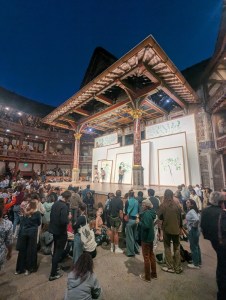
The Forest of Arden is created during the interval
After the performance ended, to rapturous applause, the groundlings filed out first, and I followed, with my cushion, and returned it to the cushion shed. The throng moved to Bankside and gradually spread out towards their various destinations. I recrossed Southwark Bridge, passed through the City, where some workers were still celebrating Friday night. past the Aldgate pump, that marked the end of the City and the beginning of the East End. The night was clear with only a light breeze. Autumn was definitely on its way but not yet at the front door.
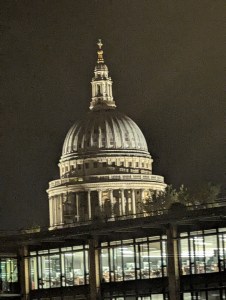
St Paul’s Cathedral lit for the evening
I wondered what Shakespeare might have made of the night’s performance. Would he have approved? Would he be pleased to think that an Elizabethan-style theatre was still to be found in London’s Bankside.
I retired to my non-Elizabethan hotel and dreamt of the world as a stage and all of the people merely players.


Leave a Reply