
By Christine Swan
I love the theatre. I love London. Combining the two for a weekend is sheer bliss.
My job is hectic and doesn’t fit into the working week. I have always had a habit of overworking, and I don’t have an “off button”. Consequently, I will work at home, in the evenings and at weekends. I should stop it, I know.
Once a month, I take myself away. I book a weekend in London, or sometimes a longer trip, I do not take my laptop, and I do not work. I may check my emails, and respond to a few on the train journey down. I have joined Teams meetings, safe in the knowledge that in two hours time, it all stops. I switch off.

Off to London again by train
This is what the theatre means to me – switching off. Unlike my theatre-going old school chum, I like to sit close top the stage, to be immersed in the scene, without the distraction of bobbing heads, crunchy snacks, sneezes, or conversations. If this is behind me, I can ignore it. It’s me, and the actors in front of me.
At the end of January I saw Noel Coward’s Rat Trap at the Park Theatre. A tale of love affairs and intrigue written when he was only eighteen years of age – so unlikely to have had huge experience of love affairs and intrigue! In the same weekend, I was excited to see Felicity Kendall in Stoppard’s Indian Ink. Kendall’s character reflects on her youth and her bohemian sister, Flora, who died in India. Stoppard allegedly wrote the character of Flora for Kendall, and she made it hers. Flora falls in love with a married painter but, as tales of forbidden love often do, it ends in tragedy with the beautiful Flora’s death.
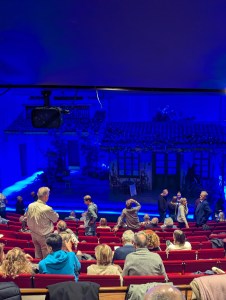
The set of Indian Ink at the Hampstead Theatre
In this version, Kendall plays the older sister, conveniently named Mrs Swan. In one scene, she stands at the grave of her sister and we can hear the grief, so soon after Stoppard’s death, so much shared history, now in the past. You could hear a pin drop, it was very affecting. A brilliant production, very worthy of the high praise lauded on it, and the extension of its run.

Cable Street at the Marylebone Theatre
In February, I returned to see Cable Street in its third incarnation, this time at the Marylebone Theatre, within the interesting environs of the Steiner Institute. I have previously written how much I enjoy this show and its story is entwined with my own family history. It is a story that talks to me, and retains its relevance today. Some of the cast reappeared but others switched roles or were new cast members. Three viewings has not spoiled my enjoyment nor dulled its appeal.
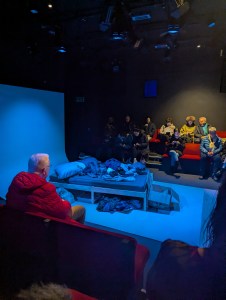
The tiny, but perfect, Finborough Theatre
In the same weekend, I also visited the compact and bijou Finborough Theatre to watch the intriguingly titled 1:17am Or Until the Words Run Out. This play has two actors meeting in the flat of the brother of one of the characters, who had recently died. The other character had been his love interest for some time, and the two girls were close friends. It is important to support friends in a time of crisis, but at what point should you leave them with their grief? The friend’s current love interest is pushy and phones frequently asking her when she is coming home – but how do you leave a friend who needs company, and to talk things through? The premise was great, and mostly, the execution was very successful. I began to wonder how this would end, expecting a finale, a final twist, a further shock. But it didn’t come. A good play and maybe I was too busy looking for an obvious ending?
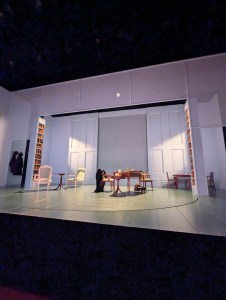
The set of Bird Grove at the Hampstead Theatre
March brought a return to the Hampstead to watch Bird Grove. The was a delightful watch that captures the societal conflict of Victorian society between the expectation of young women to marry and the desire to be free and express themselves. Mary Ann, and her father Robert Evans live in a large house that hosts a number of eligible, if dull, bachelors. Mary Ann wants to write, and surrounds herself by bohemian characters, including a couple who have decided not to marry, and yet live happily. This is very attractive to Mary Ann and brings tension to her relationship with her father, played by the wonderful Owen Teale. Mary Ann cannot be both dutiful daughter and free-spirit writer. Robert, is living beyond his means and needs her to marry well. Robert dies. She loves him, but finally, her shackles are gone. Mary Ann publishes as George Elliot. To assume a man’s name finally gives her the freedom that she craves. Brilliant!
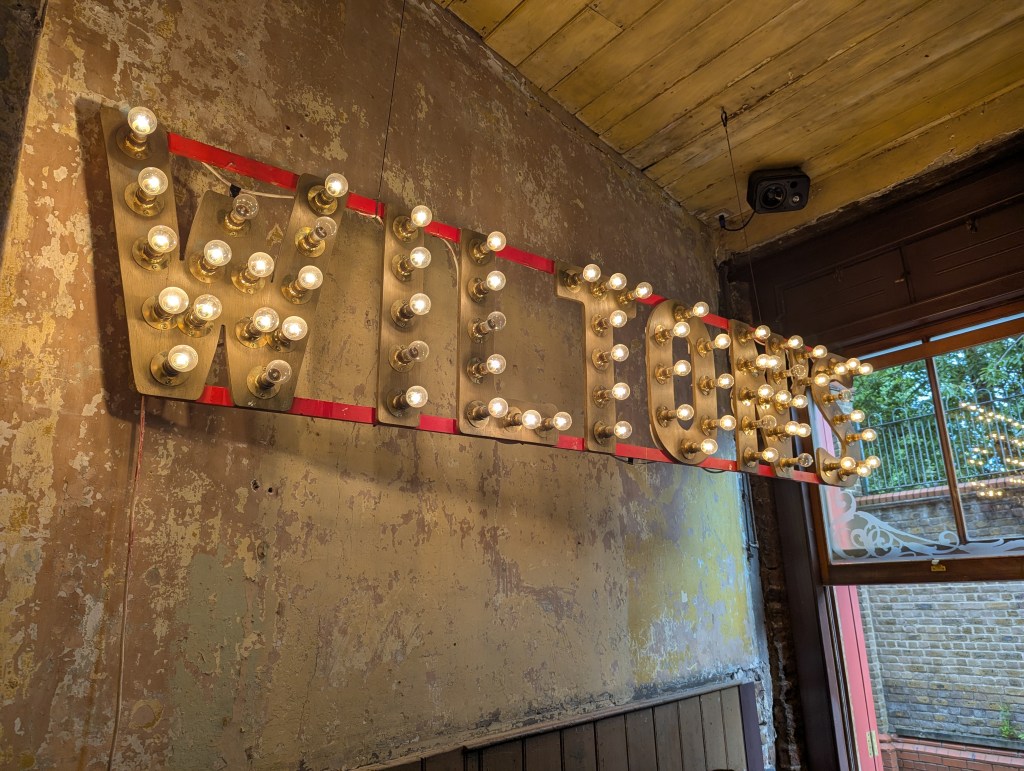
It seemed like a good idea to have a curry in the famed Brick Lane before visiting Wilton’s Music Hall to watch Ruth Ellis the musical. Slow service saw us running to Grace’s Alley on a full stomach, with only a handful of minutes remaining. This really is NOT to be recommended!

Grace’s Alley in the summertime – not recommended to run there with a tummy full of curry!
I arrived just as the show was about to begin, my companion, a few minutes later. I was seated in front of the small orchestra “pit” which did drown out some of the sung lyrics. Nobody’s fault, and when we moved to our intended seats in the centre of the stalls, the sound was perfect.
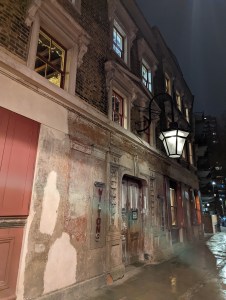
A winter Wilton’s
The tale of Ruth Ellis is a tragic one. Manipulated and abused, Ruth always believed that she was destined for something better. With her Marilyn Monroe looks and couture clothing, she projected beyond her means, and made money as a nightclub hostess. Drawn to glamour and danger, Ruth falls in love with bad-boy Derek Blakely, but he abuses her like all of the other men in her life. She began an affair with an ex RAF pilot who procured as hand gun for her. As recorded in history, Ellis shot Blakely and immediately confessed. Throughout the play, we see Ellis in the background, narrating her own life to her prison guard Albert Pierrepoint. In reality, it wasn’t Pierrepoint who stayed with her, feeding her sweets and letting her talk. We know who he is. The end of the play is shocking in its suddenness. Pierrepoint grabs her arms from behind, and the stage is plunged into darkness.
This was an extraordinary show. I spoke to the two young actors, who played Ellis and Blakely, afterwards in the bar and told them how moved I was by their performance. I had not realised that for them, this was their first professional appearance, which makes it even more extraordinary. They seemed genuinely delighted and my parting words to them were that they had done Ruth’s story proud.
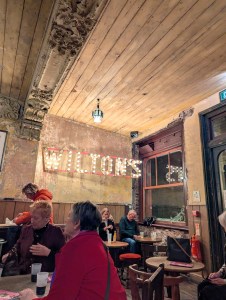
In the Mahogany bar after the show
It is easy to moralise that Ruth Ellis was a murderer. She did not deny this. It is easy to brush aside the abuses that Ruth Ellis endured, but, this powerful play shows us a vulnerable young woman, so angry with the wrongs that had been done to her, who wanted to be loved, who wanted nice things, but had a dependency on men who consistently let her down. My overwhelming emotion was sadness. The last woman hanged in England is an uncomfortable data point for all of our consciences.
 Awful Rigours and Wretched Pay
Leave a comment