
By Christine Swan
Last year, I visited Lille at Easter. It is one of two French cities that are very easy to reach from the UK. The entire journey only takes about ninety minutes which makes it convenient to reach from London in a morning, and still have most of the day remaining. I had previously explored the Lille Europe area but had not previously ventured into the City.
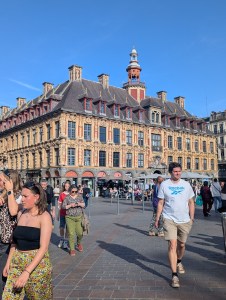
Spring in the city of Lille
At the time I visited, I had a list of specific places to visit, associated with families in my ancestral tree: Valenciennes, Tourcoing, and Lille itself. After my train had arrived, I walked into the city centre and was very impressed. Lille is a beautiful place, with stately buildings, fascinating museums and a lively ambience. Most of the historic buildings are definitely French, but there are also flashes of Flemish architecture as a reminder of how close it is to the Belgian border. In fact, trains from Lille Flandres cross the border many times a day, without many travellers noticing the shift.
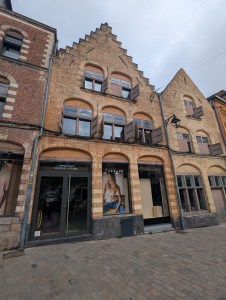
Flemish style architecture in Vieux Lille
I have now spent over two decades researching my family tree and have been delighted to confirm the legend that we really are descended from Huguenots. I can now name names, I have visited where they lived, and walked the same streets that they did. I have come to appreciate that my forebears also travelled across Northern Europe, to find work but to also escape religious persecution.
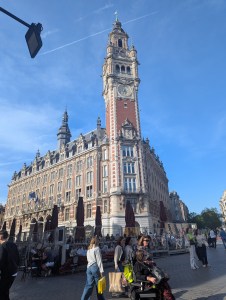
Lille architecture is also fantastically French
The Despaigne family name means “from Spain” although I have not found any evidence of this in my branch. The Ancestry website assures me that it is a comparatively rare name in modern France. “My” Despaigne family left France for England at some point before 1586. The first wave of Huguenots and Walloons arrived after the St Bartholomew’s Day massacre of 1572, and many made their way to Canterbury, to join the first families to have settled there.
My Eurostar train would have passed close to Ashford in Kent, rather than running close to Canterbury but, as it raced through the green fields of Kent. I thought of the exhausted families, escaping with only what they could carry, crossing these fields to find sanctuary.
My journey across Kent and Northern France was simple in comparison to the Despaigne’s
The journey from Lille would have been perilous and costly. Protestants hoping to escape would have had to follow specific routes, to pay for their passage, and put their lives in the trust of their traffickers. Once they arrived at the coast, they would have boarded a small boat to escape to England. Jean Despaigne would have been in his fifties when he made the journey. His son Gervois, or Jervais, would have been in his twenties, along with two sisters, Agethe and Peronne, and two brothers, Pierre and Francois. I can imagine that travelling in such numbers would have bought its own hazards as well as increased costs. I am currently unclear of the fate of their mother, Jaquesmine. One source suggests that she travelled to Leiden in the Netherlands. This feels unlikely somehow but I will seek to prove or disprove this theory.
1594 seemed to be a tragic year for the Despaigne family. Gervois, his father Jean, and mother Jaquesmine, all died. Gervois had four children, two sons and two daughters. My family link is with his eldest son Jean, who was born in Canterbury in 1586. Jean’s youngest son Henry and his middle granddaughter Esther, were the final two generations of the family to be born in Canterbury. Esther married in Canterbury, but then, like so many, travelled North to Spitalfields.
Returning to Lille, the earliest residence that I have found for the Despaigne family, I considered their life in sixteenth century Northern France. Lille was a Catholic city and the rise of Protestantism was not embraced widely. The Beggars rebellion of 1566 was a protest against economic hardship. After the mass exodus following the St Bartholomew’s Day massacre, in 1581, a group of Protestant rebels, the Hurlus, tried to sack Lille and take control of the city. They destroyed religious icons, started fires, and caused chaos.
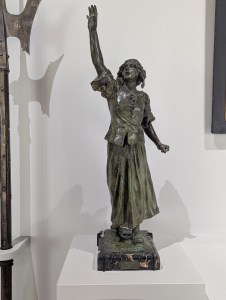
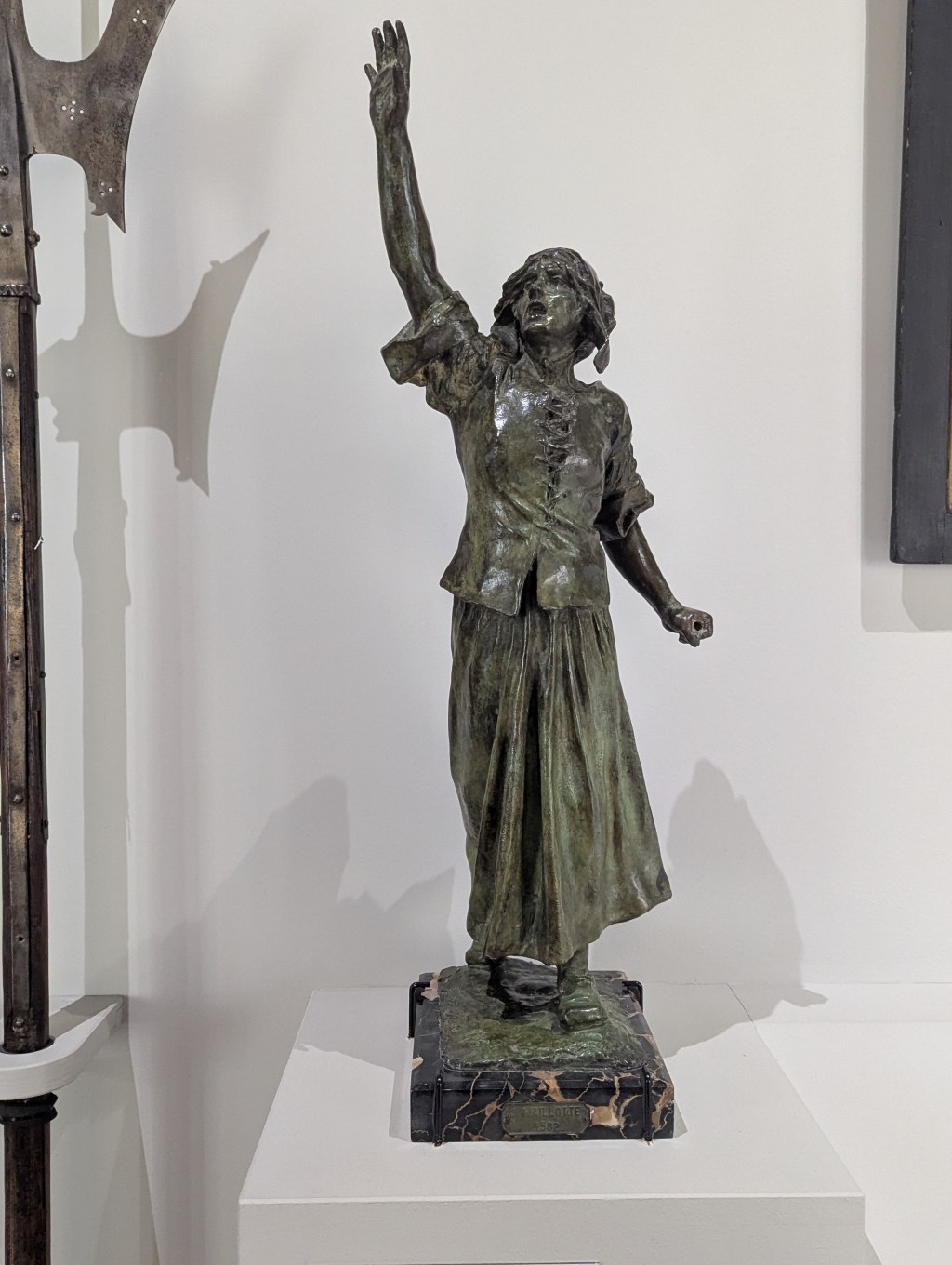
Jeanne Maillote – the heroic innkeeper who led the fight against the marauding Hurlus. She is an iconic heroine of Lille
“Je suis un descendant des Huguenots!”, I proudly announced at the Musée de l’Hospice Comtesse, and couldn’t quite understand why it appeared to fall flat. The museum detailed the city’s history and it’s defence against the Hurlu’s attacks. History is complex, treading lightly and respectfully is important wherever in the world we are.
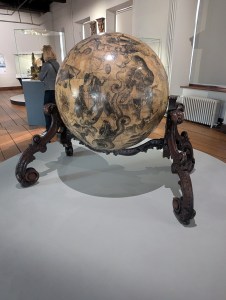
The stunning celestial globe in the museum
I had a fantastic stay in Lille and it was all the more special that I have a bond with the city that extends for over four hundred years. The museum building above, in part, would have been familiar to earlier Despaignes. This Easter, I am planning another walk through time in another area of Europe. When I began researching my family tree, I did not believe that it would take me further than the East End. Instead, it has been a fascinating journey through time and across the continent.
More information
The virtual museum of Protestantism – https://museeprotestant.org/en/notice/
Musée de L’Hospice Comtesse – https://mhc.lille.fr/
Lille Tourist Office – https://en.lilletourism.com/


Leave a comment