
By Christine Swan
Some of my earliest memories are of visiting my grandparents in Walthamstow. Every Saturday, my parents would drive my sister and I from south of the river to the north. There were various options. The Blackwell Tunnel was the least favoured option, the Woolwich ferry, or via Tower Bridge, were considered of greater interest.
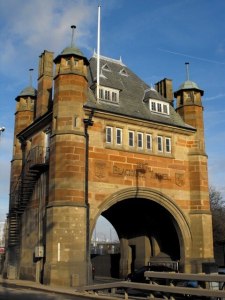
Southern gatehouse marking the entrance to Blackwall Tunnel – By Peter Thwaite, CC BY-SA 2.0, https://commons.wikimedia.org/w/index.php?curid=13896550
The family would convene in the lounge-dining room at the back of the house. The front room, or parlour, was cold, neat, but rarely used. One by one, my aunts and uncles would arrive, with my cousins. When conversation turned to football or politics, and the weather was suitable, we children would decamp to the garden to play. In inclement weather, we would find some amusement indoors.
My grandmother, Nanny, did not possess a refrigerator. Instead, perishable goods were stored in a cupboard with a metal grill at the front. My favourite dessert was tinned fruit cocktail and tinned cream, which I can still visualise and taste. Bland but smooth and creamy, it always felt like a treat. We may also have been provided with some sweets. I remember eating sweet cigarettes and coconut “tobacco” sitting in Nanny’s garden. Her husband, my grandfather was a prolific smoker, but Nanny was not.
If the weather, and us children, were good, we might have walked the short distance to Lloyd Park. I don’t remember ever visiting the William Morris Gallery, but I do remember the moat with colourful and exotic Mandarin ducks floating about.
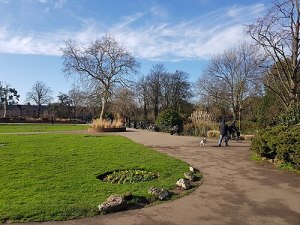
Lloyd Park, Walthamstow – By Irid Escent – 20200208_125339, CC BY-SA 2.0, https://commons.wikimedia.org/w/index.php?curid=89077516
As evening fell, we would congregate in the lounge, in winter around the coal fire. The heat and lateness of the hour, would often lull me to sleep, before I was rudely awoken and told that it was time to leave. In preparation we would climb the dark stairs, lit only from the hall below, to visit the bathroom – hoping that nobody would turn off the light downstairs, and plunge you into total darkness.
After farewells, kisses and hugs, we would step out into the cold night, and cross the road to the small road opposite where, during World War II, a V2 rocket had landed and destroyed Nanny’s house. It had been rebuilt – hence having an inside bathroom and relatively modern kitchen. We would then begin the long drive home, pressurising once again to return via an interesting route and to be able to see across Kent from the top of Shooter’s Hill. We called the twinkling lights that we could see “fairyland”, even though we could rationalise that these were distant sodium street lamps.
Daisy Betts was born in 1904. Her father, George, was a costermonger, but had the business acumen to supply products in a timely way, to meet a seasonal need. He sold coal and firewood during the winter, fish and other products the rest of the year. Daisy’s mother, Rebecca, kept house, in their little home in Walthamstow. Daisy was one of six surviving daughters and two sons. George worked hard to provide for his family, but life was not easy. In 1911, she was one of seven children living at home. Rose, the eldest, was contributing to the family coffers as a calendar machinist in a laundry, and George junior was working with his father. All of the remaining children were scholars at home. All nine household members were crammed into just four rooms.
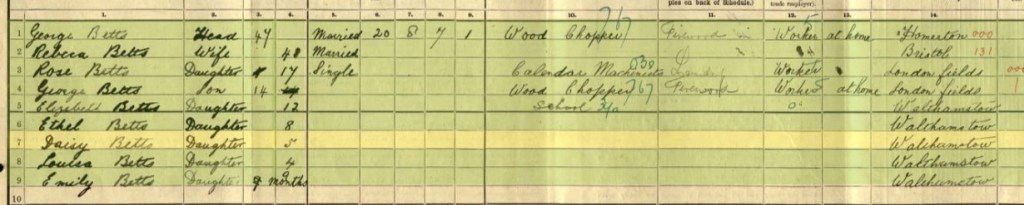
The Betts family in 1911, including Daisy, highlighted
In 1921, Daisy was seventeen years old and still living at home but she too was working in a laundry in Blackhorse Road. The massive Achille Serre laundry and dry-cleaners seemed to date from later in the 1920s but there may have been other units preceding this. Daisy’s eldest sister, Rose had married, which had permitted long-term lodger, William Godlington, some space to return to renting a room in tiny George Cottage on Chingford Road. Son George is listed as being “in the army” and it may be that it was he who introduced Daisy to my grandfather, Albert, who was also a soldier.
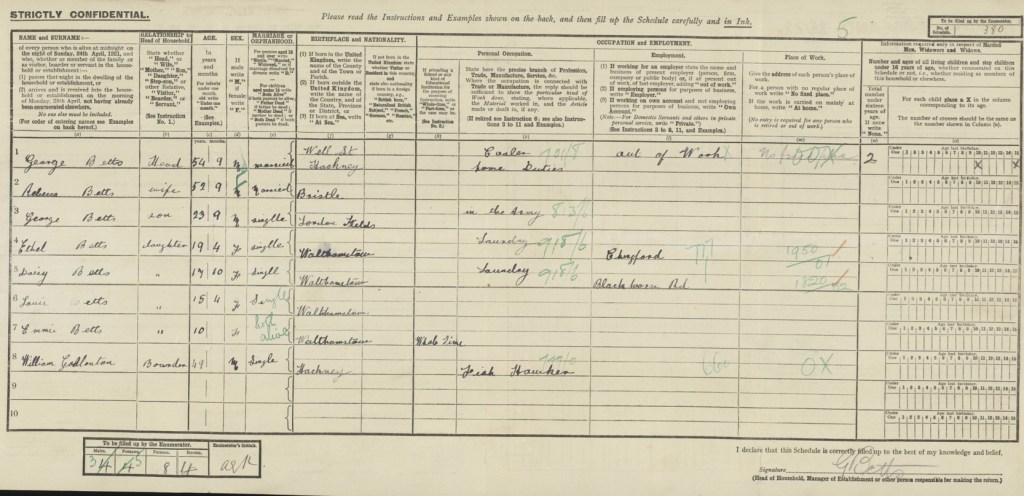
The Betts in 1921
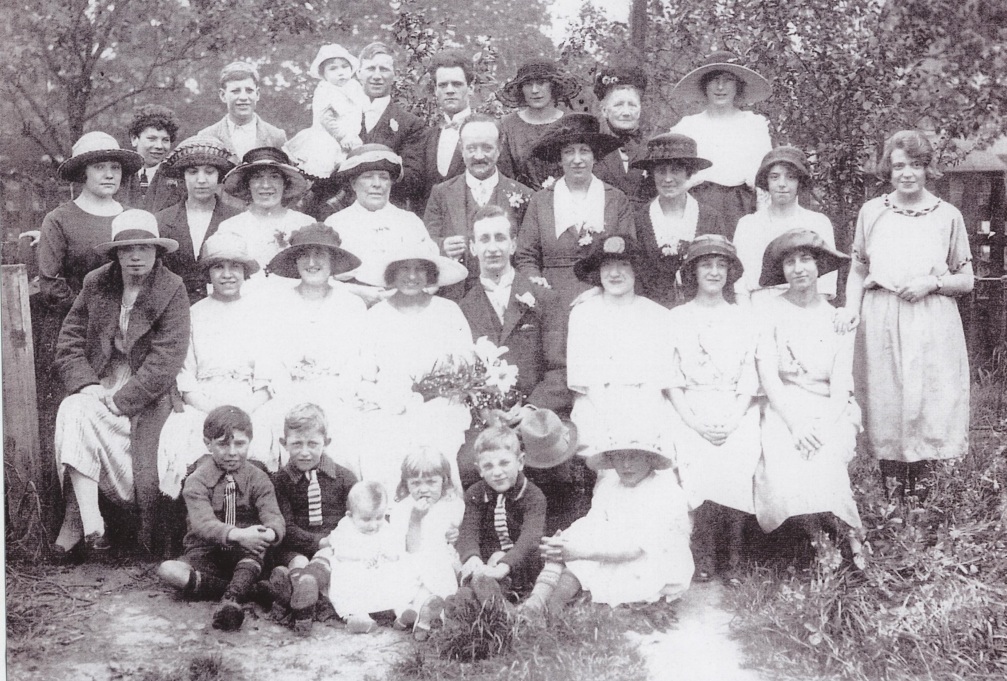
Daisy’s sister Elizabeth, aka Lizzy, married in 1921, at St Margaret’s Church, Barking. I cannot explain why she did not marry in Walthamstow. Lizzy and her sisters smile out from the photograph, a pastoral scene of happy families, gathered outside the church on a fine spring day. Small children, sit on the grass, relatives and friends that have remained anonymous for over a century.
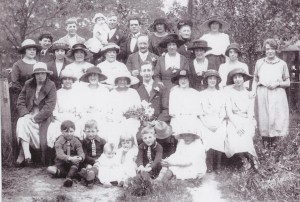
Betts family wedding 1921 – Daisy Betts is right of the groom, Joe Lewis. The bride is Lizzy Betts
I can easily spot the smile of my seventeen year old Nanny, glowing from under the brim of her large, flower-trimmed hat. I can also identify my great grandmother Rebecca but, not my great grandfather. I asked my Dad why not. “He wasn’t there”, he told me. “Why ever not?”, I asked. “He was disgusted because she was in the family way”. It seemed to be a concept from a different era and of little consequence in modern times, but for George, who was illegitimate, this was a disappointment. He hoped for better from his girls. I love this photograph as it is one of the few that captures my family so naturally, in a moment in time.
Daisy married in 1923 when Albert returned from India. I remember my grandfather’s wiry arms, decorated with regimental tattoos, his fingers stained with nicotine from years of heavy smoking. Nanny was kind and soft. She loved us all and spoiled us, but in small, rather than extravagant ways.
Daisy and Albert’s first son, also Albert, was born in 1924. Grandad worked various jobs, including as a builder’s assistant, before securing work as a nurse and a pathologist’s assistant. Daisy and Albert rented a cottage next door to her parents. My father was born two years later and always claimed to be Rebecca’s favourite. He was able to run next door to see her whenever he wanted and used to claim that he hadn’t had any tea in order to avail himself of a second meal.
The family of eight eventually moved into a new council house which, as I mentioned previously, was destroyed during World War II. Fortunately, although the house was destroyed, the family survived, and my father was permitted leave to fly back from Germany, where he was serving in the army, to return to visit them in the rest centre.
The council house was rebuilt, and it was the same as I remember from my childhood days. Even when my relationship with my parents was fraught, I would travel by bus to visit my Nanny. She remained consistently kind, non-judgemental, and always ready with a cup of tea, a slice of fruitcake, and good advice. I can remember one occasion when the heavens opened, and I arrived giving my best impression of a drowned rat. I sat by the electric fire wearing my Nanny’s borrowed clothes with mine drying on an airer. How we laughed about it.
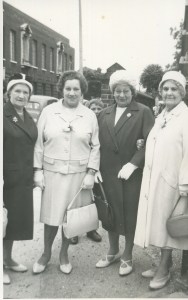
Nanny, left, and her sisters 1960s
I miss her terribly. Sometimes we are almost too close to talk to our parents. Skipping a generation somehow makes it easier to open up and have a frank discussion. She will always be my Nanny, sitting by the electric fire, opposite me wearing a different version of her clothes, attempting to dry out. She will forever be the beautiful young woman smiling beneath a wide-brimmed hat, on a spring day.
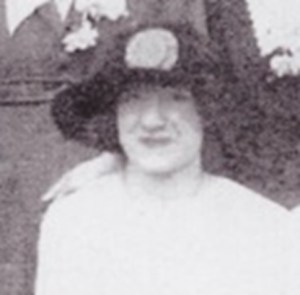
Daisy Betts, my Nanny


Leave a Reply