

By Christine Swan
“Do we want a kitten?” my daughter asked on one of the first Sundays after she had gone to university. “It’s urgent, it’s got to go now.” I still didn’t really understand why or how but it seems that Simba was bought or adopted by an international student who did not appear to understand that a cat can live for over twenty years, while their course was probably of three or four years duration. The student house landlord had evidently undertaken a visit and the kitten had been discovered. When my daughter collected her, she was not given any food, bowls, a litter tray or litter – the usual trappings of a cat owner. “Don’t you want to say goodbye?” my daughter asked. The girl allegedly did not even turn her head to see her kitten loaded into the carrier, but simply said “Bye”.

Simba slept and slept on her first day
When she was home with us, she slept, and slept, and slept – far more than a kitten should sleep. She seemed absolutely exhausted and needed complete rest. I did wonder if she was unwell. The tiny, black velvet bundle seemed so vulnerable. All of our cats have been relaxed and confident, but Simba worried me. We put food in a bowl and showed her where it was, and where her water was but she ignored it and settled back to sleep.
I cooked our food which included jacket potatoes and baked beans. Simba suddenly leapt up, onto the table, grabbed a potato skin from a plate with lightning speed and ran off. I was astounded how quickly her mode had flipped from sleep to snatch and grab. It happened so quickly and was quite unusual behaviour – baked potatoes not being the food of choice for most cats. Similarly, running a tap had a similar effect, she leapt up onto the sink and drank as if her life depended on it. Other of our cats have enjoyed water straight from the tap, but this was desperate and opportunistic behaviour, as if the water supply would soon dry up.

The soapstone solitaire game was enormous fun for a kitten
The kitten’s behaviour was quite unsettling. She had learned to steal food and get water whenever she could and although she was old enough to be away from her mother, she seemed very tiny and nervous. the other three cats in the household were fortunately relaxed and accepted her as a new resident surprisingly calmly. Their nonchalant ways perhaps helped her to realise that this place was safe, and that food and drink was always available Our local vet said that she was about twelve weeks old, but was healthy when she had her first jabs and kitten health check.

A first taste of snow
Our new kitten hadn’t always been named Simba. Her previous name was “a fei” which means “fatty” or a hooligan in Cantonese I believe. She did not fit the first interpretation of the name but perhaps did the second. A Christmas tree was a colourful climbing frame, and curtains were kindly provided for running up vertically. After her booster jabs, she was allowed to explore outside, which she came to love. The large garden, with trees to climb and grass to run about on, became her kingdom – all that the light touched, she was free to explore.

Freedom to explore and be a cat
As well as enjoying the great outdoors, Simba enjoyed confined spaces. A box had to be jumped into. I still empty boxes quickly to present them for inspection as suitable hiding and sleeping spaces. Smaller boxes, even of the impossibly small variety, were seen as extraordinary places with enormous potential – rather like her being the George Clarke of the cat world.
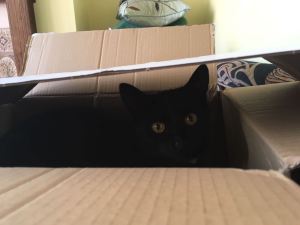
A box is catnip
Some cats are more affectionate while others are more indifferent but still embody the concept of “cupboard love”. Simba is of the former category. During the day, she tends to sleep but wakes in the evening and expects to be fed to a schedule. She enjoys the garden in the evening, as dusk falls, she comes alive. I am often greeted by jingling bells when I reverse my car onto the drive and she will run the full length of the garden to show me the way. Occasionally, the jingles take a different direction and I realise that she has bounded up the apple tree in just a few leaps. Simba has an extraordinary skill in tree climbing. This is due in part to her extra toes and claws which provide additional traction. Polydactyly is a dominant trait with some clear evolutionary advantages. “Cats with thumbs” were favoured as ship’s cats and were taken on voyages chiefly as mousers, but they were also more adept at gripping onto surfaces during heavy seas. Polydactyl cats were also much loved by Ernest Hemingway and are sometimes termed “Hemingway cats” as a result.

The more claws, the merrier
My elderly parents adored Simba and she was a regular visitor. My father could remember very little but always remembered her, even if he did believe that her name was “Timber”. My mum loved me putting her gently onto her lap so she could stroke her even when she was unable to move many other parts of her body. Dreamies are the universal currency for making cats do what you want. Stay in, go out, beg or sit. Simba knew exactly where they were stored in my parents’ house and knew that she was expected to amuse them for treats.

A comical character who knows how to entertain
After her evening perambulations, she will come back into the house. If it is late and everyone is in bed, she will cry and call until she finds some human company. Occasionally, she will seek a warm lap to sit on and genuinely seems to enjoy being around people. She has grown into a confident, relaxed companion. She has no need to worry when her next meal will be or what might happen. She knows that her care is a priority. In return, she is a reminder of our dearly beloved daughter, who loved all cats.
Did we want a kitten? Of course we did.
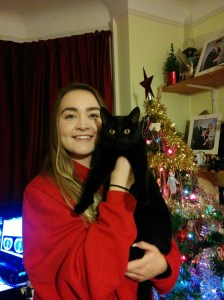
All photographs by the author


Leave a Reply