
By Christine Swan
I love exploring the places where my ancestors lived and worked, and it has been a great pleasure to discover my links with the mainland. Last week, I set off for Antwerp to research my Belgian connection.
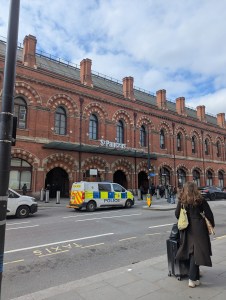
My journey to Antwerp starting at St Pancras International station
I arrived in a sunny spring evening to the magnificent, if complex, Antwerpen Centraal station. This multi-layered cathedral to rail travel, manages to pack in a large number of rail connections across multiple levels, thus reducing its geographic footprint, with escalators and stairs connecting platforms. A failed escalator saw me climbing the last two flights at the end of a long day of travel. Fortunately, my hotel was very close by, and so, after checking in, I set out to explore the city before nightfall.
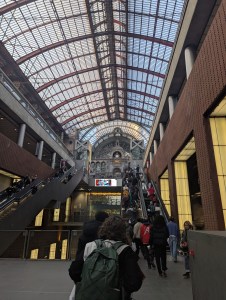
Arriving at Antwerpen Centraal station
The temperature was still pleasant, causing me to drape my Harris Tweed jacket around my shoulders, rather than fully wearing it. Among the busy streets, tram lines, cyclists, and closing shops, I tried to imagine the City as it would have been five centuries ago.
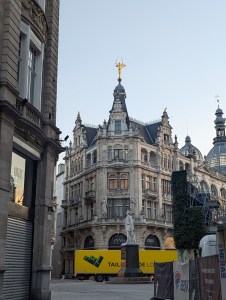
I began my exploration of the city as soon as I arrived
Although Antwerp has a historic centre, in reality, signs of sixteenth century survivors are scattered throughout it. Some have a date on the side of the building, but others share enough similar features to be of the same period. Somewhere among these streets, there once lived a man called Corneille Sedt, or Le Sedt. I estimate that he was born around 1560.
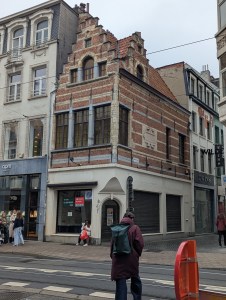
Some buildings tell their age – this one has a plaque with a date of 1520
In the sixteenth century, Antwerp was a centre of trade. Its situation on the Scheldt river allowed easy access to sea routes and merchants became wealthy as new products were imported and sold. A stock exchange was opened as early as 1531 and it became a centre for the sugar trade and spices.
However, in the latter half of the 1500s, the Spanish invasion led to fighting, massacre, and besiegement. In 1585, Protestants were given two years to leave the city of Antwerp. At this point, I have to use conjecture, rather than fact, and despite hours of research in the online archives of Belgium, France, and England, I have not plugged the gaps in my evidence.
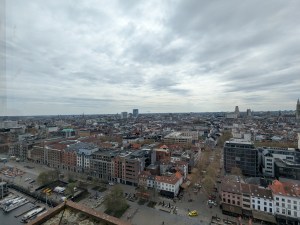
Looking out over the whole City of Antwerp
After 1585, I believe that Corneille left for France. I also suspect that he was working in the weaving industry. Antwerp was a centre for silk weaving and the manufacture of special fabrics such as brocade and velvet. Tourcoing was also a city renowned for its textile industry. Some hints that I have found indicate that Corneille might have been a fabric dyer, rather than a weaver. The term teinturier en bleu indicates that he might have used the common dyestuff Woad, which has been used since medieval times, and was grown in Northern France. It is unlikely that Indigo was used as this would have been imported and therefore, too expensive.

The quiet high street of Tourcoing
Google Maps assures me that you could walk between Antwerp and Tourcoing in around twenty six hours. As the countryside is flat, there would not have been any geographical features to present a challenge but, with the advancing Spanish army, hostility towards Protestants, and limited places to conceal himself, this would have been a hazardous journey for Corneille. Maybe he was aided along the way by sympathetic people or groups. I know that his quest was successful because in about 1590, he married Jeanne Boullin, daughter of Louis.
The entire family left Tourcoing soon after for Canterbury. As I have written previously, there were established secret routes, and help available for those willing to pay for passage to the coast and across the English Channel. My journey was much more straightforward. The Eurostar train that I caught back from Antwerp passed through Lille, close to Tourcoing, and then through Kent, mirroring Corneille’s journey.
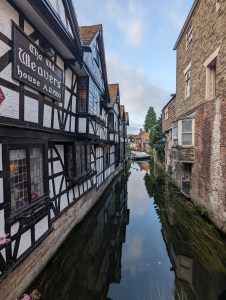
Weavers’ houses in Canterbury
Marie was born in June 1592 in Canterbury, Corneille and Jeanne’s first child born in England. They went on to have eight more children, although not all survived to adulthood.
Corneille became a minister at the French church in Canterbury and died, aged about sixty four. In his will, he leaves money to the local poor, his wife Jeanne, and two of his sons, Corneille and Jacques. Other children survived him so I am unsure why he did not share his property with them.

The Crypt Chapel in Canterbury Cathedral, where Corneille was a minister
Thus concludes the story of my Antwerp ancestor, Corneille Le Sedt, but not the end of my trip to the city of his birth. I sought out the sites that would have been familiar to him during his early life there. Although there is a historic centre, many of the oldest houses are scattered throughout the City. The best tactic to find them, is to wander about looking for them. Some bear dates to indicate their age, but others have sagging stone window frames, iron anchor plates to pull together crumbling brickwork, and irregular window glass as clues.
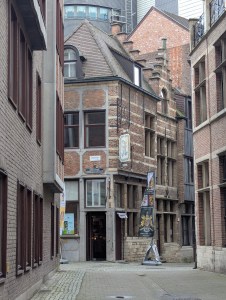
The oldest house in Antwerp, now a restaurant, dates from the fourteenth century
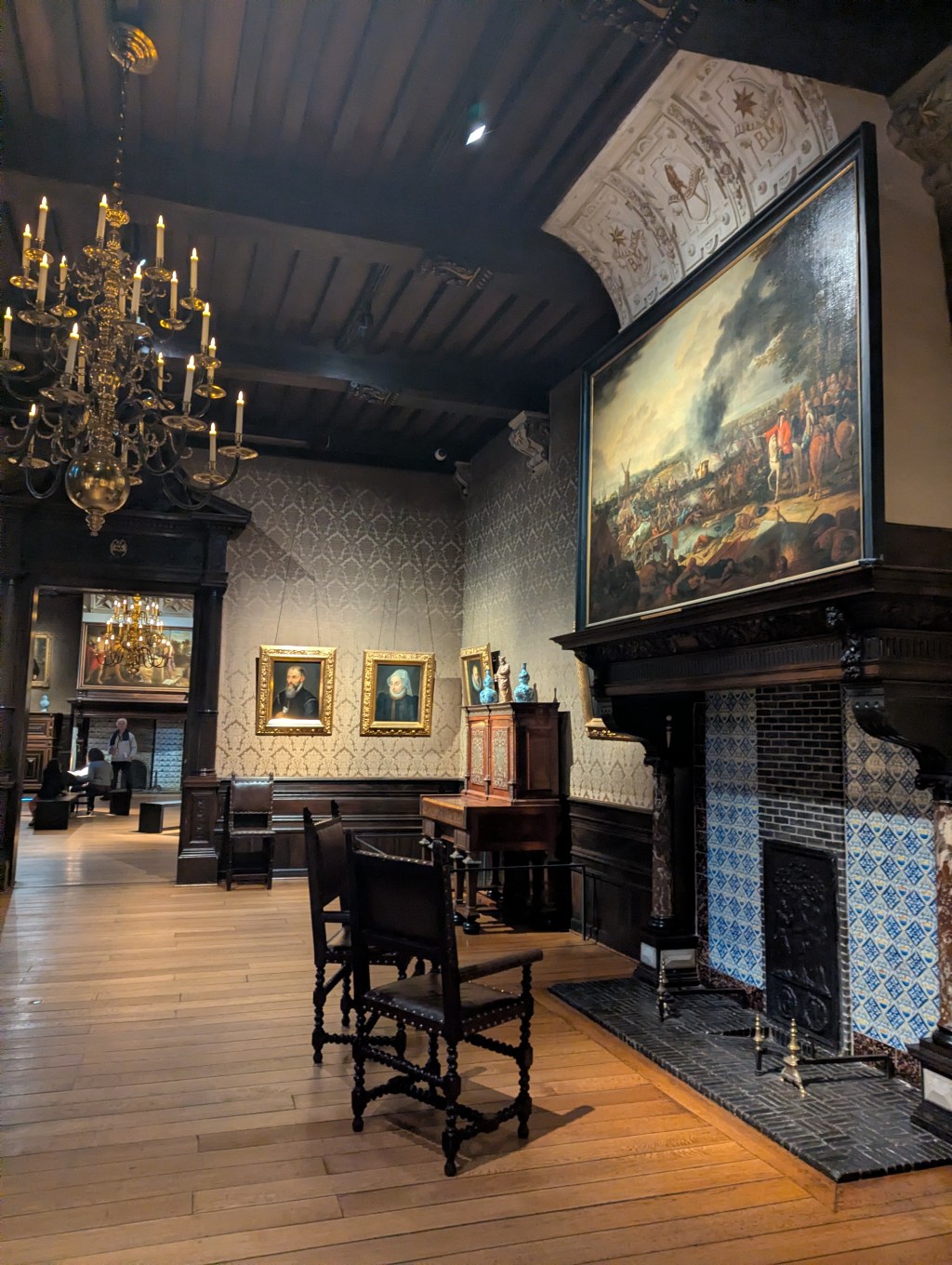
Disappointingly, I did not find a great deal of evidence of the once thriving textiles industry, but a greater emphasis on Antwerp’s significance as a port, and trade hub. I did visit the excellent Museum Plantin-Moretus in the house of a sixteenth century printer. This definitely inspired my imagination of life in Antwerp in the time of young Corneille. Each room in the house, including the shop, from where books were sold and collected, provided an insight that was valuable and informative.
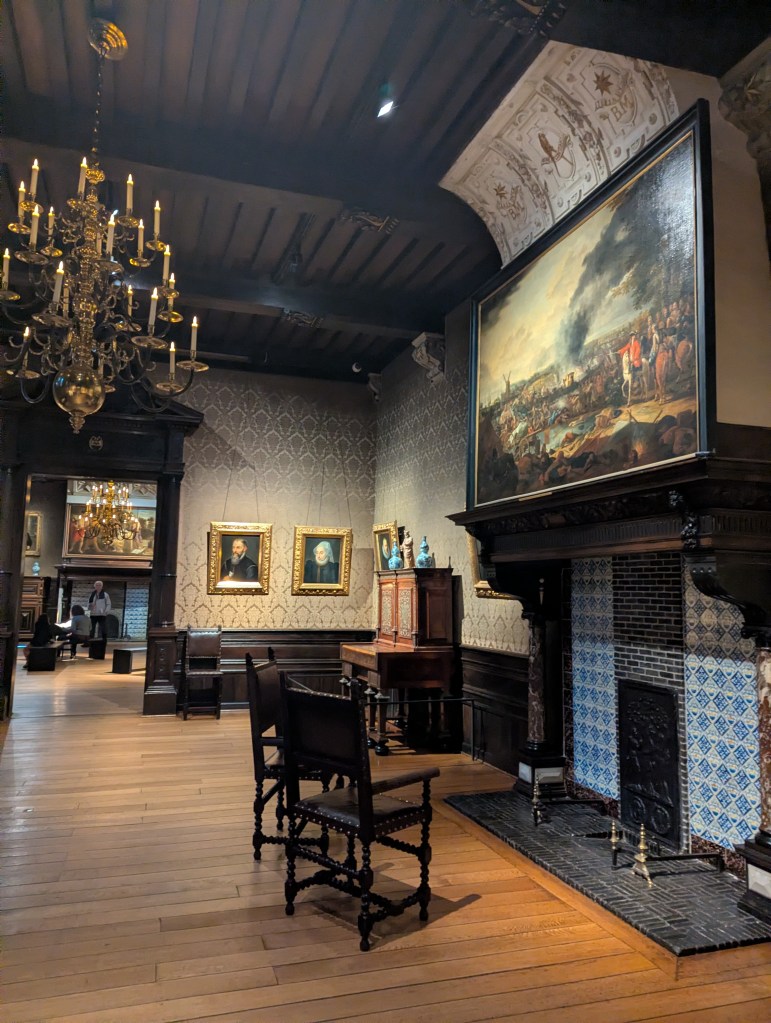
Opulent sixteenth century living at the Museum Plantin-Moretus
I visited the old Vleeshuis – a trade hall for merchants who sold meat, which would have been another building that Corneille might have known. It is a huge building, now used as a museum and space for musical performance. Unfortunately, it was closed when I visited but the red brick and cream mortar building is a dominant feature of the oldest part of the City.
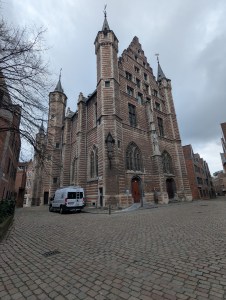
The Vleeshuis was a trade hall but is now a music museum
I also visited Antwerp’s Beguinage just before it closed for the evening. The kindly host gave tourists a few minutes before she closed the gates for the evening. A beguinage was a religious community of women, sometimes widows, who lived together in faith, but without the closed nature or strict rules of a convent. The red brick houses were situated around a beautiful garden which must have been a haven of peace for the women who lived there. I had previously visited the beguinage in Valenciennes when I visited last year.
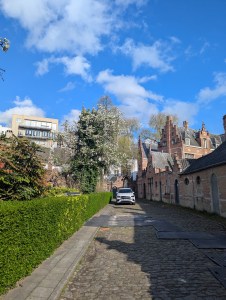
Inside the peace of the beguinage
The following morning, I caught a train from Antwerp to Brussels, and then to Lille and London. Whenever I carry out these trips, it never ceases to amaze me, how people managed to carry out these journeys four hundred years ago, with all of the hazards that they would have needed to overcome. And here I am, all that time later, remembering them all. This was the original purpose of this blog – to tell their stories. The more I research, the more I discover, and life never ceases to fascinate me.
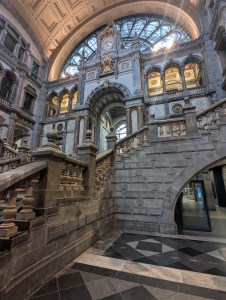
Antwerpen Centraal station is a cathedral to rail travel
More information
Antwerp tourist information – https://visit.antwerpen.be/en
Museum Plantin-Moretus – https://museumplantinmoretus.be/en/museum-plantin-moretus
The beguinages of Flanders – https://www.visitflanders.com/en/stories/discover-flanders-historic-beguinages-oases-calm
Vleeshuis Muziek Museum – sadly closed for restoration when I visited – https://museumvleeshuis.be/
 Awful Rigours and Wretched Pay
Leave a comment