
By Christine Swan
In another time, Esther Deighton would perhaps have trained as a nurse. Throughout her life, she served others, sometimes at the very end of their lives. How do I know this, you may ask? It is because of all of my ancestors, Esther’s name appears most often as the informant of a death.
Esther was born in 1823, a middle daughter of William and Eleanor Deighton, and baptised in St Matthew’s Church, Bethnal Green. At that time, the family were living in Brick Lane, just along the road from the Flower Pot Inn, where William met with other members of the union of Spitalfields weaving operatives, as a trade representative. Times were very hard for the silk weavers of Spitalfields and Bethnal Green, as they struggled to receive a fair price for their labour and goods, against the rising tide of cheap imports. The family would have been poor, there is no doubt about that. William represented the Jacquard weavers – makers of patterned silk, produced using a Jacquard loom. William hosted a stream of apprentices and it would appear that he was a significant name in the silk weaving realm. However, by the 1820s the beast of poverty was scratching at the door.
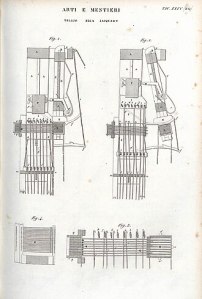
Jacquard’s complex design for a loom capable of weaving repeating patterns – By Anonymous – Available in the BEIC digital library and uploaded in partnership with BEIC Foundation., Public Domain, https://commons.wikimedia.org/w/index.php?curid=52221321
Brick Lane would have been a bustling place, lively with shops plying their trade, weavers, drapers and tailors, tobacconists, confectioners, and bakers. I visited a week ago, and although the bright shop fronts now sell vintage clothes, vinyl records, and all manner of delectable foods, many of the buildings would have been familiar to the Deightons in the first half of the nineteenth century.
The former Flower Pot Inn at the top of Brick Lane
Esther Deighton was William and Eleanor’s fourth child, and they later moved to properties in Hunt Street (now Hunton Street), and North Conduit Street, close to Bethnal Green Road. This represented a gradual move away from Spitalfields, and deeper into Bethnal Green. As each of their children was baptised, the family moved, never remaining in one location for more than a few years.
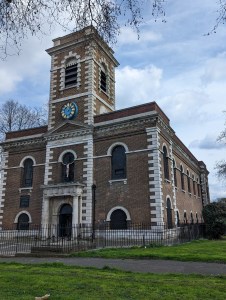
St Matthews Church, Bethnal Green
On the day of the 1841 census, Esther appears not to have been living at the Deighton residence, in Luke Street, Shoreditch. I was initially surprised that William had taken his family further west again. At this time Esther would have been eighteen and may well have been working in service. The 1851 census presents another mystery. William Deighton died in 1849, leaving Eleanor a widow. Esther’s sisters Mary and Eleanor had married. Her sister Ann was also married, but not living with her husband. I found one record that looked hopeful. The ages of Esther, her mother and sisters Ann and Elizabeth were correct, except that the mother’s name was given as Esther rather than Eleanor. Could this have been an error? Quite possibly, as there appeared to be no other record remotely similar otherwise. If it was truly the Deighton girls, they were living in Fleet Street, Bethnal Green. This is a far less imposing thoroughfare than the famous road that joins Westminster to the City of London, famous for its association with journalism. The remnant of Bethnal Green’s Fleet Street remains, but it has been dissected by the railway and now runs as a graffiti-clad path and footbridge, leading to Cheshire Street, previously Hare Street, where the Deightons lived prior to moving to Brick Lane.
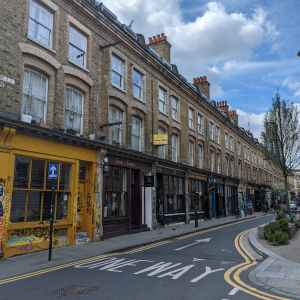
Cheshire Street, which was Hare Street, one home of the Deighton family
Looking at the details of the 1851 census record, although Esther’s sister, Ann, was married, her husband had recently been released from Newgate prison. Daniel had also assaulted Ann in a drunken rage previously so all was most definitely not well in the Crudgington household. Perhaps living in an all-female household was a more secure and peaceful prospect. The youngest member of the household was Mary, aged nine, the exact age of Ann’s daughter, and my great, great grandmother, Mary Ann. The entire household, Mary Ann excepted, were occupied as silk weavers, the Deightons’ principal occupation. There are too many coincidences for me to dismiss this record, and so I conclude that this explains Esther’s whereabouts in 1851.
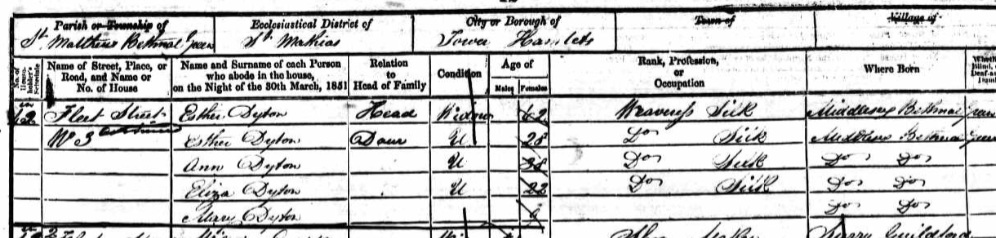
A female Deighton household that I believe was home for Esther in 1851
In 1861, Esther was living with her sister Elizabeth in Parliament Street, now Witan Street, close to Cambridge Heath Road. Intriguingly, another Deighton child was living in the household, Emily, aged four. I discovered that Emily Sophia Barford Deighton, was Elizabeth’s daughter with one William Barford. James Dunn is listed as a lodger but, as this was their mother’s maiden name, I suspect that James may have been their uncle, judging by his age in proximity to their late mother’s.

Esther was living with her sister, niece, and possibly her uncle in 1861
I was beginning to form an opinion of a family of forthright women, supporting one another with what little they had and were unwilling to marry if it was not what they wanted. Emily kept her mother’s surname, and Elizabeth did not marry her father.

Esther was the informant of her niece, Mary Ann’s death in 1878
Esther reappears in my family history as the informant of Mary Ann Deighton’s death in 1878, her niece by her sister Ann. This was the first record that I found associating Esther with the passing of a family member, in this case, her niece. She gave her address as Sebright Street. In the same year, she witnessed her niece Emily’s marriage to Arthur Boundy. In 1881 she was living with Emily, her husband and their young son Samuel in Finnis Street.

Esther living with her niece Emily in 1881
Tragically, the next death that Esther was to witness was twenty-seven year old Emily in 1884. Esther was the sole executor of her funds which amounted to £33 and 14 shillings. It is not apparent who the beneficiaries were but she was survived by her husband Arthur and son Samuel.
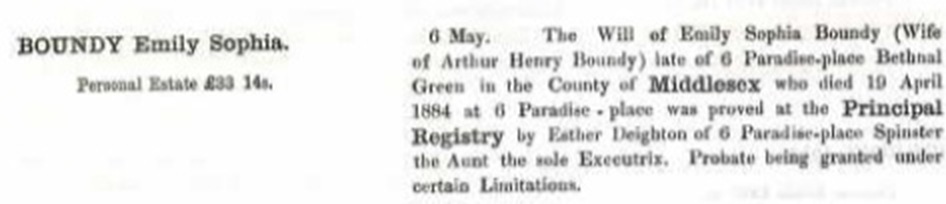
Esther was the executor of her niece’s will
In 1885, Esther was again an informant of a death – this time, for her sister Ann, from bronchitis. She had moved again to Viaduct Street, which now stands on the edge of Weavers’ Fields but, at that time, would have been more dense housing.

Spring in Weavers’ Fields – this was once dense housing
After having lost both parents, one sister and, her niece, in 1891 Esther worked as a servant for an elderly, paralysed lady in Sewardstone Road. A year later, she was a witness at the death of her brother in law Daniel Crudgington, who died of a stroke.

Esther was the informant at her brother in law, Daniel’s death
Through my research, I formed an image of a lady who cared for others in their time of need. She never married, and had no children of her own, but transferred her care to others. However, by 1998, Esther herself was finally ailing, and died aged seventy-six.
 Awful Rigours and Wretched Pay
Leave a comment