
By Christine Swan
I have previously written about my familial links with the small village of Castle Camps in Cambridgeshire. My terrifying great grandmother, Martha, who chased her grandchildren around the kitchen with a broom, and called them “varmints”, was my youngest link. Dressed in black, with grey hair scraped back into a bun, she ruled the roost of my aunt’s childhood. Ethel was the eldest of my maternal aunts. Even in her nineties, she was as sharp as a pin, and remembered her grandmother very distinctly.
Martha was the daughter of Stephen Mallyon, an agricultural labourer from Castle Camps. Thomas was Stephen’s father and also an “Ag Lab”. In fact, this was the most common occupation during the eighteenth and nineteenth centuries in the area. It may appear to be an uninteresting role, but it was essential. Manpower was needed to sow, maintain, and harvest the fields. It was hard graft – children aged seven were employed to scare crows or pick stones. Work started early and continued until the sun set. It was hard, physical work but, without a welfare state, although there was work for the fit and healthy, older people would have struggled. Local landowners would have rented out cottages, but with no work, and no income, destitution was the destination.
Additionally, in the nineteenth century, agricultural machinery revolutionised farming, reducing the number of labourers needed to perform tasks. This led to the Swing Riots of 1830 in which workers burned barns and smashed machinery to protest against rising unemployment. I have no record of Thomas being involved in any trouble of this nature but I am sure that this peaceful region of Cambridgeshire doubtless would not have escaped unscathed.
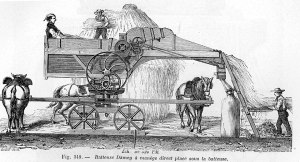
A horse powered threshing machine – By Unknown author (Dictionnaire d’arts industriels) – cropped image from 1881 Dictionnaire d’arts industriels, Public Domain, https://commons.wikimedia.org/w/index.php?curid=425243
Thomas was born in 1764 but I have a mystery around where. The 1841 census gives his birthplace as “Scotland, Ireland, or foreign parts”, although Wikipedia assures me that the surname Mallyon is English with strong origins in the East of England. In 1891, 38% of Mallyons in the UK were located in Cambridgeshire. So, Thomas’ birthplace will remain a mystery for now.

Thomas Mallyon in 1841 – not born in the county and listed as being born in Scotland, Ireland, or foreign parts
When Thomas was born, agriculture was purely manual and doubtless he doubtless would have started labouring at a young age. As my trail does not extend back to his birth, I also cannot identify his parents. Maybe Thomas moved to Castle Camps for work in the rich arable fields that surround the village.
He married Millicent Prentice in January 1799, when he was thirty-four years old and already a widower. Millicent was eleven years his junior. As with his birth, I do not yet have any records of his first marriage or any children from it. My great, great grandfather, Stephen Mallyon, was born in 1800, so was Thomas’ first child with Millicent.
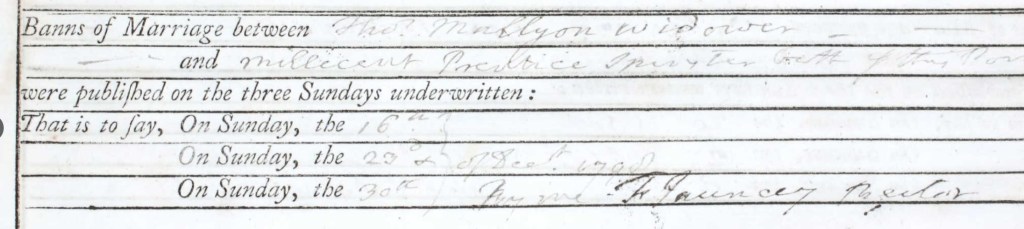
Thomas Mallyon and Millicent Prentice’s marriage banns in December 1798
Millicent and Thomas then had three more boys, William, James and John, all baptised in 1810, but likely to have been born in the preceding years. Their only daughter, Ann, was born in 1813, and youngest son Charles in 1816. Sons would have been useful hands to add to the family coffers when they reached working age, and Ann would have been a help to run the household.
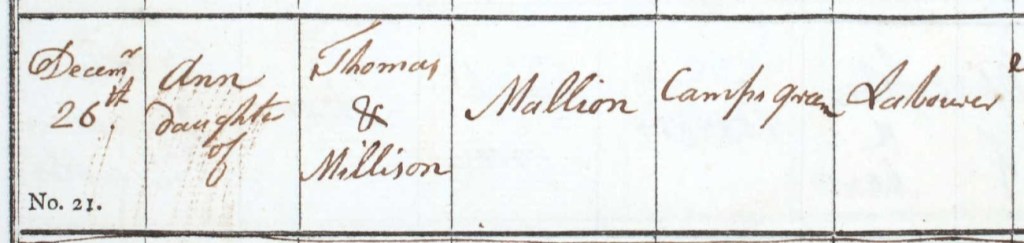
Ann Mallyon was Thomas and Millicent’s only daughter, born in 1813
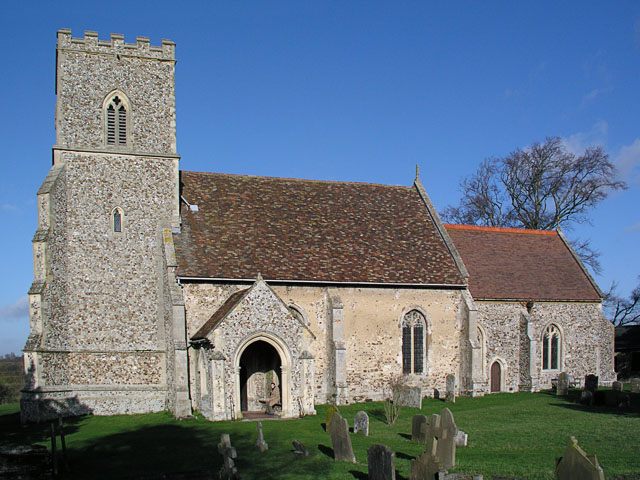
The earliest census was taken in 1841 when Thomas was seventy-seven years old, but he still gave his occupation as agricultural labourer. Milicent was sixty-six, and only their youngest son, Charles, was still living at home aged twenty-five. Their address was given as Camps Green. The “real” Castle Camps was centred on the area of the parish church of All Saints and the remains of a Norman motte and bailey castle. The Great Plague struck Castle Camps causing residents to flee to nearby Camps Green. In modern times, what was Camps Green, is now called Castle Camps, and the original village consists of the church, castle and a small number of houses. The modern village, complete with thatched cottages, pub and shops, is a short walk away.
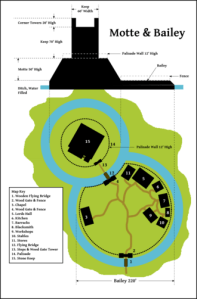
Motte and bailey castle, as was built at Castle Camps by the Normans – By Lordoftheloch – Own work, CC0, https://commons.wikimedia.org/w/index.php?curid=24714870
Thomas died in October 1850, aged eighty-seven and was buried in All Saints Church. Milicent had died several months earlier in February of the same year. Did disease visit the couple? Did Thomas die of a broken heart? Or not being able to manage at his advanced age?
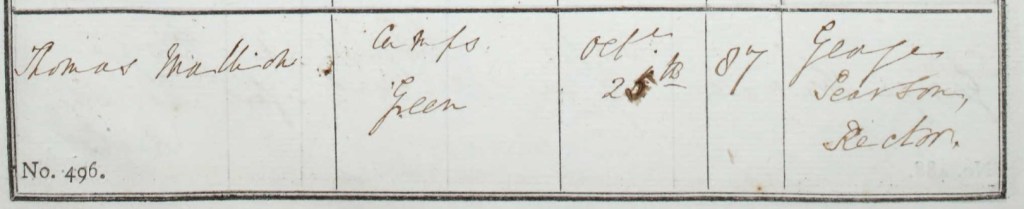
Thomas Mallyon died aged eight-seven and was buried in All Saints churchyard
There are Mallyons still in the Castle Camps area. Thomas’ son Stephen, travelled with his daughter and her husband, to Whitechapel at some point between 1871 and 1881. This my direct connection with Castle Camps was severed. I have been back to the village and have walked around the churchyard. After the industrialisation of arable farming, labourers abandoned the fields and headed to London. More people represented greater opportunity.
As we drove along the narrow lanes one late summer, with the sun shining low across the endless fields, a simpler life feels an attractive prospect. Workers cottages have been extended and modernised, the pub has been renamed, and wealthy commuters have bought desirable residences that allow them to reach Cambridge and even London, with ease.
Despite having moved around, I still feel that I have roots around the UK and in Europe. My link to a little English village in Cambridgeshire is here.
 Awful Rigours and Wretched Pay
Leave a comment