
By Christine Swan
Next week I will be another year older. This is always a time of reflection but one conversation this week made me consider all of the incredible achievements that I have witnessed during my lifetime.
The conversation related to the development of the internet. My mother was a computer operator during the 1970s, a huge desk-sized, noisy bulk. In the early nineteen eighties, the microcomputer revolution shrunk computers to a portable size. Whether it was a Sinclair ZX81 or a BBC Acorn Microcomputer, everybody was learning to program in BASIC. While training as a teacher, we were shown the wonders of the National Education Resources Information Service (NERIS) and the BBC’s Econet Local Area Network. That was the current education standard and I resolved to explore all of its hidden corners. These game changing devices featured in the education of so many children and, for a time, put the UK at the heart of computing development once again.

The BBC Microcomputer -I have wonderful memories of this versatile machine By BBC_Micro.jpeg: Stuart Bradyderivative work: Ubcule (talk) – BBC_Micro.jpeg, Public Domain, https://commons.wikimedia.org/w/index.php?curid=11672213
Some years later, I remember watching a video on a CD ROM, on a computer running Microsoft Windows 95. In that moment, I realised that this was the future. I had dabbled with an IBM XT running DOS 5.0, but I was less impressed than I had been with the ‘beeb’. Microsoft Windows 3.1 and 3.11 were very popular, but Windows 95 was a sensation. I remember having the feeling that very few people would now be scrabbling around trying to remember terminal commands, when the click of a mouse could achieve the same objective.
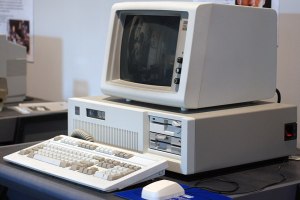
The IBM PC AT By MBlairMartin – Own work, CC BY-SA 4.0, https://commons.wikimedia.org/w/index.php?curid=50244059
I now cannot imagine my life without computers in it. I teach Computer Science Education so they are an everyday part of my work. There is a constant quest for a faster, more capable machine. Better graphics, smoother video playback, crystal clear sound quality. Did I ever think about this when I was using the BBC Microcomputer? I think not. Then it seemed and software was built to run on the hardware but now, software seems to drive the need for the hardware to run it.
In the nineteen sixties and seventies, the only EV that children were likely to have seen, was the milk float. Slowly gliding around the streets before dawn with their distinctive hum, the clank of bottles as much a part of early mornings as the dawn chorus. At the present time, whilst they are rather heavy, EVs now pack a performance punch, can be charged rapidly, and are becoming increasingly affordable.

The original EV – By Brian Snelson, CC BY 2.0, https://commons.wikimedia.org/w/index.php?curid=26875838
I remember the first moon landing. A black and white television was wheeled into our school hall and we sat on the parquet floor with our legs crossed waiting for the grainy image to show us a man, in a huge white suit and helmet, to step backwards onto the moon’s dusty surface. That evening, I tried to see the men on the moon. My Dad lent me his binoculars but I disappointedly admitted that I couldn’t see anything. One feature of travel that always fascinates me is that one can be move huge distances, and yet, still return to your starting position. The astronauts of Apollo 11 may have had similar thoughts – will we get back? Of course, happily, they did just that, and we were all amazed and joyful to watch the splashdown, just four days after that incredible small step.

We were very proud – and transfixed. By NASA / Neil A. Armstrong – Apollo 11 Image Library (image link), Public Domain, https://commons.wikimedia.org/w/index.php?curid=137926
When I was a child, music was undergoing similar groundbreaking journeys. For a much younger me, David Bowie was a visionary who represented the future. Bright, bold, weird and fearless, he was innovative throughout his brilliant life. Life on Mars is still a favourite. Nobody will ever rock a mullet like David Bowie, with bright turquoise eyeshadow, pink lips, and a pale suit, he was, and is, perfection.
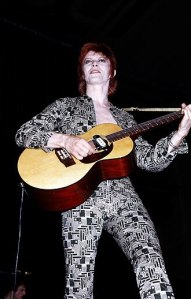
Always innovative and gone far too soon – David Bowie – By Rik Walton – https://www.flickr.com/photos/rikwalton/2259388449, CC BY-SA 2.0, https://commons.wikimedia.org/w/index.php?curid=9523995
Just five years later, my parents were watching the Today programme with Bill Grundy which featured a number of young people hoping to break into the music business. The whole episode was to go down into TV history and kick start the Punk movement. I was transfixed. Shocking clothing, noisy music, angry lyrics, sensational stunts, and expletives. Parents in the fifties were shocked by Rock and Roll but parents in the seventies were horrified. I dyed my father’s shirts black, stitched up my flared jeans with string and experimented with my hair. Punk was power. Punk questioned authority, oppression, and inequality.
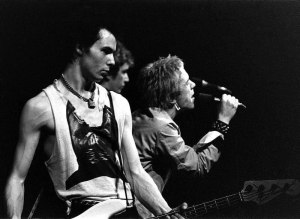
What an exciting time to be a teenager! By Riksarkivet (National Archives of Norway) Photograph: Billedbladet NÅ/Arne S. Nielsen – https://www.flickr.com/photos/national_archives_of_norway/6263353228/in/photostream/, No restrictions, https://commons.wikimedia.org/w/index.php?curid=32927533
I attended university at the end of the Punk/New Wave era and at the altogether more dandy, start of the reign of the New Romantics. I reinvented my sartorial style with huge pirate shirts, combat trousers and gold pixie boots. I could not quite match the designer clothes sold on the Kings Road, but I managed to emulate the trend within my student budget. Many bands wanted to perform in Chelsea, with its long associations with music and everything new and trend-setting. It was a wonderful place to be and a great time top be there.
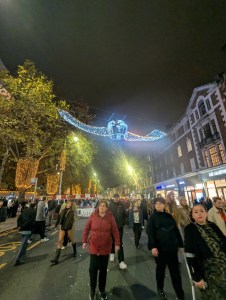
No more heroes any more – the punks and new romantics may be gone, but Kings Road will always hold a place in my heart
I have been vegetarian since I was a small child. At the time, this was considered dangerous and detrimental to development. I was assured that I would grow up weak, never reach my full height potential (I’m five feet ten inches tall), would have false teeth before adulthood, and would be permanently anaemic. None of these things happened, and, in 2025, vegan products are mainstream and widely available. It is recognised that vegetarian and vegan diets can be healthy and lower in saturated fats. I can remember visiting Cranks restaurant in the early 1980s and was amazed that I could have the pick of the menu without embarrassment or insult. Progress indeed.
Returning to Education, I have worked through the end of GCE O levels and CSE, and the introduction of GCSE, the end of corporal punishment, the introduction of the National Curriculum, SATS, ‘Baker days’ (now TED days), SATS, GNVQ, Curriculum 2000, AVCE, Academies and Multi Academy Trusts, HMIs, Ofsted, and an innumerable number of education ministers, to name just a few changes. As soon as teachers become familiar, something changes again. On the positive tack, it is never dull!

Thank heavens documents are electronic now
As I reflect on another year, I will try to stay positive about the year ahead. Like jigsaw pieces that fit together to make the whole of me, my memories and achievements are a source of pride, sometimes amusement, and always affection. I’ve come a long way, but there is still plenty of road left ahead.

 Awful Rigours and Wretched Pay
Leave a comment