

by Christine Swan
This week, I decided to focus on Isaac Crudgington’s wife, Elizabeth Passingham, as she had featured in at least one of his audacious crimes. The more I read, the more I found, and my sympathies towards Elizabeth changed as I read on. Hers is a story of trying to get by, of addiction to alcohol, estrangement from her family, and of homelessness. When I closed the book on researching her story, I realised that her life story was a testament of the failure of Victorian Society to help the desperately poor underclass and to lift them out of poverty, rather than to punish them. “Are there no prisons?…… And the Union workhouses, are they still in operation?”……”If they would rather die, then they had better do it and decrease the surplus population!”
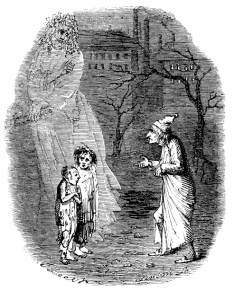
Ignorance and Want from Charles Dickens’ A Christmas Carol 1843 – By w:John Leech – https://archive.org/details/christmascarolin20dick, Public Domain, https://commons.wikimedia.org/w/index.php?curid=30299351
Elizabeth was born on the 7th December 1846, but was baptised eight years later, with her sister, Ann Frances, at St Thomas’s Church, in the Charterhouse district of London. The family’s address was given as 4 Davis’s Buildings, which I discovered, were in Whitecross Street – the very same street where I too lived as a baby. My family lived in a Peabody flat, but these were not built until 1883. St Thomas’s does not exist anymore. It was built in 1842, so would have been relatively new when Elizabeth was baptised. The architect was Edward Blore, of Buckingham Palace fame, but, despite this, the church was demolished in 1909. The site is now within a maze of buildings, dead-end roads giving clues that there used to be a thoroughfare and more, in times past.
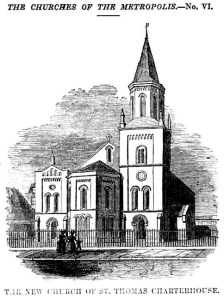
St Thomas’ Church, Charterhouse – By Unknown illustrator – http://www.victorianweb.org/art/architecture/blore/1.html, Public Domain, https://commons.wikimedia.org/w/index.php?curid=78462436
Cherry Tree Court, Whitecross Street, would have been one of the numerous slum areas found in the region, before Peabody. It is here that the family were living in 1851, before Elizabeth was baptised. She is listed in the census as Betsey, which was probably a nickname, and her father, Robert’s occupation, that of a stick dresser. Robert Passingham was a manufacturer of walking sticks, and evidently, when she was older, Elizabeth was employed to sell these products as a hawker.

Elizabeth Passingham’s baptism record in 1854 at St Thomas, Charterhouse
Young Betsey then disappears. I found no record in the 1861 census of either her, or her mother and father. By 1871, her family – mother, father and four siblings, had moved the short distance to Berry’s Place, Shoreditch, now known as Mill Row. In 1864, when she was eighteen, Elizabeth married Isaac Crudgington, in St Matthew’s, Bethnal Green. This was to be a fateful meeting for her as he was an impulsive and destructive character, and would not have been a positive influence in her life. Their daughter, Frances, was born just over a year later, and baptised in St Mary’s Newington. The couple were living in North Street, which is a name that I associate with Bethnal Green, but, in fact, they were living South of the River at this point. Daughter Ann was born in 1867 but only lived for less than a year, and died in 1868.

Baptism of Frances, daughter of Isaac and Elizabeth in 1865
In 1868, Elizabeth and her husband were caught stealing rifles from a shooting gallery at Charlton Fair. Astoundingly, Isaac was discharged and Elizabeth was remanded. This is the earliest record I could find of Elizabeth’s criminal misdeeds. Marriage to Isaac would have been chaotic and uncertain as he was frequently in prison, and his only regular occupation was his criminality.
However, Elizabeth’s father made walking canes and it is these that she hawked, choosing the specialist sales environment of the races. She also sold umbrellas which may have been a useful commodity in inclement weather. Racegoers may have found themselves in need of an umbrella at short notice, which she was able to provide. One is less likely to find oneself in urgent need of a walking cane but the possibility was there.
With her husband frequently in prison, Elizabeth was left to fend for herself. For whatever reason, she couldn’t return to her family, but instead, turned to the comfort of drink. I do not have any record yet of what happened to baby Frances. It may be that she was left in the care of a relative, friend, or neighbour, as Elizabeth needed to work her pitches, and they all involved travelling. She began to use the name of Crudgington less and less, and returned to using her maiden name of Passingham.
In 1877 Elizabeth was arrested for being drunk and disorderly, and sentenced to seven days hard labour. The following year she was arrested for having smashed windows of the Duke of Sussex in a drunken state. She claimed that the act was revenge for the landlord not helping her when she had been robbed and assaulted outside the previous week. She gave her address as being Goldsmith’s Row, at the end just off of the Hackney Road, but the pub was just over half a mile away. I suspect that there is another story behind the window breakage – that her arrest would lead to incarceration, and no matter how bad that would be, she would have a roof over her head and some kind of food.

Breaking windows was a common crime
Her prison record gives a physical description of Elizabeth as being 5 feet and four inches tall, with brown hair, blue eyes, a freckled face, and a split right ear lobe. A stout woman, she later acquired more battle scars in later descriptions.

Prison records provide useful physical descriptions
In 1880, she was arrested again for being drunk and disorderly after the Alexandra Park races, and missed one court appearance, she claimed, due to rheumatic gout. By 1881, she was in court again, and this time, admitted that she was homeless, at the age of thirty-six.
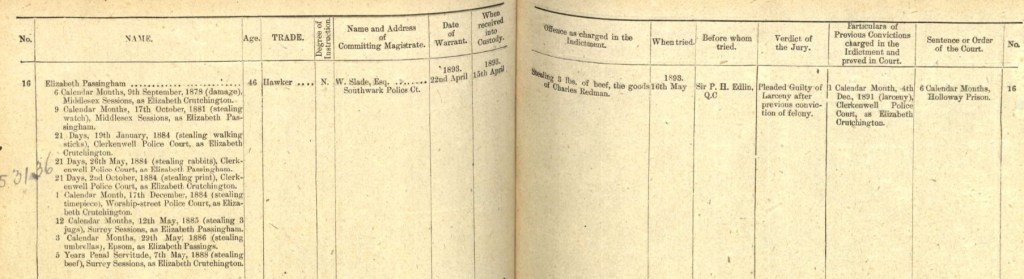
Elizabeth’s criminal record in 1893
Over the next few years, she was prolific. Almost as soon as she was released from prison, she reoffended, and was locked up again. The prospect of hard labour did not seem to deter Elizabeth. She stole small items, a cup and saucer, a walking stick, a goose, a rabbit. Breaking windows was a recurrent theme. She racked up stays in Wandsworth, Millbank, and Holloway prisons.

Elizabeth seeking help from the Union in 1891
Eventually, her hard life began to catch up with her and, aged forty-six, she went into the Bow Road Infirmary casual ward, suffering from rheumatism. She returned with bronchitis in 1895, but was discharged when her condition improved.
Unfortunately, even recent poor health did not stop Elizabeth’s drinking. In 1898, her age was reported as sixty but, in reality, she would have been fifty-two. Seeking alms at the Fox and French Horn on Farringdon Road, when the landlord refused, Elizabeth picked up glasses from the bar and began smashing them. One injured a customer, and another broke a plate glass tablet. The police were called, and Elizabeth was arrested again.
The following year, Elizabeth was homeless again. If Isaac Crudgington was a Dickensian criminal, a tragedy which could have been penned by the same author, was about to unfold. She developed bronchitis again but this time, she did not go to the infirmary herself. She was found to be in a desperate condition, suffering from hypothermia as well as a chest infection. She had been sleeping on the streets for two weeks because she was unable to obtain money for a bed. The newspaper headline of: “Died of starvation at Christmas”, is heartbreaking.
As we approach another twenty-first century Christmas, homelessness is still a serious issue. Christmas is a time to not only think of our loved ones, but also of those who are haunted by misfortune, the desperate, the hopeless. Thankfully, there are wonderful organisations, staffed by volunteers, who make sure that homeless people can come indoors at Christmas and are provided with a warm meal and company.
Just as Dickens used his Christmas Carol to evoke sympathy and to raise awareness of social issues of the day, and the need for goodwill and charity, to plug the gaps that welfare alone cannot. The need is just as relevant today as it was then. And so I end by saying a slightly premature Merry Christmas one and all!
Merry Christmas One and All!
Crisis – https://www.crisis.org.uk/
Shelter – https://www.shelter.org.uk/
The Salvation Army – https://www.salvationarmy.org.uk
 Awful Rigours and Wretched Pay
Leave a comment