

By Christine Swan
It is at this time of year that we remember those who served their country during various conflicts, including, the supposed war to end all wars, The First World War.
My father had served during the Second World War, and his father in the First. Uncles and great uncles were also similarly deployed. However, a fire destroyed many WWI service records so, thus far, I have only discovered two full sets. One belongs to the most tragic of all of the stories that I have uncovered, that of William Nelson Sloper junior.
He was the eldest son of William and Elizabeth Sloper, born in Hackney in February 1893. One by one, every one of William and Elizabeth’s children died as babies or as toddlers, only William Nelson survived. By 1896, Maud, Kate, Elizabeth, another William and Joseph, had all died. In 1898, father William had also died. Diseases such as cholera, diptheria, bronchitis and tuberculosis, were running rife and wiping out entire families. By 1900, only mother Elizabeth, and son William Nelson , remained. Patriotically named after his grandfather, who, in turn, had gained his middle name in honour of Vice-Admiral Horatio Nelson.

William Nelson Sloper’s baptism in 1901 at St John’s Church, Bethnal Green
After the death of his father, William Nelson was baptised in 1901 at St John’s Church in Bethnal Green. The family were living in nearby Hartley Street of which a tiny strip of modern housing remains.
In November 1914, at the outbreak of war, young men were keen to sign up, before the full horrors of what was to come, were known. Young William Nelson was working as a pastry cook’s assistant and kitchen porter. He was enlisted into the London Regiment and underwent a medical examination to assess his fitness for service. After just over four months, it was decided that he was unfit because he had flat feet, with apparently made him unable to fall in, by which I assume that they implied that he could not march.
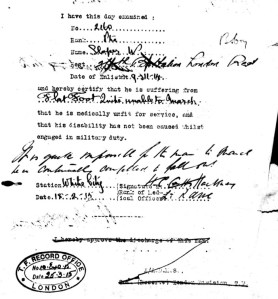
William Nelson Sloper was considered medically unfit due to his flat feet
Reflecting upon this fact in the light of history, it appears to be a lucky escape and he could have gone back to the kitchen and got on with the rest of his life. It also appears to be a petty reason to discharge a soldier in training.
However, William Nelson was not perturbed, he tried again in July 1915 and was enlisted into the 1st Battalion, the Middlesex Regiment, also known as “the die hards”, at Hackney Baths. This time, it was decided that his flat feet were of no consequence and that he was now fit to serve. I do understand that losses would have caused the army to recognise that they needed recruits more than they needed perfection. William Nelson was enlisted on the 15th July, a date which was to prove significant.
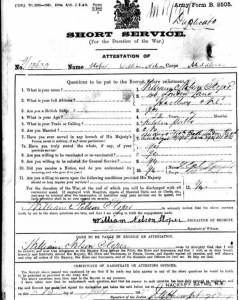
William Nelson Sloper signs to join the Middlesex Regiment in 1915
In just two days, he was posted to Chatham for further training before being transferred to France in January 1916. The Battle of the Somme began on 1st July 1916. Initially, the 1st Battalion were billeted in Bethune before marching to the trenches at Cuinchy. The battalion journal reports that the enemy was quiet and the weather bad. They were then relieved on the seventh of July and billeted at Gonnehem. The soldiers were then transported from Choques to Amiens overnight on the eighth, arriving at 3am. They then had a four hour march to Coisy, only to find the billets were filthy. The next march was to Corbie, which took six hours, starting at 05:45 on the eleventh of July. They began to see evidence of the battle and over the next three days, moved towards Mametz, bivouacking, rather than staying in billets. Reading the journal, there seemed to be a huge amount of travelling around, including marching, often starting early in the morning, which would have been exhausting. That said, did they know what lay ahead? Could they possibly have imagined the horror that awaited them?
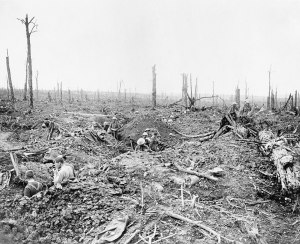
Who could imagine the horrors of the Somme? By John Warwick Brooke – http://media.iwm.org.uk/iwm/mediaLib//358/media-358345/large.jpgThis photograph Q 4417 comes from the collections of the Imperial War Museums., Public Domain, https://commons.wikimedia.org/w/index.php?curid=39574943
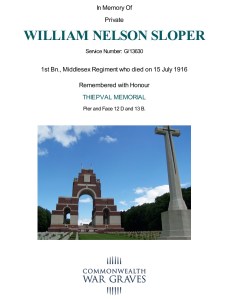
On the morning of the fifteenth, the soldiers marched to Bezentin le Petit, through a gas cloud. This was an omen, an overture, a portent. By the end of this day, Saturday, 15th July, William Nelson Sloper would be dead. along with over one hundred others. This feels like a small number, but add to it losses from other battalions, other regiments, other battles, and the numbers become horrific. I am focusing in this post on one person, my first cousin twice removed, the son of Elizabeth and William Sloper, their only child to survive to adulthood, who then died in a muddy battlefield in France, leaving his widowed mother heartbroken.
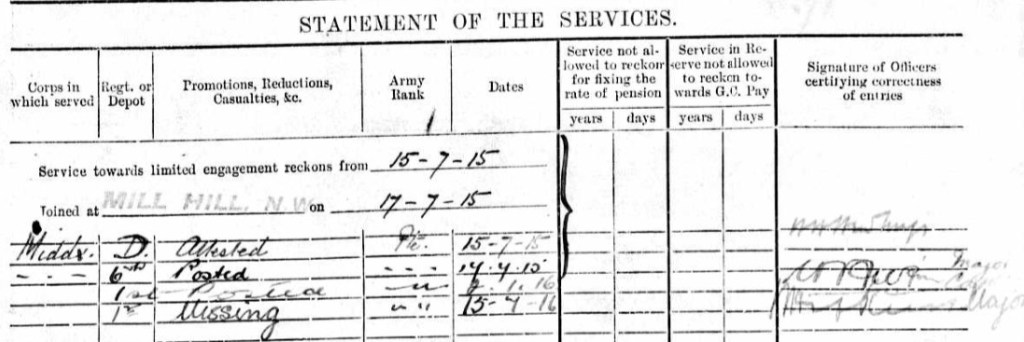
Exactly to the day of enlistment, William Nelson Sloper was killed one year later
William Nelson was recorded as missing, presumed dead on the sixteenth of July. His mother was notified on 21st August. Unfortunately, the wheels of authority turn very slowly and by the time his medals were ready to be awarded, his mother was dead. His only other living relative was his great aunt, Ellena Ann Bridge nee Crudgington. I have no way of knowing what happened to these medal. Eleanor had a stepdaughter, who had a daughter, but I hope that the medals were cherished.
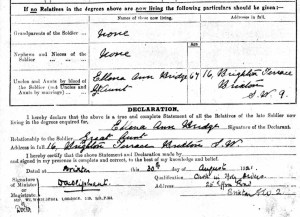
Ellena Ann Bridge was the only living relative to receive William’s medals in 1921
Every year, I remember William Nelson Sloper, he is one of my personal connections with the Battle of the Somme. Historians have analysed the military strategies deployed during the battle. The Battalion journal records that machine gun fire came from High Wood, to the East of Bezentin le Petit. It appears that the allies plans were betrayed and that the enemy forces were well-prepared. The commanding officers of the 1st Battalion believed that High Wood was under allied control and so were taken by surprise. No matter how many times I review the story of William Nelson’s life, I am struck again by the sadness of it all, a young life snuffed out. Just one year to the day since he enlisted, he was dead – but never forgotten.
 Awful Rigours and Wretched Pay
Leave a comment