
By Christine Swan
I never knew my maternal grandmother. Sadly, she passed away when I was just a few months old. My mum frequently told me what a lovely person she was and how she missed her every day. I knew that she had worked as a servant and that she came from a large family in Helions Bumpstead, North Essex. From this starting point, I knew nothing of her brothers and sisters and my mum had never met them either.
Helions Bumpstead is a tiny village where Charles Humphreys worked as an agricultural labourer as a young man. He married Martha Malyon, from nearby Castle Camps, just across the border in Cambridgeshire, and, in about 1877, transplanted their young family to Lea Bridge, greater London (but then, still Essex).

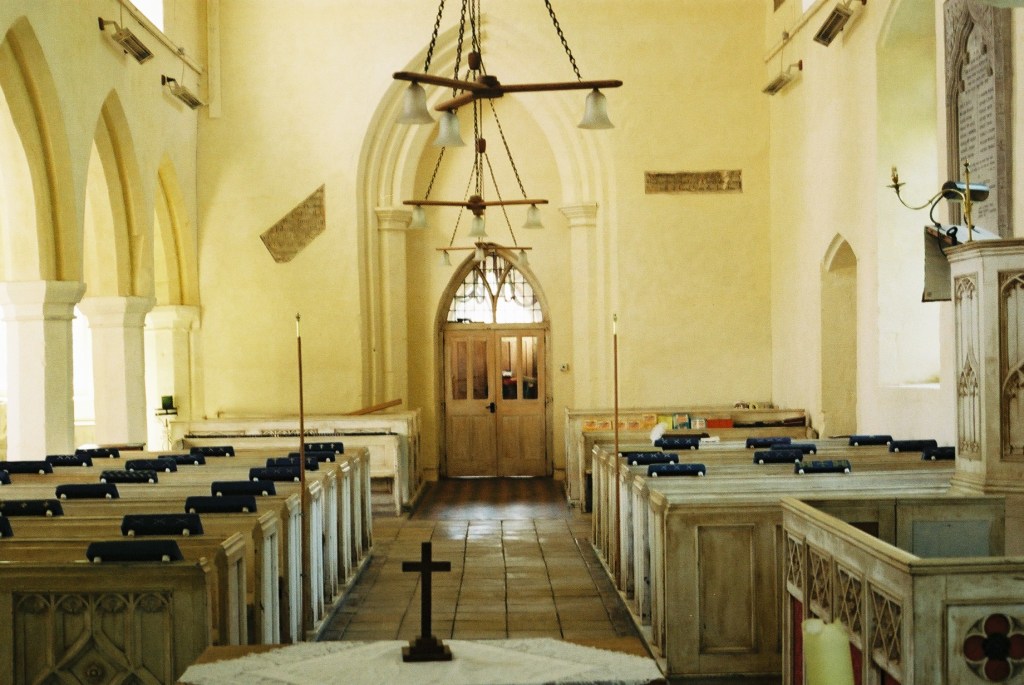
The village of Helions Bumpstead
Emily Ann was their first child, born in 1872, and would have been about five years old when the family arrived in Leyton. She may have remembered the vast expanse of fields in the almost flat landscape, the narrow lanes, flanked on each side by hawthorn hedges, and skylarks soaring above the fields. At the time of their arrival, the Lea Bridge area would still have been relatively rural but the river and nearby canal network, brought trade and industrialisation to nearby areas, with more work opportunities. Charles switched from being an agricultural labourer to general labouring work. The family were living at no 5 Nursery Cottages, Hitcham Road in 1881, just a short distance from Lea Bridge Road. I found a photograph of Nursery Cottages in the Waltham Forest archive, which showed a short run of timber-clad cottages, with a pitched clay tile roof, each with shutters on the downstairs window, and an unshuttered sash window upstairs.
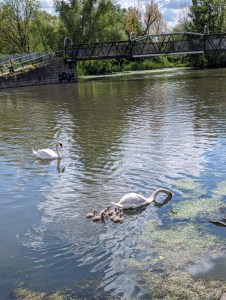
By the River Lea on a sunny day
Emily disappears in 1891. Her parents had moved to School Nook, just off of Lea Bridge Road, and very close to the River Lea. Emily would have been nineteen years old and, as other Humphreys girls had to do, probably went into service. I have looked to see if she was working nearby, but I suspect not. In 1898, Emily married John Edward Bruce, a carpenter from Tottenham. Emily gave her address as Mayston’s Cottages, Lea Bridge. This does seem to match with her mother, Martha Malyon’s address in 1901, of Pleasant Place. Although this isn’t mentioned in the census, Pleasant Place was in the same row of cottages as Mayston’s and it seems that other residents were also confused about the address. Her father, Charles Humphreys, had died in 1897 which may have also prompted Emily and John to marry in 1898. The couple were married in St Matthews church, Upper Clapton and the two witnesses were her brother Alfred and younger sister Dora, my grandmother.

Emily Ann Humphreys marries John Edward Bruce in 1889
The newlyweds settled in Mount Pleasant Road, Tottenham, next door to John’s parents. In 1901, the houses had names rather than numbers – Emily and John lived in Helen Villa, and his father Cornelius and mother Mary, in the charmingly named Glencoe. Mount Pleasant Road is a long road that runs parallel to the Broadwater Farm Estate. Cornelius was also a carpenter and, I would imagine, worked with his son. John and Emily had one baby daughter, Helen Emily, at this point, born in 1900.

The Bruce family in Tottenham in 1901
By 1911, the houses in Mount Pleasant Road were numbered. Cornelius and Mary living at 286 and John and Emily in 284. I conclude that these were the same properties that they were living in ten years previously. I am unsure why the switch was made between from names to numbers, but this did enable me to find the exact location on Google Maps. The Bruce family had grown with the addition of son Alfred, and daughters Dora and Winifred.
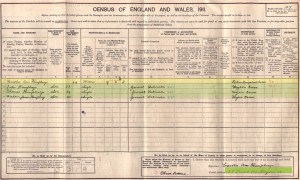
At the same address in 1911
The family were still living at the same address in 1921. John appears to have received promotion to the role of a builder’s foreman, Helen was working as a typist, Alfred as a plumber’s mate, and Dora and Winifred were still school pupils. This was an interesting shift. Dora’s namesake, Emily’s sister, worked as a servant as a young woman – this was the most common occupation for young women. My mother told me that one of Dora’s first tasks was to pluck a chicken, a job which she disliked, and cried while undertaking it. She had also confided how lonely and sad she felt as a young girl, living in a strange house and working long hours of physical work. Emily’s younger daughters were able to remain in school, living at home. Helen, working in an office, may have worked long hours, but it was less intensive than the downstairs graft that her aunt had had to undertake. Although women’s emancipation was in its early days, this period of history is interesting in seeing these changing roles.

The Bruce family still in Tottenham at the same address in 1921
Cornelius was still living next door but was now a widower. John’s two youngest siblings were still living at home. Helen, had assumed the role of housekeeper after the loss of her mother, and youngest daughter Clara, was working as a postal clerk, another example of a woman working in the office and, perhaps a job with prospects.
By 1939, Emily and John had moved to Haileybury Avenue, Edmonton. John was still working as a builder’s foreman, now aged sixty seven. Their eldest daughter, Helen, was still living at home, aged forty, and now working as a clerk for an insurance company.
Emily died two years after this, just shy of her seventieth birthday. The probate record indicates that she was survived by husband John and bequeathed just over £160 to him, which would have been equivalent to about £6000 in modern times.
I have no memory of my grandmother Dora, only have the memories shared by my mother as a reference point. Even she knew little of other members of the Humphreys family, other than that they hailed from Helions Bumpstead. Women had a tendency to fade into the background in census records as most did not have a career recorded after marriage but, I have pledged to tell every single person’s story. All of these stories are part of the fabric of family, a piece of the puzzle that I have been able to put into place. And so, I remember you Emily Ann Humphreys. I never knew you, nor you me, but now, at least, I feel that we have been introduced.
 Awful Rigours and Wretched Pay
Leave a comment