

By Christine Swan
There are some things, such as tea parties, the changing of the guard, double decker buses, arguing about the order of cream and jam on scones, and queuing, that are the essence of Britishness. We can be eccentric and simultaneously traditional.
I have lived in Worcestershire for over thirty years and, until last Sunday, had never attended the historic hill climb track at Shelsey Walsh. Astoundingly, this is the oldest, continually used motor racing venue in the world and was established as long ago as 1905. Sir Stirling Moss raced there as well as other big names of the motor racing world and a number of plaques define its heritage and unique place in motor racing history.

Shelsey’s pedigree is on display
Shelsey Walsh is set in the beautiful Teme Valley, which is surrounded by wooded slopes, and peppered with beautiful black and white cottages. Two of these are directly adjacent to the racing start line – there cannot be any more unique a setting for the sport. The car park is in a field at the foot of a wooded slope. This can prove a challenge for the low profile of a performance machine, but competitors enter the pits via tarmac so need not worry. Most arrive on the back of a trailer although vehicles of all shapes and types can attempt the hill.
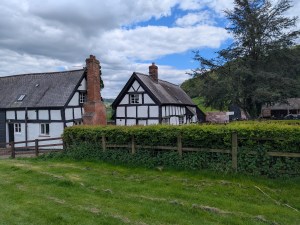
The start line is behind these two cottages – the white banner on the right says ‘start’
The morning was bright, and the sun warm. We showed our tickets at the wooden entrance booth, and received wrist bands in return. We then began the ascent up the hillside to find a suitable viewing spot. There is bench seating, although some regulars had equipped themselves with luxury folding chairs that provided a superior level of comfort. Some spots give better views than others. You can choose to see more of the start, or move further up the hill and see more of the bends. Some spectators had very sophisticated cameras, lenses and other paraphernalia, but I still managed a few decent shots with just my smartphone.
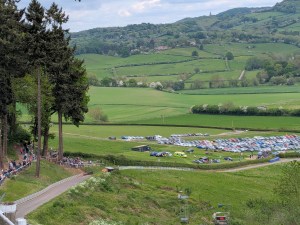
Half way up the hill provides stunning views across the Teme Valley
The morning’s proceedings were the run-offs. The previous day had seen practice runs and the run-offs require racers to attempt the hill in the reverse order of qualifying time. The final few cars were impressively fast. Time markers on the hill allow you to track exactly how fast by displaying the elapsed time. You can also see what happened next, even though it is impossible to see round the final bend to the straight run before the end of the track. Each batch of cars goes up the hill one at a time, but they all return together. As the track is a single track, and there is no return loop, to see the cars trundle back down one after the other seems quite bizarre.
After the run-offs, the racing was halted for lunch. There are a number of catering options on site but some spectators were well prepared with picnics and flasks of tea. At the bottom of the hill, there is a restaurant, bar, and coffee stall. The pits are also at the bottom of the hill. Spectators are able to wander around, look at the cars and see final preparations being undertaken to ready the car for the afternoon’s climbs. The nearest row of cars in the car park seems to also be a prestigious spot, with many classic and performance cars parked, but also on display for people to view and to chat to their owners.
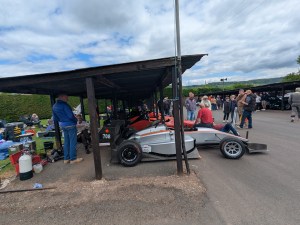
Teams prepare their cars for the afternoon’s racing
Lunch provides a one hour break in the racing. I realised that the hill that I had climbed up, and then climbed down, I would now need to climb again. Sunday was most definitely a “leg day”! This time, we went higher still up the slope than in the morning, in an attempt to give a superior view of the two bends. I began to notice different driver’s tactics – where exactly to slow before tackling the first of the two sharp bends, when to change gear, at which point to accelerate out. Wider cars, with bodies and configuration aligned for a race track, appeared to have the edge over modified versions of cars intended for the road. Stability and weight distribution could have a frightening impact on cornering.
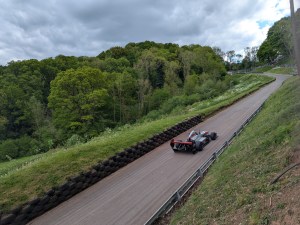
Approaching the first bend
There is another tea and coffee stall towards the top of the slope, to allow visitors to enjoy another essential British tradition – afternoon tea. A hot drink was most welcome, and I cupped my hands around the cup with gratitude.
The wind had changed direction to become more chilly. At first, you try to ignore it but eventually, the desire to find a warmer spot becomes compelling. My paper cup of coffee was now cold. It was time to move again. We picked our way back down the hill to a lower, more sheltered position and watched some more of the attempts before going back to the pits and the start line to watch some of the racers set off.

And they’re off!
Unfortunately, we did see a mechanic injured while preparing a car ready for its race. I have since been able to confirm that he is OK which is a relief and I wish him a speedy recovery. It was a shocking reminder that all forms of motorsport are dangerous. This even cast a shadow over the afternoon and we decided to head off for home. However, reflecting on the whole day, it was a unique experience and definitely one that I would repeat. It is a charming setting and a very affordable day out – more so if tickets are purchased in advance. The banked sides of the track are strewn with wildflowers, and the rolling hills of Abberley in the distance make for stunning views. I am grateful to live in such a beautiful county and on Sunday, to have witnessed a local spectacle.
More information
Shelsey Walsh Hill Climbing Track – https://www.shelsleywalsh.com/
 Awful Rigours and Wretched Pay
Leave a comment