

By Christine Swan
I had planned a visit to Valenciennes as part of my recent short stay in Lille. My Gallemar, or Galmar, ancestors made it their home in the sixteenth century, so it seemed only reasonable to pay a visit as I was staying so close. I booked my ticket and walked the short distance to Lille Flandres station and found the correct platform in the main station. The train was a double-decker, of the type that I frequently travel on in the South of the country, so I made my way upstairs to get the best views. The train departed on time and, as we clicked and clacked through the flat French countryside, the train rocked me to sleep. I couldn’t even keep my eyes open even though it was still morning.

Leaving Lille Flandres from the main station, heading for Valenciennes
The journey took about forty minutes, passing through several little stations along the way. Valenciennes looked quite a major town on the map and it did have some busy areas, but also some oases of calm. After alighting the train, I walked towards the town centre and soon found the main shopping centre and surrounding streets. However, I was looking for the older parts. Guislain Gallemar was born in Valenciennes in 1550 and is my twelfth great grandfather. He was baptised in the Église Saint-Géry, which is a Catholic church. At around this same time, Valenciennes was becoming a centre for Calvinist Protestantism. As I sat by the modern shopping centre, it was hard to imagine Protestants being rounded up after the oppression by the invading Spanish army, and due to be burned at the stake. Rebels managed to release some to freedom when Guislain was about twelve years old – but probably not all. I looked around me. Could that violence have really happened here? What followed would have been one hundred years of siege, release, capture and recapture, before Valenciennes became part of France.
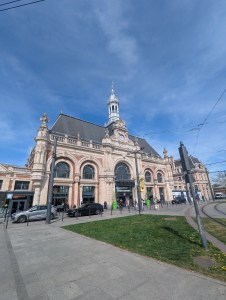
Gare de Valenciennes
I stood up and headed towards the oldest part of the town, Le Béguinage de Sainte Elizabeth, which dates from the fourteenth century. This area would originally have been inhabited by nuns, who lived in a community of small houses and dedicated themselves to living simply, prayer and service, and caring for the poor. This was a women’s community and it supported young women in the community outside of the béguinage. It felt rather intrusive to walk through the little streets and to look in at the pretty houses, which are now a tourist attraction and curiosity. Practical problems exist, such as, where do you put your wheelie bin living in an historic building? The pretty houses have window boxes, flowering plants in tubs and colourful windmills. Each is unique, but part of a secluded community, intruded upon by the curious, in this case, me.
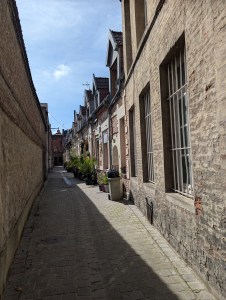
Le béguinage
My next stop was the ornate war memorial, next to one of the remaining relics of the original city wall, le Tour de la Dodenne. It was originally a water gate, providing an exit from the city to the River Rhonelle.
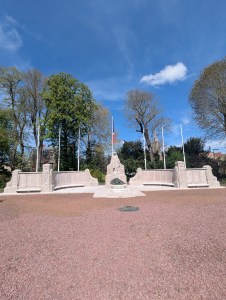
The immaculately presented war memorial of Valenciennes

La Tour de la Dodenne – one of the remaining fortifications of the city
Across the road is the Parc de la Rhonelle, where the river continues to flow away from the city. I sat on a bench opposite the ornamental lake, while lunch-breakers ate their food and others talked animatedly into their mobile phones, deep in conversation, while ducks quacked and moorhens hooted. I sipped my water and then stood up and headed back into town.

The peaceful Parc de la Rhondelle
I explored more of the centre. There are some other historic buildings of interest. The tourist office dates from the time of the Spanish occupation and the Masion du Prevot dates from the fourteenth century, as do the remaining structures of the Citadelle – part of the military buildings that housed the protectors of the City.
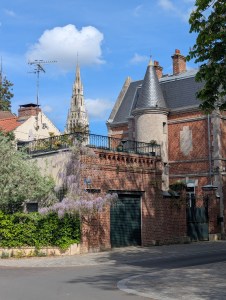
Quirky and beautiful Valenciennes
I walked back to the station, pleased that I had experienced the old soul of Valencienne, a city that has experienced so much turmoil.
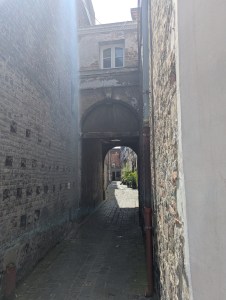
I walked back through le béguinage, to drink in the history of the place one last time
Quentin Gallemar was born in Valenciennes in 1592. In this period, a number of cities were under siege in Northern France, as part of the religious wars. Valenciennes is further south than Tourcoing, and yet, Quentin would have taken the dangerous route northwards, and then boarded a boat to England. The route was dangerous. To be discovered as a fleeing Protestant could result in death and yet, he took the risk, like so many others, and made it safely to England. Also, like many others, he found his way to Canterbury, where the French community was already well-established. There Quentin married Suzanne Six in in 1612, when he was twenty.
Their son Jean, is my tenth great grandfather and he remained in Canterbury for his entire life. His daughter Jeanne, married Josue d’Arras in Canterbury in May 1677. There was a significant age gap between Josue and Jeanne, of about fifteen years. This may imply that Josue had been married previously, but I have not yet found any record to confirm this.
Josue and Jeanne d’Arras were the first generation of this family who chose move northwards to Spitalfields, at some point between 1678 and 1682. The silk industry there was booming, employing thousands of workers. This must have been the lure that drew them to London. Jeanne died in about 1700, the same year as her husband Josue. The Gallemars did have three sons to continue the family name but my research has not extended forward in their direction yet, but this is a task for a future date.

If buildings could speak, I am sure that this one would have a tale to tell – old buildings in Valenciennes
More information
Valenciennes tourism – https://www.tourismevalenciennes.fr/
Explanation of the concept of le beguinage – https://en.wikipedia.org/wiki/Beguinage
All photos by the author
 Awful Rigours and Wretched Pay
Leave a comment