

By Christine Swan
My great great grandmother, Mary Ann Dighton, died aged just thirty-six. In her short life, she led a complicated existence and was married twice as far as I am aware. My research has led me to the conclusion that my great grandfather, David Deighton Taylor, was illegitimate. On his death certificate, the witness was his sister, Elizabeth Sloper, but written as “C. Sloper”, which was possibly a transcription error. After much fruitless searching, I decided that this must be the case. Another chance discovery, while researching my great grandfather, David Dighton Taylor, uncovered his half-brother, William English.
Mary Ann married William’s father, William English senior, in 1868, when she was twenty-six. William English junior gave his birth year as 1857. At this time, Mary Ann would only have been fifteen years old and in any case, she married William Brown, Elizabeth’s father, when she was eighteen. This implies that William English junior was indeed the son of William English senior – but who was the mother? One other possibility is that William English had previously been William Brown, born before Mary Ann was married. Later on, when William English junior married, one witness was William Brown, who I believe was another half-brother, and therefore, they couldn’t have been the same person – or could they?
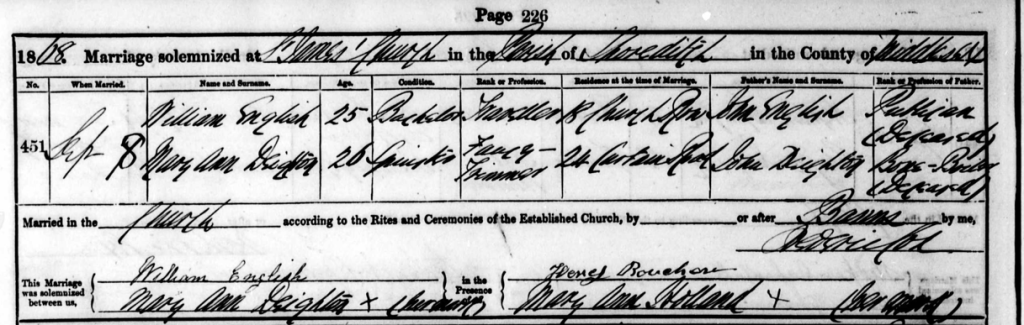
Mary Ann Deighton marries William English senior in 1868
Life was certainly complicated for Mary Ann Deighton. In 1871, the family were living in Henrietta Street, Hackney. The road is now Allgood Street, a little stump of a road off of the main artery of Hackney Road, and just a few minutes’ walk from my dad’s workplace, the Metropolitan Water Board office on the corner of Kay Street. My father never knew how close he was working to the very place where his grandfather had lived as a boy. He did not even know of the existence of a great uncle, or even half a great uncle, let alone of our passing association with the surname of English.
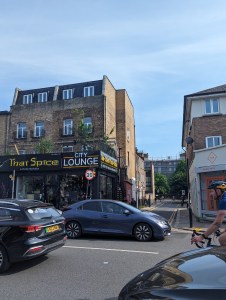
The site of Henrietta Street
In 1871, William’s age is given as ten but, he would in fact have been fourteen. His half-brother, David, my great grandfather, was four years old. Baby John was one year old and was the only child biologically of both parents. As I have recounted in another post, Mary Ann died in 1878, when William would have been about twenty-one. He was definitely not living with the family in 1881 but was living in lodgings in Woolpack Place, Hackney, and working as a dock labourer. This is just a short walk from Frampton Park Road, where his father was living in 1881.
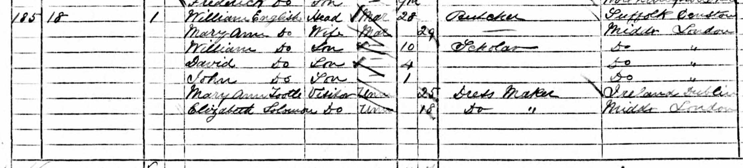
The English family in 1871
After Woolpack Place, William seems to have moved between several addresses, Jupps Road, Mile End, Well Street, Hackney and Florfield Road. William married Lilian Harriet Miller, a widow, in 1892, in St Thomas’s Church, Bethnal Green. William was thirty-four when he married, and Lilian was thirty-seven. I have not been able to find records of any children, either from this, or Lilian’s first marriage.

William English marries Lilian Harriet Miller in 1892
This union did not endure. Lilian died just eight years later in 1900. William was alone again and not in good health. Tuberculosis is a disease that does not progress quickly. After losing his wife, William was admitted to the workhouse infirmary in 1901 and was also provided with poor relief in 1906, presumably because he could no longer work.
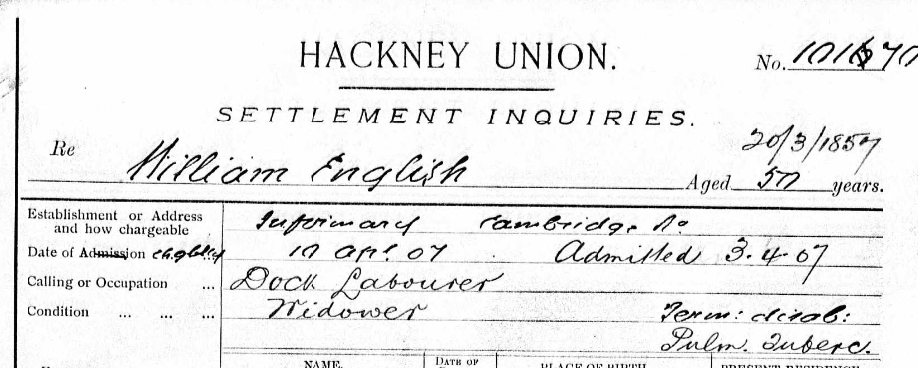
William English being admitted to Bethnal Green Infirmary one final time
At this time, he was living with his half-brother David, my great grandfather. It must have been very cramped in the small house in Wadeson Street, with David, Julia, and, at that time, four children. It is an established fact that diseases such as Tuberculosis, spread within crowded homes. William was admitted to Bethnal Green Infirmary in 1907 with a terminal diagnosis. Little did my great grandfather know that both him and his wife would die of the same disease, just a few years later. William died aged fifty, as would David, and my great grandmother, Julia, when she was just forty.
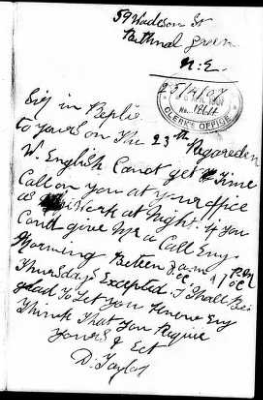
A letter from my great grandfather in support of his half-brother
I think the really fascinating aspect of this story is that until my discovery, my father knew absolutely nothing about his great grandfather, or the existence of his half-brother. Elizabeth, their half-sister, did not succumb to T.B., but suffered the tragedy of losing her husband and all of her children. Although both David and Elizabeth were interred in the family grave purchased by Daniel Crudgington, William was not buried there. Stumbling across a Poor Law record from 1907, just before William died, was a golden key that led me to learn of his existence. Amongst the scanned pages was a letter from my great grandfather, offering to speak to the authorities to explain his half-brother’s predicament. To me, it illustrated the bond between the brothers, the care and willingness to help, even though resources were scant for all of them. David and Julia took William into their home, even though the disease that he had would ultimately kill them too.
 Awful Rigours and Wretched Pay
Leave a comment