
By Christine Swan
Last year, I needed to visit Devizes, Wiltshire twice for work. At about the same time, I began to research the Sloper family. Between the first and second visits, I discovered that the Slopers had originated from Bishops Canning, a small village north of Devizes. Incredibly, some kind soul had shared their research, dating back to the sixteenth century. Most intriguingly was the discovery of Sir John Thomas Sloper, born in 1550. He was my first “Sir” in my ever expanding family tree. Amateur genealogists are acutely aware that going back several generations draws in hundreds, and potentially thousands, of people into their tree, so I always try to rein myself in from getting too excited at the prospect of blue-blooded ancestors. My motto is that everybody is interesting, and that everyone has a story to tell. This was my starting point for this blog but, for this week, I travel three generations back, and one step to the side.

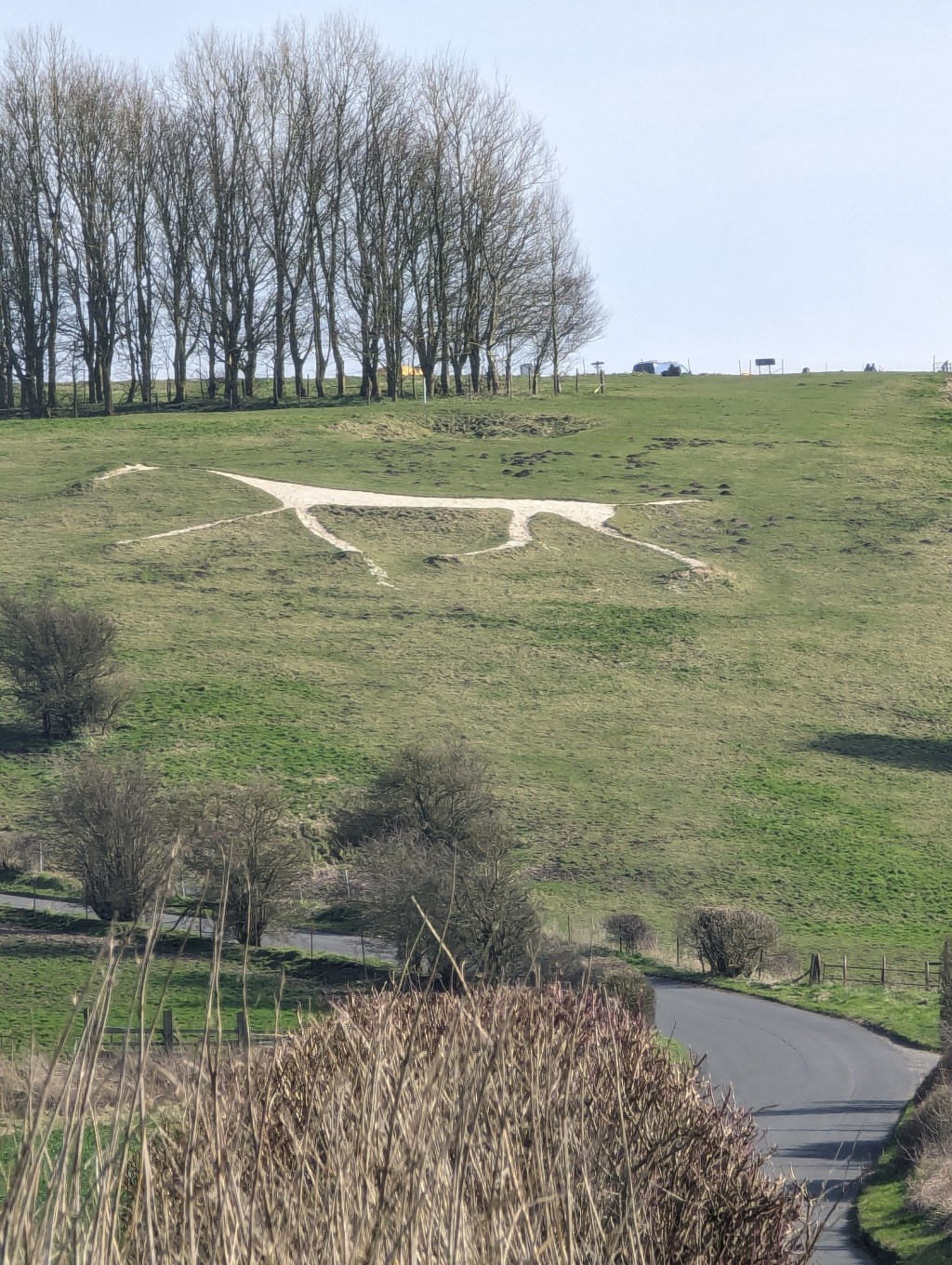
The Cherhill white horse between Devizes and Avebury
William Nelson Sloper was born in the beautiful city of Bath in 1806. This was the same time that the author Jane Austen was also a resident. William was given a patriotic middle name to commemorate the victories of Admiral Lord Horatio Nelson, who had died just a year prior to William’s birth. The Sloper family had a strong association with this part of the South West of England. His father, Richard Sloper, had been born in Market Lavington, Wiltshire, where he trained as a tailor and breeches maker. Bath would have been a more populous area, and therefore, better for business.
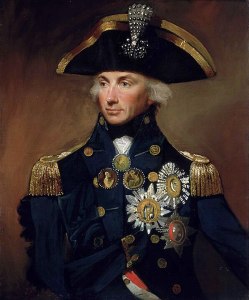
Portrait of Nelson by L. F. Abbott (1799) By Lemuel Francis Abbott – National Maritime Museum website: Embedding web page: http://www.nmm.ac.uk/collections/nelson/viewRepro.cfm?reproID=BHC2889 (archived version)Image: https://collections.rmg.co.uk/mediaLib/484/606/bhc2889.jpgFull catalogue record: https://collections.rmg.co.uk/collections/objects/14362.htmlThe painting was published as early as 1898 in: Sladen, Douglas (1898). “The Nelson Centenary”. The Magazine of Art 22: p. 530. London, Paris, New York & Melbourne: Cassell and Company. Retrieved on 2010-01-15., Public Domain, https://commons.wikimedia.org/w/index.php?curid=2833419
William was baptised in the magnificent surroundings of historic Bath Abbey on 16th July 1806 to proud and patriotic parents, Richard and Mary. In 1825, when Richard was nineteen years old, he married spinster Margaret Simmons in St Swithun’s church in the Walcot district of Bath, just a short distance from Royal Crescent and the Assembly Rooms. Margaret was five years William’s senior and yet appeared never to have been previously married.

Bath Abbey – By Diliff – Own work, CC BY-SA 3.0, https://commons.wikimedia.org/w/index.php?curid=33921347
I have been unable to find any children from this marriage. In 1841, William and Margaret had moved to St Augustine’s Place, Bristol, where he gave his trade as shoemaker. The area still exists today, even though the small shops and houses have long gone. St Augustine’s Place would have been at the end of what is now the end of Colston Street. The Bristol Beacon, formerly Colston Hall, was built on the site of a friary which then became a boy’s school and then finally, a place of entertainment. Colston was a trader of enslaved people so it is of little wonder that his name is being erased from Bristol’s history. Even in 1841, he had been dead for over a hundred years.

William Sloper marries Margaret Simmons at St Swithun’s Church, Walcot, Bath, in 1825
In 1850, Margaret died. Without children, William found himself alone at forty four. However, William was not to be a widower for long. He met and married Harriet Cooze, a spinster from Bridgewater, in 1852, in St Augustine’s Church, a short distance from William’s home, and presumably, trading premises. Harriet gave her address as Trinity Street and she was a rather surprising twenty years William’s junior. Harriet and William went on to have a very large family , consisting of four boys and four girls. William Sloper junior then went on to marry my great, great aunt Elizabeth Brown.
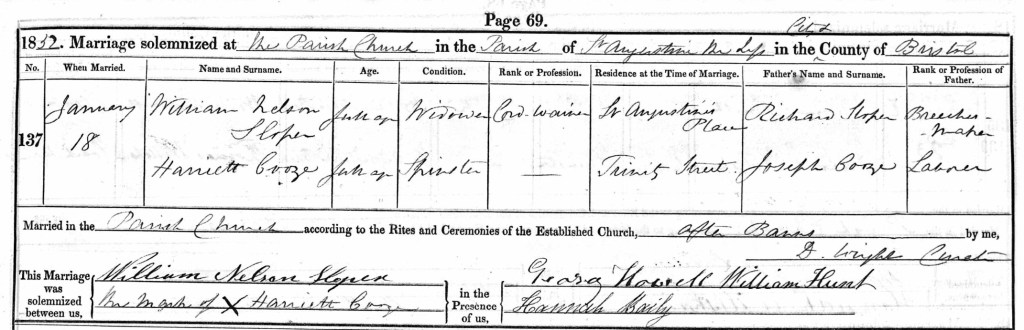
William Sloper marries Harriet Cooze in 1852, in St Augustine’s Church, Bristol
William did appear to move around Bristol over the next ten years, with his growing family. They moved to Oxford Road, West Street, and then back to St Augustine’s Place in the 1860s. The 1861 census found him living there with Harriet and their first four children, Joseph, William, Eliza, and Mary.

The Sloper family in Bristol in 1861
In the latter part of the 1860s and early 1870s, William moved to one of the most historic streets in Bristol, and the site of Hatchet Inn, which I have featured in a previous post as being the oldest surviving pub in Bristol. Frogmore Lane still has a number of old buildings, and the front of the pub is on a relatively quiet part of the road. William and his family lived at number eleven and would definitely have known the Hatchet Inn. In 1871, William was sixty-four and described himself as a journeyman shoemaker. Previously, he was listed in trade directories as a shoemaker or cordwainer. Maybe he went from self-employed work to working for somebody else in his more senior years.
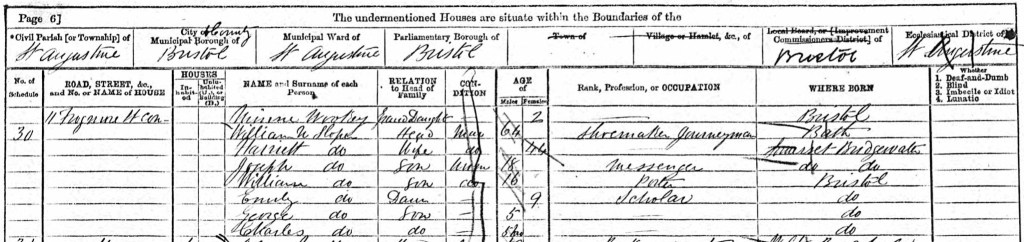
The Slopers in Frogmore Street 1871
Despite her younger age, Harriet died in 1874, when she was just forty-eight years old. Their youngest son, Charles, was just four years old although the oldest daughter, Eliza, would have been nineteen years of age, so more than capable of looking after her younger siblings. Nevertheless, this would have dealt a crushing blow to William, now nearly seventy and having been married for twenty two years.
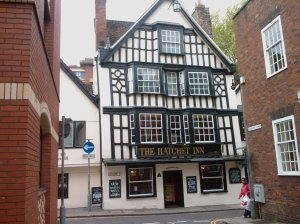
The Hatchet Inn Frogmore Street
William died in 1879, aged seventy-three. His son William headed to London to become a house painter. William Nelson’s name was later given to his grandson, who was tragically killed in World War I. I remember him every year during Remembrance Day and also the fact that his death marked the end of this line.
The Slopers represent another of my links with the South West, and with the trade of shoemaking. I do intend to work my way back through the generations to Sir John Thomas Sloper, but for this week, William Nelson appeared to be an honest, hardworking man, who led a quiet life, in a beautiful part of the country.
More information
Visit Bath – https://visitbath.co.uk/
Visit Bristol – https://visitbristol.co.uk/
 Awful Rigours and Wretched Pay
Leave a comment