

by Christine Swan
Sometimes, when accessing ancestral records, little clues indicate that things are not as they should be, or that things are not well between family members. This is my impression within John Crudgington’s marriage, more of which I will write later.
John was the middle son of Isaac and Mary Ann Crudgington. Isaac had been born in the beautiful Shropshire town of Worfield but had left for London with his other brothers, in the latter half of the eighteenth century. Isaac was a shoemaker, a profession that many of the family members also pursued.

The farmhouse in Newton, Worfield, where the Crudgington family lived
Crudgington is a place name, now swallowed up by the Telford New Town development, it is best known as the site of the Muller dairy. One ancestral Crudgington residence is Newton Farmhouse, which rests in the peaceful greenness of the Shropshire countryside. What a huge contrast eighteenth century London would have presented to the rural newcomers. Most of the Crudgington clan settled in East London including Isaac, who married Mary Gould in St Leonard’s Church, Shoreditch in 1780.
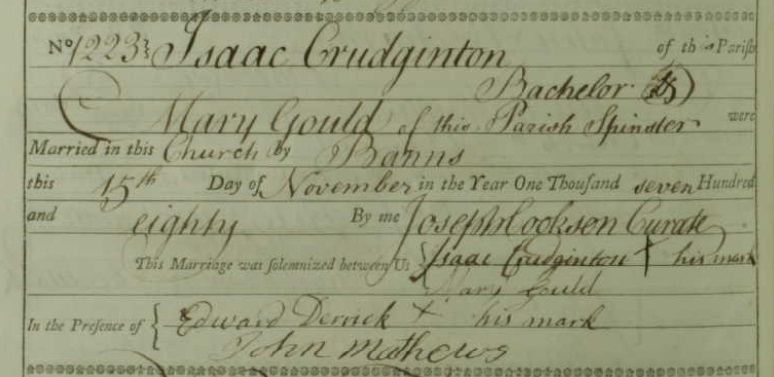
Isaac Crudgington married Mary Gould in St Leonard’s Church, Shoreditch in 1780
The Crudgingtons were shoemakers which was a non-location dependent trade but it did surprise me to learn that John, and a number of his siblings, were baptised at St Saviour’s church, Coplestone Road, Denmark Park, Southwark – an area that we would now class as Peckham. Perhaps Isaac opened a shop there, or had other relatives that I have not yet found, but it certainly did not appear to fit the pattern of residence.

John Crudgington’s baptism record at St Saviour’s Church, Denmark Park
In 1811, John was living north of the river and married, Frances Kinman, a shoe binder from Hatton Garden, when he was aged eighteen. The couple married in Christchurch Greyfriars in Newgate. This church stood near to the infamous Newgate Gaol, a place that was to become familiar to a number of the Crudgingtons, John included. The site had originally been a monastery and the later church built by Sir Chirstopher Wren. Amongst the notable burials was Sir Thomas Malory, author the tales of King Arthur – Le Morte d’Arthur. The church was all but destroyed during a Blitz raid, but the perimeter walls and interior space survive as a garden.
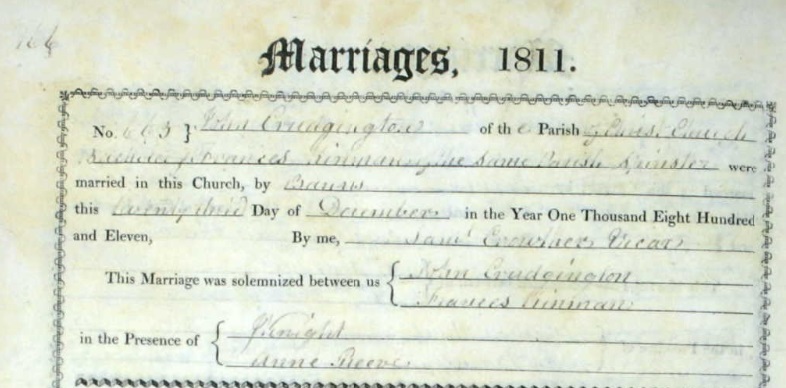
John Crudgington married Frances Kinman at Christ Church, Newgate, in 1811

The remaining structure of Christ Church, Newgate, as it looks today
The couple moved to King Street in Clerkenwell, now Cyrus Street. James and Daniel were baptised at St James Church, although interestingly, Daniel always gave his birthplace as Spitalfields. In approximately 1820, the Crudgington family moved to the infamous Flower and Dean Street. At the time that they lived there, it still would have been a poor neighbourhood, but its slum status was not established until later, and its notoriety enshrined in history as the residence of one of the women victims of the Whitechapel murderer, known as Jack the Ripper.

There are still reminders of Flower and Dean Street
One address that I always associate with the Crudgington family is 19 Collingwood Street, Bethnal Green. This was part of the slum district and consisted of a series of alleys and courts. In some documents, it is described as North Street and then, after a comma, Collingwood Street. It was a poor area and a hotbed of crime. In 1827, John was arrested with another man, David Baron, stealing a sow, which they had driven from Kennington Cross. They took the pig to a dealer on the Ratcliff Highway and agreed a sale. However, both of the thieves were apprehended and John was sentenced to six months incarceration in Newgate prison with hard labour. The pair did not appear to be criminal masterminds as the pig was immediately recognised by its owner and the pair were seen by several witnesses driving her along during the night after the theft. It appears to have been a great deal of effort, resulting in their arrests.

John Crudgington in Newgate Prison in 1827
From his prison record of 1827, I have a physical description of my fourth great grandfather, John Crudgington. He was five feet four inches tall with a fair complexion. He was of stout build with grey eyes and fair hair. If I close my eyes, I can see a virtual image of him, and I also have a prison photograph of one of his sons, which helps me to visualise him. I am a full six inches taller than he was, and naturally have dark hair.
Meanwhile, Frances Crudgington was the now the mother of six children at this time, and with a husband in prison, would have worked hard to put food on the table. In 1834, their son Daniel, my great, great, great grandfather, was arrested and tried for stealing second hand shoes. As I recounted in the series of posts about his life, he was transported to New South Wales for seven years. The family had gone to the court house in Clerkenwell to see him tried, but had been informed by the clerk to return to the court in the afternoon as young Daniel was not to be in the dock before lunchtime. This, however, was incorrect, and when the family returned in the afternoon, his case had already been heard and sentence passed. The family organised a petition of local residents, to appeal against his sentence, but to no avail.

The imposing original Court House in Clerkenwell
Unlike so many other transported convicts, Daniel Crudgington returned to England in 1841. He had intended to let his father John know but, had put insufficient postage on a letter to be sent to him. Thus it was that it was retained at the Sydney post office, the only record of Daniel attempting to contact his father.

Letter held at the General Post Office in Sydney in 1841 from Daniel Crudgington, convict, to his father John
John and Frances were living at 19 Collingwood Street, or at least they were on the night of the 1841 census, and yet Daniel’s letter was addressed to Dog Row, Whitechapel. In the census, the females of the family, starting with Frances, were listed before the males. In all other family records, they appear to be listed in the order of husband, wife and then children’s ages in descending order. There is little to explain this separate gender listing so I jumped to the conclusion that all may not have been well. There were still eight Crudgington children living at home – enough to cause any amount of strife.
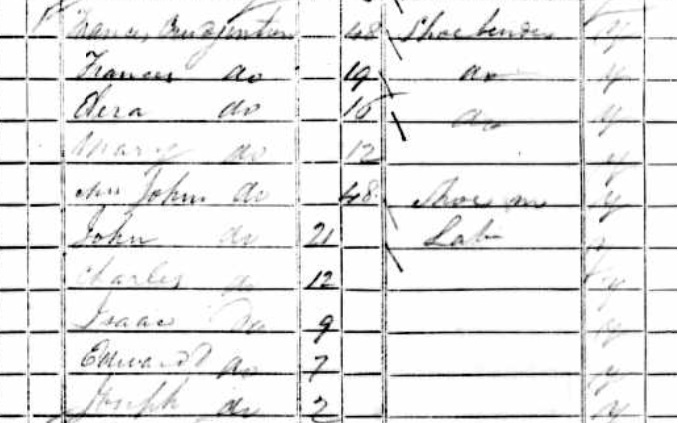
Female and male Crudgington family members listed separately in 1841
Thorough searching led me to believe that John and Frances separated. In 1851, Frances was living with the couple’s four youngest children – Joseph, the youngest of all, aged twelve years. Frances described herself as the head of the household with three of the children also working as shoemakers. But what of John? I believe that he may have been living with another woman who he appears not to have married. There were marriage banns, but no marriage record. In 1861, he was living with his daughter Susan in Turk Street. Frances was living in Collingwood Terrace but, was the proprietor of a shoed shop with son Joseph and his wife. She still described herself as married – but there was no sign of John living with her. Ten years later, Frances was still living with son Joseph and his now large family and still claiming to be married.

Is this John Crudgington, living apart from Frances in 1861?
John died in 1873 aged eighty. This was quite a considerable age in this period of history. Frances died aged seventy-seven, just two years before John. She appeared never to move on from being married to John, even though she remained within the bosom of her family. John seemed to have moved away and lived a separate life. Record keeping was not integrated so it was possible for couples to live bigamously and, as long as they were not reported, a blind eye was turned.

John Crudgington in the workhouse infirmary in 1871, two years prior to his death
The Crudgingtons never cease to amaze and intrigue me. Although John was not a master criminal, one of his sons, Isaac, made a career of it, and will be the subject of a future post. It was a long way from Shropshire to London, but once they had arrived, the Crudgingtons certainly made their mark.
All original photos by the author
 Awful Rigours and Wretched Pay
Leave a comment