
By Christine Swan
When I was a child, I had relatives who lived in different parts of London but I never considered how they got there. We assume that nineteenth century people did not travel huge distances and indeed, in some rural communities, generations lived and died within the space of a few square miles. However, some of my earlier ancestors, migrated to the UK escaping persecution, their journey spanning several countries to get here.
I did not meet any of the Bulls. I do remember my paternal grandmother’s sisters but, as they were married ladies, they had different surnames. My father referred to William Henry Bull as “the old grandfather”, and only had vague recollections of him. As far as I knew, the Bulls were from Bristol, and that was that.

The old grandfather – William Henry Bull
For this week’s blog, I am focusing on William Henry’s father, George Bull. In a previous post, I recounted how George had been born in Rye, Sussex. His parents, Henry and Sarah, were Wesleyan Methodists. My father lived until his nineties and often told me stories about the family that he could remember. They were not always accurate, for example, when he told me that his paternal grandfather had been hospitalised due to being kicked by a horse and hospitalised. He was indeed hospitalised but he was suffering from bronchitis so appeared in the general rather than the surgical register of the London Hospital archives. Other stories were accurate, for example, our Huguenot ancestry. I was less than convinced and found no evidence until a few years ago when I discovered that the oh-so-English surnames, were in fact corruptions of French names. Dad also told me that the Bulls were Quakers but, in fact, they were Methodists. Non-conformists still, but not quite accurate.

Gun gardens, Rye – Simon Carey / Gun Garden, Ypres Tower
Wesley himself had opened the Chapel in Gun Gardens in 1789 but he had first preached in Rye over twenty years before that. It was here that George was baptised in 1813 after the chapel had been renovated in 1812. Later, the original chapel was destroyed during a World War II bombing raid. Sermons moved to the original Sunday School from thence on.

George Bull baptism on 26th December 1813
Gun Gardens was an area that formed part of Rye’s military defence. The Ypres Tower was a fortification from the Medieval period, and added to by King Henry VIII. It was also believed that Napoleon intended to invade this particular stretch of coast. Rye was also a place of smugglers, secret tunnels, gibbets and ancient pubs.

Beautiful Rye, Sussex – Cobbled street, Rye, Sussex by John Salmon, CC BY-SA 2.0 https://creativecommons.org/licenses/by-sa/2.0, via Wikimedia Commons
George and his father worked as chairmakers. Not a seafaring trade but worked with wood, rushes and willow to make these most essential items of the home. Sussex became famous for its chairs when William Morris designed and made traditional rush-seated chairs as part of his Arts and Crafts movement in the nineteenth century. Morris admired the simple, elegant, functional designs which he called the Sussex chair and used them in his homes. They were popular and examples still survive today and are doubtless still being sat on.
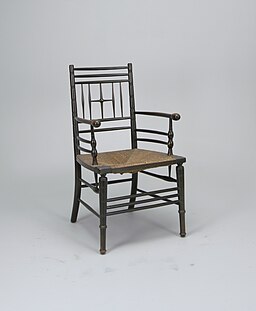
A Morris Sussex chair – Cooper Hewitt, Smithsonian Design Museum, Public domain, via Wikimedia Commons
Rye was and still is, a small town. Maybe this limitation alone was enough to make the young man George, restless, and to wonder what else there was in the world. George headed North to London as did so many people during the nineteenth century, possibly to find his fortune and to practice his trade with a larger customer base. This journey would have taken about two days by stagecoach, and much longer by other means. However George travelled, he arrived and set to work.
George married Harriet White at St Dunstan’s and All Saints church in Stepney in 1837 when he was twenty four and Harriet nineteen. He and Harriet were recorded as living as neighbours in Portland Street, now Westport Street, Stepney, a short distance from the church. Their first child, that I have been able to find, was Emma, born in 1843. Son John was born in 1844 and Samuel in 1848.

George Bull marries Harriet White at St Dunstan’s and All Saints church in 1837
Around 1850, the Bull family left Stepney and moved west to Bristol, one hundred and twenty-four miles away. I would like to think that they travelled by means of Isambard Kingdom Brunel’s magnificent Great Western Railway, which had been completed just nine years earlier. The rail journey would have taken just four hours, as opposed to approximately two days by horse-drawn stagecoach.
Why did they move? This is a mystery, but I wonder if they had relatives already living in Bristol who they moved to join. The Bulls were prolific families so they may well have had siblings, uncles and aunts who had already established business there. The death of his father in 1848 may also have been a trigger although, I have no evidence that he too had moved from Rye to London.
George and his family lived in Castle Street, in the centre of the City, and advertised in the local trade directory as a fancy willow chair maker. Georgianna was their first child born in Bristol, followed by my great, great grandfather, William Henry (or Henry William).

Advertisement in the Post Office trade directory of 1851
In 1854, Harriet died aged just thirty-six, leaving George with five children. Emma, the eldest, was only eleven so would not have been able to care for her younger siblings.
George wasn’t a widower for long. In 1856 he married Matilda Protheroe, the daughter of a cabinet maker. Matilda was seven years younger than George but was soon a working member of the chairmaking Bull family. Matilda and George had two more boys – George and Edward.
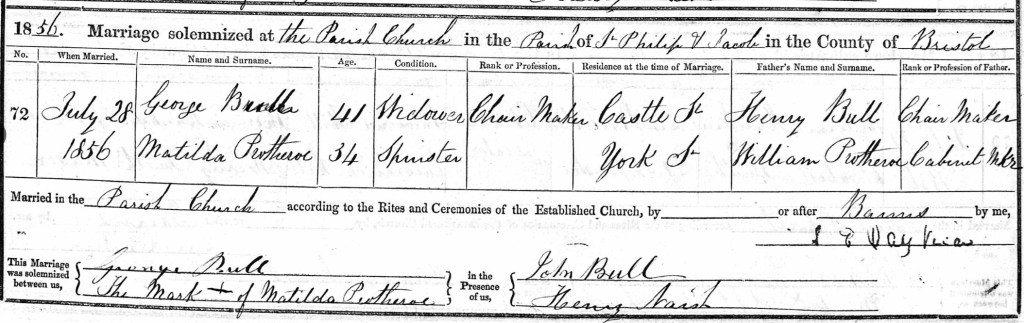
George Bull marries Matilda Protheroe in 1856
The Bulls moved to River Street, close to the River Frome, traversed by small bridges and connecting to Skinner Street on the other side. The area was predominantly industrial with an oil and colour works on one side and a laundry blue manufacturer on the other. In the 1861 census, the three eldest children were working in the family trade of chairmaking, and in other records, I found Matilda’s father was also listed as a chairmaker, indicating that she may have joined the Bull family already with some useful skills in the trade.

George Bull and family in 1861
Matilda died in 1867, aged forty-five, leaving George a widower again. However, George wasted no time in marrying again in 1868, this time to Harriet Wells, a widow, ten years his senior. Finally, I feel that George married for companionship in his later years, rather than to care for his children. George and Harriet were married for twenty years before she died, the most enduring of all of his unions.
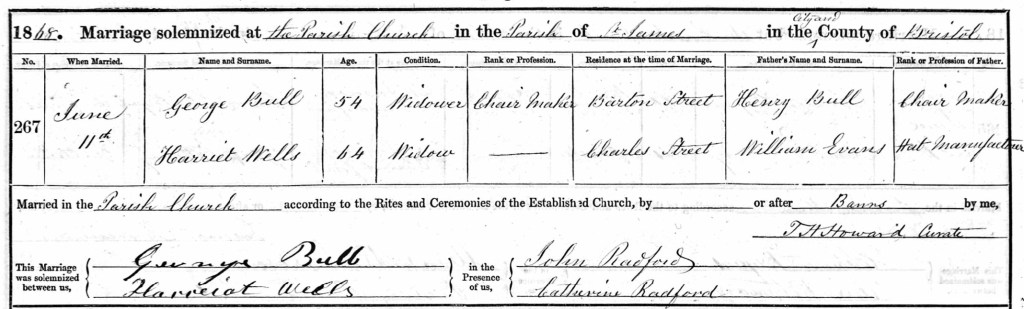
George marries Harriet Wells in 1868
I thought that Harriet’s death might be the end of George’s romantic intentions now that he was three times widowed. However, eternal romantic George married again, aged seventy-four, to widow Elizabeth Abbott, twenty-two years his junior. The couple lived in the grandly named Hampton Court, off Water Street. I suspect that these may have been small courtyard houses, or even one large building with tenements, in a part of the city still close to the River Frome, in an industrialised area. George lists himself as still employed at the age of seventy-four in the 1891 census although I believe that he was seventy-seven. He was to die just two years later aged seventy-nine.

George and Elizabeth Bull in 1891
 Awful Rigours and Wretched Pay
Leave a comment