

By Christine Swan
On the border between Essex and Cambridgeshire, the landscape will have remained unchanged for hundreds of years. Far away from the bustle of the City, and its busy mix of high tech and academia, life continues at a slower pace. Driving along narrow lanes, with hedges and fields on either side, you cannot help but to try to blot out the trappings of the twenty first century, such as the car you are driving, the tarmac road, and electricity pylons.

Helions Bumpstead, Essex
I last visited Castle Camps a few years ago, in the late afternoon of a warm summer’s day. I was struck by the remoteness of the place as well as the quiet stillness. I am sure that it isn’t always like this, but, for me, time stood still. Before the concept of the London or Cambridge commuter belt, this was, and still is, an agricultural heartland.
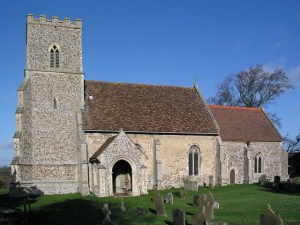
All Saints Church, Castle Camps, Cambridgeshire – By mym, CC BY-SA 2.0, https://commons.wikimedia.org/w/index.php?curid=7138410
Castle Camps is an intriguingly named village where the Mallyon family have lived for centuries. It is everything you might expect from a small settlement – pub, church, village hall and High Street, surrounded by agricultural land. The highest point in Cambridgeshire is near here and the RAF had an airfield during World War II here, 128m above sea level. The flat vista allows you to take in county, and Castle Camps gives you the best view.
There was indeed an ancient castle here, most probably Saxon, and then later, a fortified house. The Romans occupied this area, and after them, the Saxons. The Danes tried, and failed.
The Mallyons hadn’t always lived there. I haven’t yet definitively discovered where my three times great grandfather, Thomas Mallyon, was born in Scotland, Ireland or foreign parts, as recorded in the 1841 census. Ancestry DNA has fluttered around my having Scottish, Irish and Welsh roots, and this year, has settled for Scottish. The estimate does seem to vary from year to year, and records my Dutch roots but not my French, even though I have verified these. Could it be that I am part Scottish too? At the moment, this is an unknown and further research will be needed.

Thomas Mallyon in the 1841 census – not born in England
Stephen Mallyon was born in 1801 to parents Thomas Mallyon and mother Millicent Prentice. Millicent was born locally and the couple had married in 1799 in Castle Camps. Thomas was ten years older than Millicent. He died in December 1850, and Millicent just a few months prior to this in March. Could this have been due to disease possibly?
Stephen married Esther Dygens in October 1825 in St Andrew’s Church, Helions Bumpstead, just two miles away from Castle Camps, and their first child William, was born one year later. Stephen worked as an agricultural labourer, as did most young men in this corner of Essex. The Mallyons went on to have a further nine children which was a prodigious achievement indeed. The family consisted of Stephen, Esther, three daughters – Mary, Rebecca and my great, great grandmother Martha Ann, and seven sons – William, Abraham, Isaac, Jacob, Joseph, Benjamin and David. Large families meant many mouths to feed but perhaps, living in an agricultural area gave greater access to produce. In either case, many young hands could contribute to the family income and older children were engaged in employment at ages that would shock a twenty first century young person.
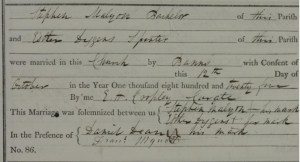
Stephen Mallyon married Esther Dygens in 1825 in Helions Bumpstead
The 1841 census indicates that Stephen was also not born in England, like his father. This is intriguing because in every other census, he gave his birthplace as Castle Camps. An error possibly? However, looking at it again, it seems very deliberate. The family’s address is simply indicated as Boblow. After thinking that this might indicate the landowner, one Robert Low, it appears that I was incorrect. Boblow was the site of a former hunting lodge which has associations with the St John’s Hospitallers. The latest building, Boblow House, dates from the sixteenth century and is listed. I cannot, in my wildest of imaginings, believe that Stephen, agricultural labourer, and his large brood, inhabited a grand, moated house. Instead, I assume that there were associated cottages for farm labourers as this seems far more likely. Their neighbours lived in Claphouse Yard. I suspect that this refers to traditional clapboard cladding which was a common form of weatherproofing in rural houses in counties such as Essex and Kent. The Mallyon’s house may also have been clapboarded on the exterior.
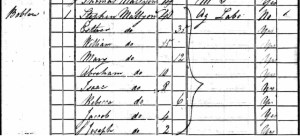
Stephen and Esther in 1841, living at Boblow, Helions Bumpstead
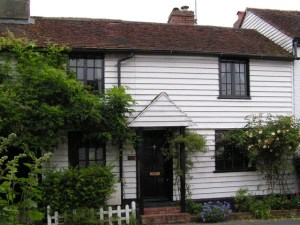
Clapboarded houses in Kent , of the type also seen in rural Essex – By Nigel Chadwick, CC BY-SA 2.0, https://commons.wikimedia.org/w/index.php?curid=9319032
Rebecca died in 1843 aged just eight and Mary died in 1845, aged just sixteen which would have been a double tragedy for the family. In 1851, The Mallyon boys Abraham, Isaac and Jacob were also working as agricultural labourers, and therefore contributing to the family purse. Martha Ann was only six years old so would not have been able to help with household chores and without any older daughters, this would have made managing the home a challenge for Esther.

The Mallyons in 1851
Ten years on in 1861, Stephen was sixty years old, but still had three of his children living at home. Isaac is listed as a horsekeeper, and Martha Ann, aged fifteen as a shirtmaker. Youngest son David, just twelve years old, is also listed as being an agricultural labourer. This census record was nine years before education became compulsory, and even then, only to age eleven, so David was already of employable age.

The Mallyon family in 1861
Stephen’s wife, Esther, died in 1869, after forty-four years of marriage. I can imagine that this was a devastating blow to the family. Martha Ann married Charles Humphrey in 1871 in St Andrew’s, Helions Bumpstead. The newly married couple lived with Stephen. Their first two children were also born in the village but, in 1875, something prompted them to move to Leyton. Charles and Martha Ann moved to the Lea Bridge Road area of Greater London, to the charmingly named Nursery Cottages, and Stephen moved with them. This must have been a significant change for him as he was now in his seventies although, at that point, Lea Bridge Road would not have been an urban area, and even now, still has a significant amount of green space.

The final record of Stephen Mallyon living with his daughter, Martha Ann, in Helions Bumpstead
I assumed that Stephen would have remained in Helions Bumpstead, but he must have moved with them and died in London in 1875. He was buried in Queen’s Road cemetery, the same where his daughter , Martha Ann, would be buried in 1923.
 Awful Rigours and Wretched Pay
Leave a comment