

By Christine Swan
The Kemplay family were poor. Born in 1823, Isabella was the fifth child of parents David and Elizabeth Mary. David worked as a plasterer and I suspect that he moved to be near his current place of work. However, the family, even by usual standards, moved a great deal. In the early days of their marriage, they lived in a small road off of the rather famous Tufton Street before moving south of the River.
Isabella was born in Walworth and was baptised in St Mary’s Newington church, just along from the Elephant and Castle roundabout. Although difficult to imagine in modern times, in the nineteenth century, the area around Newington Butts was famous for its gardens, with groundbreaking species being cultivated there including unusual double narcissi, chrysanthemums and even a Newington peach.

Peaches? In Walworth? Yes, they really were cultivated there – By File: Kenraiz – This file was derived from: Illustration Prunus persica0.jpg:, Public Domain, https://commons.wikimedia.org/w/index.php?curid=145133377
The church of St Mary’s Newington was extensively remodelled during the Georgian period. A plainer church would have greeted the Kemplays in 1823 when they took Isabella to be baptised. In the same year, a new sewer was laid nearby exposing the marshy ground upon which the buildings were stood. Sadly, very little remains of the more recent Victorian church because St Mary’s was destroyed during a bombing raid in 1941. The front façade and tower are still standing but a twentieth century church is situated behind it.
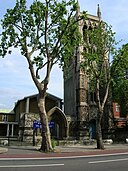
St Mary’s Newington church, Walworth. Only the tower and original entrance remains – R Sones, CC BY-SA 2.0 https://creativecommons.org/licenses/by-sa/2.0, via Wikimedia Commons
Just before Isabella was born, the family were living in Northampton Street, now the Old Kent Road, and when she was still a baby, they moved south-west to Stockwell. When Isabella was ten years old, her father was declared bankrupt. In the press notice, he was listed as a builder, even though David Kemplay recorded his profession consistently as a plasterer in every record that I have located. Perhaps this was a bold venture that ended unhappily. Maybe this was the real reason for the frequent moves, to stay one step ahead of the rent man.
The Kemplays had a large family and this would have meant that the older children were obliged to seek work as soon as they were able, to contribute to the family income or to stop their depletion of the family’s meagre funds. The boys, David junior, William and John, all became apprentice plasterers. David junior was lodging with the Aylott family in West Ham in 1841 and probably got to know the family well. Delivery boy William Aylott was just fifteen at that time but it was his older sister Hannah that David would have paid more attention to as they later married in 1844. This was the first marriage between the Kemplay and Aylott households, but it wasn’t the last.
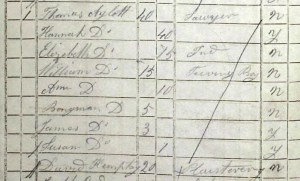
David Kemplay junior lived with the Aylotts in 1841
Isabella married William Aylott 1847 when she was aged twenty four and William, twenty-two. She formalised this happy union with William Aylott in the magnificent St Bride’s Church near Fleet Street. This appears to be quite some move away from Southwark but Isabella was living in Bridge Street, Blackfriars, just three minutes’ walk away from St Bride’s. I was not able to find a record for her in the 1841 census but is likely that she was working in service or employed in Blackfriars. Blackfriars is a strange London borough in that it now extends both north and south of the Thames, connected by a road and railway bridge. Originally, Blackfriars formed the south-western tip of the City of London and the site of the monastery of the same name. As the traffic thunders over Blackfriars Bridge, it is hard to picture what Isabella’s view would have been but, wander towards St Brides’, away from the noisy traffic, and time is reversed.

Inside St Bride’s church

St Bride’s Church on a rainy autumn day
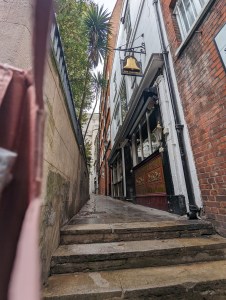
Bride Lane, which runs alongside the churchyard, gives a glimpse of the past
In my previous post, I had assumed that William Aylott was a lawyer, based on census records and transcripts. However, an eagle-eyed reader of my blog suggested that his occupation was in fact a sawyer. This fits well with where the Aylott family lived, often in fairly industrialised parts that would have fitted with a saw-mill being present, but less so legal premises.

In 1871 the Aylotts were living in Carpenters Road, Stratford
As mentioned in my post about William Aylott, the family moved from South Street to the industrialised area of Horsepond, off Laboratory Yard, Stratford. This area is now part of what was the 2012 Stratford Olympic Park. The family remained living in Stratford, as did my great grandmother. William Aylott died in 1874, aged just forty-nine years and Isabella was only fifty-three when she also passed away. Neither of their ages would be considered advanced years. I don’t have any photographs of my great, great grandmother, or my great grandmother. My grandfather never spoke of his mother, most probably because he did not remember her. He was just two years old when she died. These were short generations and the landscape where they lived is now almost erased. When I started writing this blog, I promised to remember everybody in my family tree. My late parents took delight in hearing any of my discoveries. My mum in particular was fascinated to learn anything that I had found out, because she knew so little. My earliest memories of Stratford were driving through on the way to my granny’s house every Saturday. It was still a maze of canals, railways, roads, warehouses and factory units. As an adult, I saw swathes of land cleared for the Olympic Park and stadia. There are still a few remaining glimpses of its history to be seen, and I hope that my blog brings to life some of its residents.

The Olympic Stadium from the train
 Awful Rigours and Wretched Pay
Leave a comment