
By Christine Swan
In my previous post, I described how Judith du Hamel had travelled from Leiden in the Netherlands to Canterbury as a young woman in the 1660s. This may have been as a result of religious persecution but possibly for economic reasons. When living in Canterbury, she met and married a French silk weaver, Claude Gaffe. I haven’t yet been able to find their marriage record or Claude’s baptism record, but I can only guess that he was born in France and, like Judith, travelled to England and settled in Canterbury. Looking at the distribution of the family name, most Gaffes are located in Northern France and particularly in the Pas de Calais region. Claude and Judith’s marriage appears to have taken place during a gap in records between 1669 and 1673. Although I don’t have their marriage record, I have managed to find baptism records of their children. At the time that they were living in Canterbury, it was home to a thriving community of French and Walloon protestants who established their own church, which eventually moved into the crypt of the hugely impressive Canterbury Cathedral.
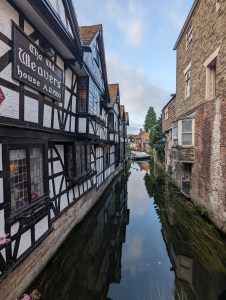
Weaver’s houses in Canterbury
The Huguenots had been living in Canterbury for almost one hundred years when Judith and Claude married, and were established as a community, living, working and contributing to the economy. I am guessing that French was spoken although, I would imagine that the younger folk also spoke English. I don’t know precisely when the Gaffes came to England but I do know that Judith du Hamel arrived after 1650 and she would have been in her late teens or early twenties when she married Claude Gaffe. Their first born daughter Judith, was baptised in 1675 and son Claude arrived two years later.

The Huguenot chapel in Canterbury Cathedral
Claude and Judith’s third child, Magdeline, survived into adulthood, married and had children of her own. She was born in 1679 in Canterbury with Pierre du Hamel and his wife Magdaleine as witnesses to the baptism. Magdeline married Johannes Le Fevre in 1705 and they had three children, John James, James and a daughter Mary.
The Gaffes next daughter, Mary, was born just one year later in 1680 but tragically died while still a baby. Then came Susanne, born in 1684 and Elizabeth in 1686. My eight times great grandfather, Benjamin, was born in 1688. Claude and Judith’s youngest son Pierre, was born in 1689.
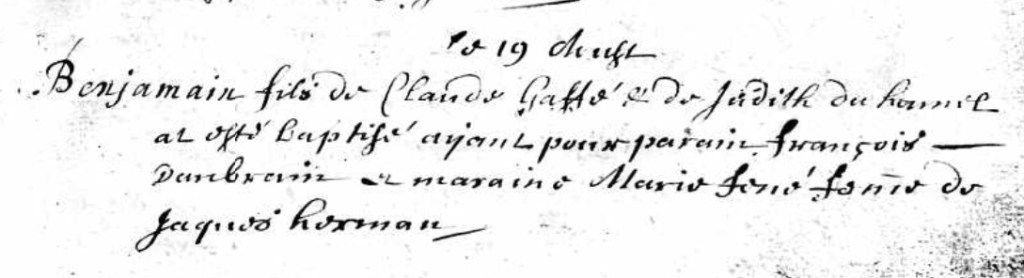
Baptism of Benjamin Gaffe in 1688
Sadly, their daughter Judith died in 1698, aged just twenty three years. Son Claude died the same year, aged just twenty one. The parents had lost their two namesakes, their eldest children. Perhaps the similar dates of their deaths were indicators that disease had visited the household. Life expectancy at the time was about thirty five to forty years on average so this was distinctly premature. Typhus, Bubonic Plague and Tuberculosis as well as Cholera, spread by contaminated water. Life was hard, and often snuffed out whilst still in the flush of youth.
The weaving trade began to decline in Canterbury during the 1700s, and many weavers moved north to the London districts of Spitalfields and Bethnal Green, as well as cities further afield. Judith and Claude’s son Benjamin Gaffe married Susanne Fere in July 1712 and at this time, the entire family were still living in Canterbury. Their own children, Benjamin, Jean, Samuel and Jacob, were similarly born and baptised in Canterbury.
Benjamin’s father Claude, died in 1719 in Canterbury and perhaps this was the event that caused the family, like so many others, to move to Bethnal Green. Son Jean anglicised his name to John as was also quite common practice, presumably to blend in with the local population. Benjamin Gaffe senior died in 1758 but interestingly, wrote a last will and testament before he did. Eldest son Benjamin and second eldest Jean (now John), had both died before Benjamin senior. Jean was my seventh great grandfather and he married Esther Dara in 1737 when he was aged twenty two but tragically died just four years later. It is quite difficult to comprehend a death so young leaving a wife and three very young children. To compound the tragedy, Esther, his wife, only lived a further three years. Her eldest daughter, my sixth great grandmother, also named Esther, was just six years old when her mother died. Her grandfather, Benjamin Gaffe, mentioned Esther affectionately in his will – perhaps he and his wife cared for their small, orphaned, grandchildren? Benjamin senior lived in Fleet Street, now Fleet Street Hill, Bethnal Green, which now exists as a stump of road under a railway arch. His son Jean, had lived a short distance away in Spital Street and both worked as silk weavers. In 1929, a block of sixteen apartments, called Weavers House, was constructed in Pedley Street, adjacent to Fleet Street Hill, giving an indication of the occupations of former residents of the area.
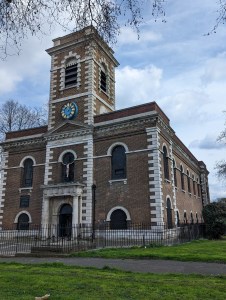
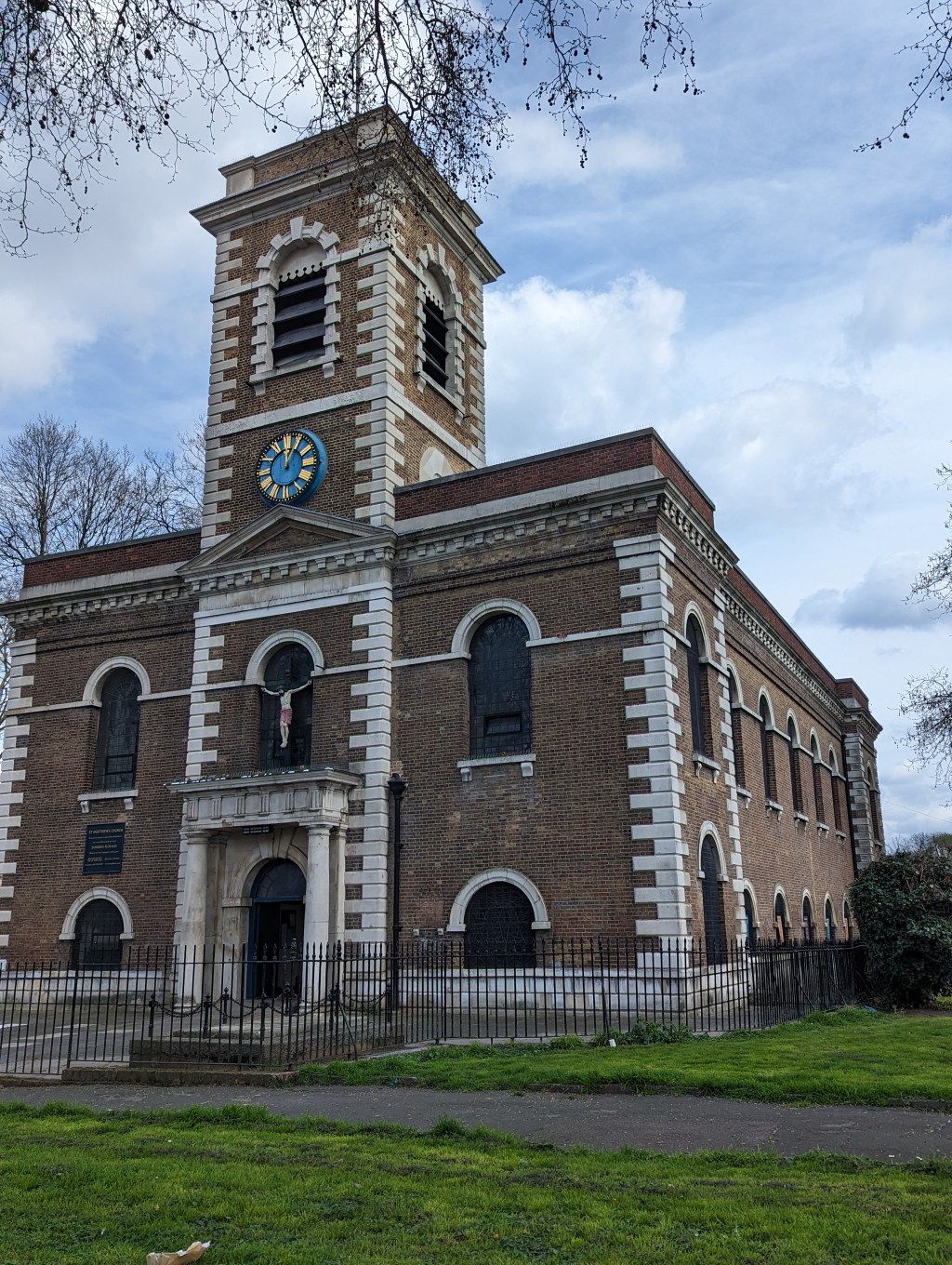
St Matthew’s Bethnal Green

Esther Gaffe marries Richard Deighton 1757
Esther Gaffe married one year before her grandfather Benjamin died. Her husband, Richard Deighton was also a silk weaver. The couple married at St Matthews church, Bethnal Green, and was one of the earliest of my familial links with this church. My family name is Deighton. It was my great great grandmother’s family name and hers mother’s before. Due to illegitimacy, I can only trace these ancestors via the maternal line. Nobody knew our family association with the name Deighton because my great grandfather chose to suddenly stop using it in 1880. I have not yet discovered the reason behind this but perhaps this mystery is one that will reveal itself to me as I continue my discoveries.
I intend to fully immerse myself in the stories of my French ancestors to see what I will uncover. I have a huge affinity for the country and commented whilst on holiday there that: “It feels like home, I can’t explain why.” And now, I can explain why. So many people form who we are. To answer the often asked question: ” Who do you think you are?” I can truly say, that I am beginning to find out.
All original photographs by the author


 Awful Rigours and Wretched Pay
Leave a comment