

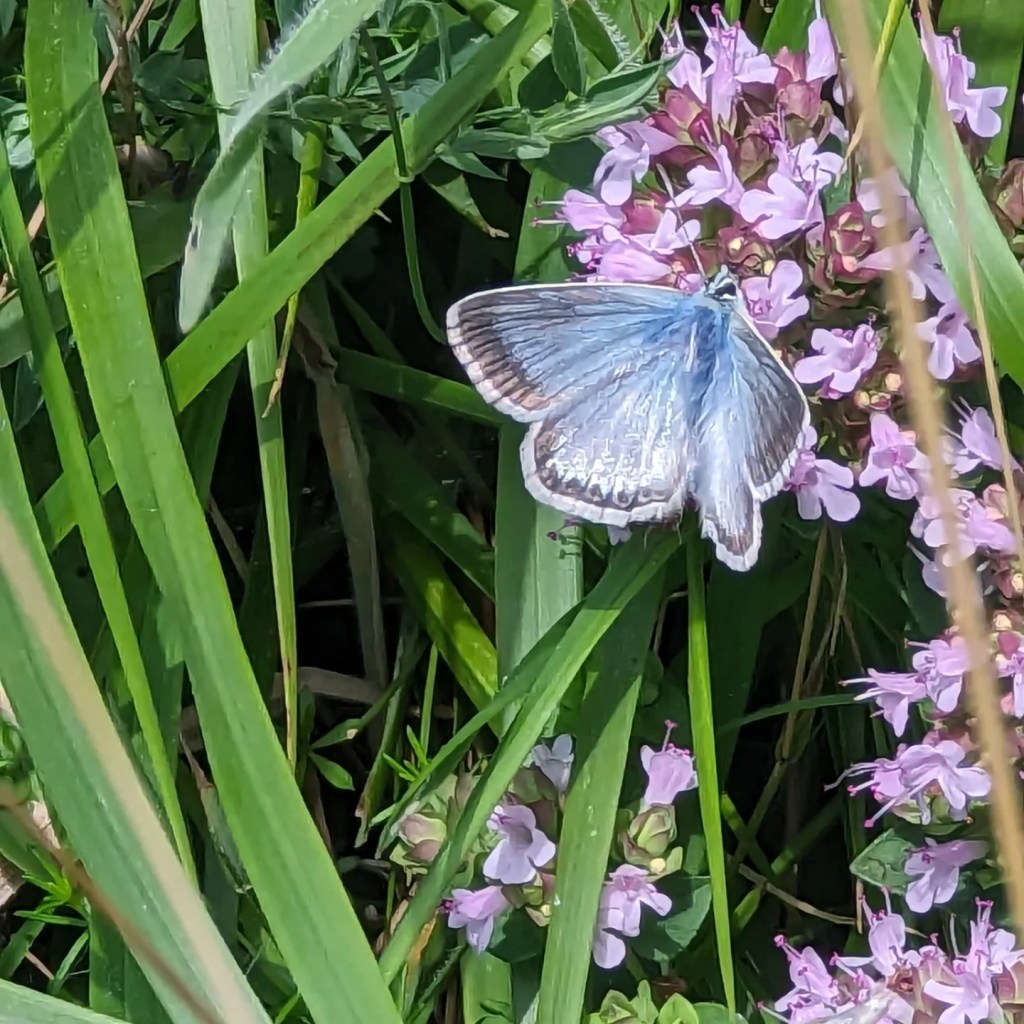
By Christine Swan
I know that for many, the Covid lockdowns were a horrendous and very worrying time. This post in no way attempts to undermine this fact. On a grey day in London, I decided to treat us all to some of nature’s palette by reflecting on my penchant for chasing butterflies during lockdown which culminated in some impressive species “ticks”.
Here in the UK, were were permitted one walk per day for exercise. I have lived in Worcester for over thirty years but, my busy life prevented me from really exploring the area where I live. My lockdown meandering provided the perfect opportunity to do so. Sometimes, we don’t notice what is right under our noses because we are just too busy.
I decided to give my walks a particular focus. The spring of 2020 was beautiful, with many warm, sunny days that were perfect for butterflies coming out of hibernation. Initially, the advice was to stay close to home but later lockdowns did permit short journeys by car that allowed exploration of local nature reserves.
When I was planning what to write about this week and scrolled through my photos to seek inspiration. I stumbled across my lockdown butterflies and decided that they were perfect for the weekend when the clocks go back and sunny days feel so distant.
The first butterfly that I found in March 2020, was a Comma in a local park . This beautiful and delicate butterfly is camouflaged to hide amongst dead leaves and can be identified by its wavy-edged wings and delicate little white comma on its dark underwing. Like others of the Nymphalids, eggs are laid onto nettles, a plant which many gardeners detest as a weed, and yet, it gives us the pleasure of seeing butterflies so we should allow a patch to grow for that reason alone.

A Comma (Polygonia c-album) seen just after the first lockdown began in March
I found trying to photograph Peacock butterflies maddening. Their compound eyes are exceedingly sensitive to the changing light levels caused by a clumsy human, thinking that they could signal a bird about to devour them. Consequently, creeping up and trying to snap them with my mobile phone camera, more often than not resulted in a disappointing encounter for me as they fluttered off before I could get myself organised.
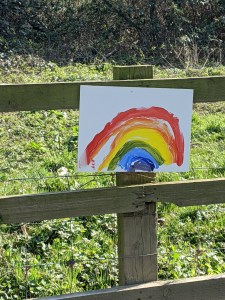
Not a butterfly – but at least it didn’t fly away!
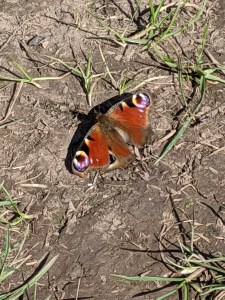
Finally – A Peacock butterfly (Aglais io)

Small tortoiseshell (Aglais urticae)
The Peacock, Small Tortoiseshell, Comma and Red Admiral butterflies all hibernate so these early individuals would have emerged when the warm sunshine appeared along with early spring flowers. Dandelions are another bane of the gardener’s life and yet, they can provide salad leaves year-round and sunny yellow flowers, pretty much at the same time. They provide vital nectar for early emerging species to enable them to breed successfully.

Small white on dandelion in early April 2020
I found that the closer I looked, the more butterflies I found. On one occasion, I walked past a patch of holly in a hedge and spotted an early Holly Blue.
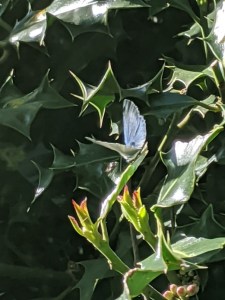
Holly blue (Celastrina argiolus)

Stay safe
The warm weather continued into May. While Mr Cummings was apologising for testing his eyesight by driving, I was testing mine looking for butterflies. Other walkers would ask: “Have you seen anything interesting?” I would explain which species I had seen and they appeared to be very interested. As a biologist in a former life, I could impress them with my apparent expertise.
I began to identify the best spots to look at different times of the day. Butterflies do not like rain or high winds and so I waited for dry, sunny weather with light winds before going to look for them.
May brought a wider range of species as well as the flowers to nourish them and plants on which to lay their eggs.

Speckled Wood butterfly (Pararge aegeria)
The Speckled Wood butterfly is camouflaged to hide in woods with dappled sunlight. I found that these emerged later than the Nymphalids but they were quite prolific in one particular area close to a small stand of trees. I wasn’t quite sure of the reason for this but I read that they mostly feed on honeydew, from aphids, in treetops. The trees in the vicinity and the combination of food and places to conceal themselves seemed to be perfect.
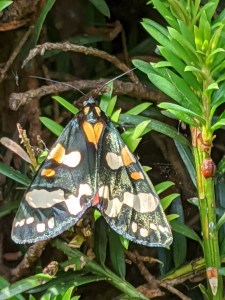
Scarlet Tiger moth (Callimorpha dominula)
While sitting in my garden in June, I spotted this stunning Scarlet Tiger moth on our yew hedge. It was sunning itself and the iridescence of its wings was astoundingly beautiful. I quickly grabbed my phone and preserved this glorious vision forever.
As late spring gave way to summer, more butterflies made themselves known to me. The little Gatekeeper, fluttering flashes of rust and brown, between the brambles, often accompanied by the darker Ringlet and Meadow Brown. Although not as gaudy as some other species, they are still a delight.

Gatekeeper (Pyronia tithonus)

Ringlet (Aphantopus hyperantus)
Closer to the little stream that runs through my local park, I found some skipper butterflies. I believe that these are Essex Skippers even though I now live some considerable distance from that county. It is similar to the Small Skipper with only slight differences, such as the colour of the club of the antenna. Bearing in mind my bad luck in approaching butterflies stealthily, I decided to use my best guess for identification.
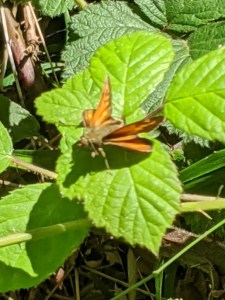
Essex Skipper (Thymelicus lineola)
My butterfly quest took me to Grafton Woods, a renowned habitat of rare species and haunt of serious butterfly twitchers. After quite some time walking on a warm and sticky day, there it was, my first Brown Hairstreak – possibly my greatest “tick” of the lockdown butterflies. It is an understated species, similar to other brown woodland butterflies but with a little flourish on its lower underwings. They are red-listed in the UK so to see one was a rare treat indeed.

Brown Hairstreak (Thecla betulae)
I was beginning to feel like a proper butterfly spotter but, without the proper gear, I was a mere enthusiastic amateur. There were other spotters in Grafton Woods, with huge telephoto lenses and camera cases, but even armed with my lowly mobile phone camera, I was still quite satisfied with my results.
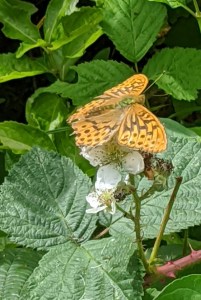
Dark Green Fritillary (Speyaria aglaja)
On a patch of brambles I saw a large Dark Green Fritillary, which is a huge beast in comparison with the tiny Brown Hairstreak. Where is the dark green you may be wondering. I wondered it too but the thorax of this species is actually quite green. This was particularly noticeable when I was messing about with the photograph ready to post It onto this blog. As a species, it flies quite slowly and reminded me of a tropical butterfly that could be encountered in a walk-through butterfly experience.
Just after I had snapped my phone pictures, Mr Telephoto Lens appeared and clearly wanted me to keep a socially acceptable distance and flutter off. I could not match his demand to pap this beautiful specimen so I left him to it.

Brimstone (Gonepteryx rhamni)
The Brimstone was my final tick of this particular trip. Its exotic leaf-like shape and green underwing colouration, allows it to deceive birds that it is just a young, fresh leaf, rather than a tasty butterfly. When it opens its wings, the sherbet lemon yellow flashes through the sky.
My lockdown spring and early summer was full of butterflies. I don’t think we have had such a good spring since. Unfortunately, this, habitat loss, use of pesticides and weedkillers, has wreaked havoc on the butterfly population like never before. This year’s Big Butterfly Count resulted in a declaration of an emergency for Britain’s butterflies. Population numbers have crashed and without action, further decline could result in extinction.
We can all help in small ways. Firstly, by pledging not to use pesticides and herbicides. Planting butterfly and caterpillar food plants in our gardens really helps. We cannot have one without the other. Nettles support a number of our most beautiful species. They can be contained within a pot if you don’t want a patch. A buddleia bush will keep the adult butterflies happy and many garden centres can advise on other butterfly-friendly plants.
We need to change our attitudes to green spaces and invest in some joined-up thinking. Nature shouldn’t be an afterthought. We can all do our bit for butterflies, no matter how small.
Further information
The UK butterfly emergency from Butterfly Conservation https://butterfly-conservation.org/news-and-blog/uk-butterfly-emergency-declared
 Awful Rigours and Wretched Pay
Leave a comment